
Lyrebird vs Bowerbird for Kids: Mimic or Builder?
The Superb Lyrebird and Satin Bowerbird are Australian songbirds famous for extraordinary courtship, mimicry, and careful displays. A male lyrebird sings on a forest mound while spreading a long ornate tail over his body. A male Satin Bowerbird builds a stick avenue, decorates it mainly with blue objects, and performs beside it. The bower is a stage, not a nest.
About Superb Lyrebird
- Type Large ground-dwelling songbird
- Diet Mostly insectivore
- Group Lyrebird family, Menuridae
- Known for Expert sound mimicry and the adult male’s lyre-shaped display tail
- Special skill Copies many natural and mechanical sounds and combines them in a complex display song
About Satin Bowerbird
- Type Forest bowerbird songbird
- Diet Mostly fruit eater
- Group Bowerbird family, Ptilonorhynchidae
- Known for A stick bower decorated with carefully arranged blue objects
- Special skill Builds, paints, sorts, and continually rearranges a courtship avenue filled with blue decorations
Quick Answer
Quick answer: A Superb Lyrebird is a very large, mostly ground-living forest songbird whose male has a long lyre-shaped display tail and imitates many sounds. A Satin Bowerbird is much smaller; its mature male is glossy blue-black and attracts females with a decorated stick bower. Both can mimic sounds, but only the bowerbird constructs a courtship display site, and only the lyrebird carries the main display on its body.
Superb Lyrebird vs Satin Bowerbird: Quick Comparison
| Feature | Superb Lyrebird | Satin Bowerbird |
|---|---|---|
| Scientific name | Menura novaehollandiae | Ptilonorhynchus violaceus |
| Bird family | Menuridae, the lyrebirds | Ptilonorhynchidae, the bowerbirds |
| Adult length | About 80 to 100 cm including the long tail | About 27 to 33 cm |
| Adult male look | Brown body with an enormous ornate tail of 16 specialized feathers | Glossy blue-black plumage, pale bill, and violet-blue eyes |
| Native home | Moist forests of south-eastern Australia and southern Tasmania | Wet forests and woodlands along eastern and south-eastern Australia |
| Main food | Insects, spiders, worms, and occasional seeds scratched from leaf litter | Mostly fruit, plus insects in summer and some leaves in winter |
| Famous construction | Scratches a display mound but does not build a bower | Builds two parallel walls of sticks to form a courtship avenue |
| Courtship | Sings, mimics, dances, and throws the tail forward over the body | Displays, buzzes, mimics, bows, and presents decorations beside the bower |
| Nesting | Female builds a domed nest and raises the chick alone | Female leaves the bower, builds a tree nest, and raises chicks alone |
| Eggs | Usually one egg | Usually two to three eggs |
How Lyrebirds and Bowerbirds Are Alike
- Both are Australian perching birds with remarkable courtship performances.
- Both can imitate other birds and sounds from their surroundings.
- Both live mainly in forested habitats along eastern Australia.
- In both species, the female builds the true nest and cares for the young without the male.
- Both males use a special display place that they maintain during the breeding season.
How Lyrebirds and Bowerbirds Are Different
- The Superb Lyrebird is far longer, mainly because of the adult male’s huge tail.
- The lyrebird searches leaf litter for invertebrates, while the Satin Bowerbird eats mostly fruit.
- A male lyrebird displays specialized tail feathers, while a male bowerbird displays beside a decorated stick structure.
- The lyrebird’s display mound is a singing stage, while the bowerbird’s avenue is carefully built, painted, and decorated.
- A female lyrebird usually lays one egg, while a female Satin Bowerbird generally lays two or three.
Lyrebird vs Bowerbird Adaptation Showdown
Adaptation showdown: Superb Lyrebird wins size because an adult can measure 80 to 100 cm including its tail, compared with 27 to 33 cm for a Satin Bowerbird. Speed is a Tie because reliable matched flight or running speeds are unavailable. Superb Lyrebird wins strength because its powerful legs and feet rake through dense leaf litter and soil. Stealth is a Tie because both use brown, green, or dark forest colors and quiet cover outside display. Satin Bowerbird wins social behavior because females and young may gather in flocks, while lyrebirds usually forage alone. Swimming is a Tie because neither bird is an aquatic specialist. Satin Bowerbird wins weirdest for constructing an avenue, painting its walls with chewed plant material and saliva, and arranging mostly blue objects as courtship art.
Fun Superb Lyrebird vs Satin Bowerbird Facts
A Forest Sound Library
A male Superb Lyrebird blends his own whistles and clicks with accurate imitations of local birds and other sounds he has heard.
A Tail Turned Into a Curtain
During courtship, the male raises his long tail, throws it forward over his body, and vibrates the feathers while singing and dancing on a mound.
Feet Like Leaf-Litter Rakes
The Superb Lyrebird spends much of the day scratching backward through soil and leaves with strong feet to uncover insects, spiders, and worms.
The Bower Is Not a Nest
A male Satin Bowerbird’s avenue is a courtship stage. After mating, the female flies elsewhere and builds the actual nest in a tree or bush.
A Blue Collection With a Plan
Male Satin Bowerbirds collect blue flowers, feathers, berries, shells, and human-made objects, then sort and reposition them around the avenue.
Lyrebird vs Bowerbird Quiz
- Which bird has a long lyre-shaped display tail? Answer: The male Superb Lyrebird.
- Which bird builds an avenue of sticks? Answer: The male Satin Bowerbird.
- Is a bower the place where eggs are laid? Answer: No. It is a courtship stage, while the female builds a separate nest.
- What does a Superb Lyrebird search for in leaf litter? Answer: Mostly insects, spiders, and worms.
- What decoration color does a male Satin Bowerbird especially favor? Answer: Blue.
Superb Lyrebird vs Satin Bowerbird FAQ
Is a lyrebird a type of bowerbird?
No. They belong to separate bird families, although both are Australian songbirds with complex displays.
Can both birds mimic sounds?
Yes. Both imitate other birds and environmental sounds, but the Superb Lyrebird is especially famous for long, complex mimicry performances.
Why does a Satin Bowerbird collect blue things?
The objects help create a courtship display that visiting females inspect along with the male’s dance and calls.
Does a Superb Lyrebird copy every sound perfectly?
No. It learns and repeats selected sounds from its surroundings as part of a changing song repertoire.
Should people leave plastic decorations at a bower?
No. Plastic, string, glass, and other rubbish can harm wildlife. Observe the bower without touching or adding anything.
Animal Words to Know
- Bower: A structure built by a male bowerbird for courtship, not for holding eggs.
- Mimicry: The imitation of another sound, signal, or appearance.
- Courtship: Behavior used to attract and communicate with a possible mate.
- Plumage: A bird’s covering of feathers.
- Leaf litter: Fallen leaves, bark, and twigs covering the forest floor.
Create Two Courtship Display Maps
Create Two Courtship Display Maps
Draw exactly one adult male Superb Lyrebird and exactly one adult male Satin Bowerbird at honest relative scale, making the lyrebird much longer. Label the lyrebird’s curved outer tail feathers, lacy tail feathers, strong scratching feet, leaf litter, and song mound. Label the bowerbird’s pale bill, violet-blue eye, glossy feathers, stick avenue, natural blue flowers, feathers, and berries. Add sound bubbles without copying real brand logos. Never approach a displaying bird, touch a bower, or add plastic, string, or glass.
Meet Each Animal
Want the full fact file? Here are quick highlights from each animal’s own facts page.
Superb Lyrebird Fact Highlight
From the full animal facts page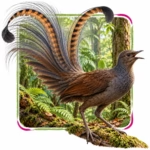
Satin Bowerbird Fact Highlight
From the full animal facts page
More Animal Comparisons
Pick another animal matchup and keep exploring. Compare appearances, habitats, diets, abilities, and surprising differences.




Make an Animal Story
Send a master mimic and a blue-collecting forest designer into a courtship mystery with our free Animal Story Generator.