
Macaw vs Parrot: Long-Tailed New-World Macaw-Subgroup-to-Whole-Parrot-Order Comparison
Every macaw is a parrot, but only one small branch of parrots receives the macaw name. Macaws are long-tailed New World true parrots spread across several genera, not one species and not simply every large colorful parrot. The wider order Psittaciformes also includes tiny pygmy-parrots, crested cockatoos, African greys, Amazons, nectar-feeding lorikeets, alpine kea, and the heavy flightless kākāpō. This page compares the macaw subgroup with that much wider order and labels named examples whenever size, color, diet, speech, or behavior cannot be generalized.
About Macaw
- Type Bird
- Diet Mostly plant-eating omnivore consuming ripe and unripe fruit, palm nuts, seeds, flowers, leaves, buds, and stems, with insects or snails adding animal food in some species; strong bills crack hard shells, and some western Amazon populations visit sodium-rich clay licks, but clay eating is regional rather than a habit of every macaw
- Group Macaw is a traditional common-name group of long-tailed New World true parrots, mostly within tribe Arini and spread across six commonly recognized living genera; current references list roughly 16–17 living species, but counts shift with checklist decisions and the treatment of extinct or historically uncertain forms
- Known for A large curved bill, long graduated tail, streamlined flight shape, loud contact calls, strong zygodactyl feet, and in many species a pale or yellow bare facial patch marked by tiny feather lines; size ranges from the roughly 30-centimeter red-shouldered macaw to the approximately 100-centimeter and 1.4–1.7-kilogram hyacinth macaw
- Special skill A long tail stabilizes and brakes the streamlined body through forest openings, while the bill, tongue, and hand-like feet process hard fruits and nuts and assist climbing. Many large macaws combine enormous crushing leverage with delicate food handling, and bare facial skin crossed by tiny feather tracks creates a highly recognizable face; western Amazon birds may also locate and use mineral-rich riverbank clay.
About Parrot
- Type Bird
- Diet Species-dependent herbivore or omnivore eating combinations of fruit, seeds, nuts, flowers, nectar, pollen, buds, leaves, bark, roots, fungi, insects, larvae, snails, carrion, or other foods; lorikeets have brush-tipped tongues for nectar and pollen, while kea, kākāpō, macaws, cockatoos, and pygmy-parrots each use very different menus
- Group Parrot means the whole order Psittaciformes, a diverse evolutionary group of roughly 400 living species; exact totals and family boundaries vary among modern checklists, but the order includes New Zealand parrots, cockatoos, and the large radiation of true parrots such as macaws, Amazons, African greys, lorikeets, budgerigars, and lovebirds
- Known for A stout curved bill with a mobile upper mandible, two-forward and two-backward zygodactyl toes, grasping feet often used to bring food to the bill, strong vocal communication, extended learning and parental care, and extraordinary variation from pygmy-parrots around 8–10 centimeters and 10 grams to the roughly 100-centimeter hyacinth macaw and flightless kākāpō that can approach 3 kilograms
- Special skill The hooked bill acts as both food processor and climbing aid, while zygodactyl feet grip branches and manipulate objects. Different lineages add human-sound mimicry, learned contact-call labels, brush-tipped tongues, tool use, snow-country problem solving, ground living, flightlessness, lek booming, seed dispersal, or powerful nut cracking, but no single generic parrot has every adaptation.
Macaw vs Parrot: Quick Answer
A macaw is a kind of parrot from Mexico, Central America, or South America. Macaws usually have a very long tail, a large hooked bill, and in many species a bare facial patch with fine feather lines. “Parrot” names the whole order, so parrots can instead be tiny or heavy, short-tailed or long-tailed, crested or crestless, flying or flightless, and native to several continents. Both macaws and other parrots share zygodactyl feet, curved bills, social calls, intelligence, and long chick care.
Where Do They Fit?
Follow the branches to see how Macaw and Parrot are classified and related.
Macaw vs Parrot: Quick Comparison
| Feature | Macaw | Parrot |
|---|---|---|
| Scientific identity | Traditional subgroup across several New World genera, mostly in tribe Arini | The whole order Psittaciformes, including macaws |
| Native range | Mexico, Central America, and South America | Americas, Africa, Asia, Australasia, New Zealand, and many islands |
| Size | About 30 cm mini-macaw to 100 cm hyacinth macaw | About 8–10 cm pygmy-parrot to 100 cm hyacinth macaw; kākāpō is heavier |
| Tail | Usually very long, graduated, and pointed | May be long, short, square, rounded, pointed, or reduced |
| Face | Many large species have bare facial skin crossed by tiny feather lines | Facial feathering, bare skin, crests, cheek patches, and skin color vary enormously |
| Typical colors | Often brilliant blue, red, yellow, green, or combinations; some are mostly green or blue | Every major macaw color plus gray, black, brown, white, pink, and subtle greens |
| Bill | Large and strongly curved, especially massive in big nut-cracking species | Same parrot plan in sizes and shapes suited to seeds, nectar, bark, fruit, leaves, or mixed foods |
| Food clue | Fruit, palm nuts, seeds, flowers, leaves, and some invertebrates; regional clay use | Species may eat seed, fruit, nectar, pollen, leaves, insects, fungi, carrion, or other foods |
| Typical nest | Tree hollow, earthen bank, or cliff cavity depending on species | Tree, bank, cliff, cactus, termite mound, rock shelter, or ground cavity depending on species |
| Memory clue | Long-tailed New World branch | The whole parrot tree contains that branch |
How Are Macaws and Parrots Alike?
- Every macaw is a parrot, so both share the Psittaciformes body plan: stout hooked bill, mobile upper mandible, muscular tongue, zygodactyl feet, and a climbing style that can use the bill like a third gripping point.
- Both can hold food in one foot, rotate and inspect objects, crack seeds or fruit, learn routes and relationships, solve problems, play, and use calls to locate mates, family members, flock partners, food, or danger.
- Both commonly form strong pair and family bonds, preen one another, share food, lay white eggs in sheltered sites, and raise helpless chicks that need long feeding, protection, and learning before independence.
- Both may disperse or destroy seeds, prune fruiting branches, feed other forest animals through dropped food, and depend on old nesting trees, connected habitat, predictable food seasons, and safe communal roosts.
- Both include threatened species affected by forest clearing, nest-tree loss, fire, illegal trapping, and wildlife trade, and wild birds should never be fed, chased, handled, or removed from nests.
How Are Macaws and Parrots Different?
- Macaw is a common-name subgroup containing roughly 16–17 living species across several genera. Parrot is the entire order of roughly 400 living species and includes every macaw as well as many unrelated-looking lineages.
- Wild macaws are native only to the New World. Other parrots also evolved in Africa, Asia, Australia, New Guinea, New Zealand, and numerous Pacific and Indian Ocean islands.
- Macaws usually have conspicuously long graduated tails. The wider order includes short-tailed Amazons and African greys, crested cockatoos, tiny pygmy-parrots, long-tailed parakeets, and the rounder ground-adapted kākāpō.
- Many large macaws show pale or yellow bare facial skin with narrow feather tracks. Other parrots may instead have fully feathered faces, small eye rings, colorful cheek patches, a cockatoo crest, or different areas of bare skin.
- Macaws occupy the large end of parrot length, but mini-macaws are only about 30 centimeters. The wider order contains both much smaller pygmy-parrots and the heavier flightless kākāpō, so “macaw means biggest” is incomplete.
- Clay-lick gatherings are famous for several western Amazon macaws and other parrots, yet they are regional. Most macaws and most parrots never visit a giant riverbank clay lick, and the strongest evidence emphasizes dietary sodium rather than a universal detox treatment.
Macaw vs Parrot Adaptation Showdown
Long-tailed New World branch versus whole parrot order showdown: Size is a tie because the hyacinth macaw is the longest living flying parrot at about 100 centimeters, while the non-macaw kākāpō is heavier, and macaws themselves are already inside the parrot order. Speed is a tie because published flight figures concern particular species under unlike conditions rather than a controlled order-wide race. Macaw receives a cautious strength win only for the representative crushing bill of the largest nut-specialist macaws; other parrots also have formidable bills, and no ethical standardized bite contest supports a universal multiplier. Stealth is a tie because vivid macaw colors can break up among leaves, fruit, light, and shadow while other parrots range from cryptic green and gray to equally bright. Social behavior is a tie because macaws show strong pairs and flock coordination while other parrots display equally complex but different systems. Swimming is a tie because neither side is aquatic, even though many parrots bathe or cross water. Parrot wins strangest adaptation at broad-category level because non-macaw examples add cockatoo drumming and powder down, lorikeet brush tongues, alpine kea, and a flightless nocturnal lekking kākāpō; no single parrot combines those traits. These fields compare adaptations, not combat.
Fun Macaw vs Parrot Facts
Every Macaw Is a Parrot, but Not Every Parrot Is a Macaw
Macaws belong inside the true-parrot radiation and are spread across several genera such as Ara, Anodorhynchus, Primolius, Orthopsittaca, Diopsittaca, and Cyanopsitta. “Macaw” is therefore a useful traditional subgroup, not one scientific species or one genus. A cockatoo, budgerigar, African grey, or kākāpō is a parrot but not a macaw.
The Longest Parrot Is Not the Heaviest Parrot
A hyacinth macaw can measure about 100 centimeters from head to the end of its enormous tail and weighs roughly 1.4–1.7 kilograms. The flightless New Zealand kākāpō has a much shorter body-and-tail length but can approach about 3 kilograms. Length, mass, wingspan, and flight ability answer different versions of “largest.”
Macaw Faces Can Carry Tiny Feather Tracks
Many large macaws have bare pale facial skin between the eye and bill, crossed by rows or swirls of tiny feathers. The exact amount of bare skin, skin color, and feather pattern varies by species and individual; blue macaws may show smaller yellow areas instead. The face is a clue, not a stamp shared identically by every macaw.
Some Amazon Macaws Visit Sodium-Rich Clay
At certain western Amazon riverbanks, scarlet, red-and-green, and other parrots gather to swallow selected soil. Studies found the eaten clay especially rich in available sodium, a scarce nutrient far inland. Clay may have additional effects, but “all macaws eat clay to remove poison” is too simple because use changes by place, species, food, and season.
A Macaw Pair Can Stay Together Inside a Flock
Many macaw partners reinforce a long bond by preening, sharing food, calling, and roosting close together. When a flock travels, paired birds may fly side by side and rejoin at feeding or roost sites. The flock still contains families and individuals, and exact group size, nesting division, and pair behavior differ among macaw species.
Macaw vs Parrot Quiz
- Is a macaw a parrot? Answer: Yes. Every macaw belongs to order Psittaciformes.
- Where do macaws live naturally? Answer: In the New World, from Mexico through Central America and South America.
- Which is heavier: a hyacinth macaw or a kākāpō? Answer: The kākāpō, although the hyacinth macaw is longer.
- What tail clue is common in macaws? Answer: A very long, graduated, pointed tail.
- Why do some western Amazon parrots visit clay licks? Answer: Strong evidence shows the selected soil supplies scarce sodium, although use varies and may have more than one effect.
Macaw vs Parrot FAQ
What is the main difference between a macaw and a parrot?
A macaw is one type of parrot: a generally long-tailed New World bird from a traditional subgroup spread across several genera. “Parrot” is the much wider order Psittaciformes and includes macaws, cockatoos, Amazons, African greys, lorikeets, budgerigars, kea, kākāpō, and hundreds of other species.
How can you tell a macaw from another parrot?
Look for a long graduated tail, large curved bill, streamlined body, New World range, and—especially in large species—a bare facial patch with fine feather lines. No single clue works alone: mini-macaws are smaller, some blue macaws have reduced yellow facial skin, and other parrots can also be large or long-tailed.
Which is bigger, a macaw or a parrot?
The question compares a subgroup with the whole group. The hyacinth macaw reaches about 100 centimeters and is the longest living flying parrot, but the flightless kākāpō can be much heavier. Pygmy-parrots are tiny, and mini-macaws show that even macaw size is not one number.
Can macaws talk like other parrots?
Macaws can imitate environmental sounds and human speech, but talent varies among species and individuals. African grey parrots are especially famous mimics. In the wild, a macaw’s important vocal skills are natural contact calls, pair and family communication, alarm, flock coordination, and learned social recognition—not human conversation.
Do all macaws eat clay?
No. Dramatic clay-lick gatherings occur mainly in parts of the western Amazon and include several macaw and other parrot species. Research strongly links selected soils with scarce sodium, but clay use varies with geography, season, diet, and breeding. Most macaws live without visiting a giant riverbank clay lick.
Animal Words to Know
- Macaw: A traditional group of long-tailed New World true parrots spread across several genera.
- Psittaciformes: The bird order containing macaws and every other living parrot.
- Zygodactyl: Having two toes directed forward and two backward for gripping and climbing.
- Facial patch: An area of bare or sparsely feathered skin around a macaw’s eye and bill, often crossed by tiny feather lines.
- Geophagy: Deliberately eating soil, as some parrots do at mineral-rich clay licks.
Macaw and Parrot Family Activity
Macaw and Parrot Family Activity
Draw a scarlet macaw beside two other parrots, such as an African grey and a budgerigar. Give the macaw a very long tail, large curved bill, and bare facial patch, then place it on a map of the tropical Americas. Add a bracket around all three birds labeled “parrots” and write: a macaw is one kind of parrot. Label macaw, parrot, bill, climbing feet, tail, and range.
Meet Each Animal
Want the full fact file? Here are quick highlights from each animal’s own facts page.
Macaw Fact Highlight
From the full animal facts page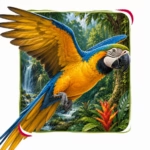
Parrot Fact Highlight
From the full animal facts page
More Animal Comparisons
Pick another animal matchup and keep exploring. Compare appearances, habitats, diets, abilities, and surprising differences.
Make an Animal Story
Turn this macaw vs parrot comparison into a long-tailed New World branch-of-the-parrot-tree rainforest mystery with our free Animal Story Generator.
Source notes: References used for this comparison. See more See less
Try Another Matchup
Explore this comparison →