
Mantis Shrimp vs Shrimp: Peacock Mantis Shrimp vs Whiteleg Shrimp Crustacean Comparison
The name mantis shrimp is a double trick. A peacock mantis shrimp, Odontodactylus scyllarus, is not a praying mantis and not a true shrimp. It is a stomatopod crustacean with folded raptorial appendages that resemble mantis arms. For the broad word shrimp, this page uses the whiteleg shrimp, Penaeus vannamei, also called Litopenaeus vannamei, as one familiar exact true-shrimp benchmark in order Decapoda. Both animals have jointed legs, stalked compound eyes, antennae, gills, a hard exoskeleton, molts, eggs, swimming limbs, and planktonic young. The peacock mantis shrimp is a solitary reef-burrow predator with spring-powered clubs and an unusual visual system. The whiteleg shrimp is a longer, translucent omnivore whose adults spawn offshore, whose young use estuaries, and whose abdomen and tail fan power swimming and emergency reverse flips.
About Peacock Mantis Shrimp
- Type Colorful Club-Armed Indo-Pacific Stomatopod
- Diet Carnivorous smasher eating snails, clams, crabs, other crustaceans, and occasional small fish by breaking hard shells with club-like appendages
- Group Living species Odontodactylus scyllarus in order Stomatopoda and family Odontodactylidae; despite its name, it is neither a true shrimp nor a praying mantis
- Known for Green, blue, orange, and red armor, independently moving stalked eyes, many photoreceptor channels, ultraviolet and polarized-light sensitivity, U-shaped reef burrows, solitary territorial life, and spring-loaded raptorial clubs that create impact and cavitation forces
- Special skill Loading elastic parts of each raptorial appendage like a spring, then releasing a club so quickly that impact is followed by force from a collapsing cavitation bubble
About Whiteleg Shrimp
- Type Translucent Eastern Pacific True Decapod Shrimp
- Diet Life-stage-changing omnivore: larvae take phytoplankton and zooplankton, while postlarvae and larger shrimp forage for detritus, worms, bivalves, crustaceans, and other bottom food
- Group Living species Penaeus vannamei, also widely called Litopenaeus vannamei, in order Decapoda and family Penaeidae; it is the exact true-shrimp benchmark used here
- Known for A translucent white body, toothed rostrum, long antennae, five pairs of walking legs, abdominal swimmerets, powerful tail fan, rapid backward escape flips, ocean-to-estuary life cycle, many larval stages, and worldwide importance in aquaculture
- Special skill Using swimmerets for sustained forward swimming and a sudden abdominal flex with the broad tail fan for a rapid backward escape called a tail flip
Peacock Mantis Shrimp vs Whiteleg Shrimp: Quick Answer
A peacock mantis shrimp is a stomatopod, not a true shrimp. Its folded front appendages end in clubs that strike hard-shelled prey with impact plus cavitation, and its independently moving eyes detect color, ultraviolet, and polarized-light information in an unusual way. A whiteleg shrimp is a true decapod shrimp with ten walking legs, swimmerets, a long abdomen, and a tail fan. It grows longer, eats a broader omnivorous diet, and moves between offshore adult habitat and estuarine nurseries.
Where Do They Fit?
Follow the branches to see how Peacock Mantis Shrimp and Whiteleg Shrimp are classified and related.
Peacock Mantis Shrimp vs Whiteleg Shrimp: Quick Comparison
| Feature | Peacock Mantis Shrimp | Whiteleg Shrimp |
|---|---|---|
| Scientific identity | Odontodactylus scyllarus; Stomatopoda, Odontodactylidae | Penaeus vannamei; Decapoda, Penaeidae |
| Maximum cited length | About 18 cm, or 7 inches | Up to about 23 cm |
| Body appearance | Stocky and vividly green, blue, orange, and red with heavy armor | Longer and usually translucent white, with a toothed rostrum and long antennae |
| Front tools | Spring-loaded raptorial appendages ending in rounded smashing clubs | Five pairs of ordinary walking legs, with front appendages used in feeding but no hammer clubs |
| Eyes | Highly movable compound eyes with many receptor channels, including UV and polarization | Stalked compound eyes suited to finding food, movement, and light in coastal water |
| Native home | Warm Indo-Pacific reef rubble, rock, sand, and U-shaped burrows | Tropical eastern Pacific ocean as adults and estuaries or mangroves when young |
| Food | Predator specializing in hard-shelled snails, clams, crabs, and crustaceans | Larval plankton feeder and later omnivorous bottom forager |
| Movement | Walks, swims, and darts from a burrow; the famous speed belongs to its strike | Uses swimmerets for sustained swimming and its abdomen and tail fan for reverse flips |
| Young | Eggs are tended by the female; larvae drift in plankton before settling | Six nauplius, three protozoea, three mysis, and postlarval stages before the juvenile form |
| Social and shelter | Usually solitary and territorial inside a reef burrow | May aggregate in suitable habitat but is not a bonded colony animal |
How Are Peacock Mantis Shrimp and Whiteleg Shrimp Alike?
- Both are marine arthropods in class Malacostraca, so they have segmented bodies, jointed appendages, gills, and an outer skeleton.
- Both must molt the old exoskeleton to grow, leaving the new covering soft until it hardens.
- Both have stalked compound eyes, antennae, multiple walking or feeding limbs, abdominal swimming structures, and a tail region.
- Both hatch into tiny larvae that spend time in the plankton before taking on a more bottom-associated juvenile life.
- Both can move forward through water and make quick escape responses, although their bodies emphasize very different kinds of speed.
How Are Peacock Mantis Shrimp and Whiteleg Shrimp Different?
- The peacock mantis shrimp belongs to Stomatopoda, while the true whiteleg shrimp belongs to Decapoda.
- The mantis shrimp reaches about 18 centimetres; whiteleg shrimp can reach about 23 centimetres and therefore wins maximum length.
- A mantis shrimp has paired spring-loaded smashing clubs, but a whiteleg shrimp has the five walking-leg pairs that give decapods their name.
- The mantis shrimp is a solitary reef-burrow carnivore; the whiteleg shrimp changes habitat and diet from offshore larvae to estuarine juveniles and offshore adults.
- Mantis shrimp eyes include exceptionally varied color, ultraviolet, and polarization channels, while whiteleg shrimp are especially adapted for swimming and tail-flip escape.
Peacock Mantis Shrimp vs Whiteleg Shrimp: Adaptation Showdown
Adaptation winners: The Whiteleg Shrimp wins size by maximum cited length, reaching about 23 centimetres versus about 18 centimetres, and swimming because its long abdomen, swimmerets, and tail fan support sustained travel and rapid reverse flips. The Peacock Mantis Shrimp wins speed for its roughly 20-metre-per-second club action, strength for measured impact and cavitation forces, and weirdest adaptation for pairing spring-loaded hammers with an extraordinary visual system. Stealth is a Tie because both use bottom shelter and subdued periods. Social behaviour is a Tie because neither benchmark forms cooperative societies. These categories compare ecological tools, not a fight.
Fun Mantis Shrimp vs Shrimp Facts
Mantis Shrimp Are Not True Shrimp
Both are malacostracan crustaceans, but their branches separated long ago. Peacock mantis shrimp belong to Stomatopoda. Whiteleg shrimp belong to Decapoda, the order whose members have five pairs of walking legs. The word mantis describes the stomatopod’s folded hunting appendages, not an insect relationship.
One Club Strike Makes Two Force Peaks
Measurements of peacock mantis shrimp found limb impacts of about 400-1,501 newtons. The extremely fast club also lowers pressure in the water enough to form a vapor bubble. When that cavitation bubble collapses a fraction of a millisecond later, it adds a second force peak that can reach about 504 newtons.
More Color Receptors Do Not Mean Sharper Color Matching
Mantis shrimp eyes contain many kinds of photoreceptors and can detect ultraviolet and polarized light. Experiments overturned the simple idea that more receptor types must produce finer color discrimination. Their system seems to sort colors in a fast, unusual way, even when nearby shades are harder for them to tell apart than expected.
Whiteleg Shrimp Change Neighborhoods
Adult whiteleg shrimp live and spawn in open marine water. Their planktonic young are carried toward shore. Postlarvae enter estuaries, lagoons, and mangrove areas, where food and shallow nursery habitat help them grow before later stages move back offshore.
A Shrimp Baby Changes Names Again and Again
The FAO profile lists six nauplius stages, three protozoea stages, and three mysis stages before the postlarval phase. The earliest nauplii live on yolk, later larvae eat tiny plankton, and postlarvae eventually settle toward the bottom and begin a more shrimp-like way of life.
Peacock Mantis Shrimp vs Whiteleg Shrimp Quiz
Which animal is a true decapod shrimp? A) Peacock mantis shrimp B) Whiteleg shrimp C) Praying mantis Answer: B) Whiteleg shrimp
What forms after the mantis shrimp’s ultrafast club moves through water? A) A cavitation bubble B) A feather C) A web Answer: A) A cavitation bubble
Which animal reaches the greater maximum cited length? A) Whiteleg shrimp B) Peacock mantis shrimp C) They are always identical Answer: A) Whiteleg shrimp
What helps a whiteleg shrimp swim forward? A) Swimmerets B) Wings C) Hooves Answer: A) Swimmerets
What is the first named whiteleg shrimp larval form? A) Ephyra B) Chick C) Nauplius Answer: C) Nauplius
Mantis Shrimp vs Shrimp FAQ
Is a mantis shrimp really a shrimp?
It is a crustacean, but not a true decapod shrimp. Mantis shrimp belong to order Stomatopoda, while this page’s whiteleg shrimp benchmark belongs to order Decapoda.
Which shrimp is used in this comparison?
The exact true-shrimp benchmark is the whiteleg shrimp, Penaeus vannamei, also widely called Litopenaeus vannamei.
Which is longer, a peacock mantis shrimp or whiteleg shrimp?
The whiteleg shrimp. The cited maximum is about 23 centimetres, compared with about 18 centimetres for the peacock mantis shrimp.
Can a mantis shrimp see more colors than a human?
Its eyes use many receptor types and detect ultraviolet and polarized light, but that does not mean finer discrimination between every nearby color. Its processing strategy is different.
Why does a whiteleg shrimp flip backward?
A sudden abdominal bend pushes the broad tail fan against water, shooting the shrimp backward away from a surprise or danger.
Animal Words to Know
- Stomatopoda: The crustacean order containing mantis shrimp.
- Decapoda: The crustacean order whose members have five pairs, or ten total, walking legs.
- Cavitation: Formation and rapid collapse of a vapor bubble in liquid when pressure changes suddenly.
- Exoskeleton: A firm outer body covering that supports and protects an arthropod.
- Nauplius: An early crustacean larval form with a small body and simple appendages.
Build a Crustacean Tool-and-Movement Diagram
Build a Crustacean Tool-and-Movement Diagram
Draw a peacock mantis shrimp beside a reef burrow and a whiteleg shrimp above an estuary bottom. Add a curved arrow showing how a mantis club stores and releases spring energy, then draw two small water circles for impact and cavitation. On the shrimp side, add forward arrows beside the swimmerets and a backward arrow from a bent abdomen and tail fan. Finish with five comparison captions: order, maximum length, front tool, main movement, and first larval name.
Meet Each Animal
Want the full fact file? Here are quick highlights from each animal’s own facts page.
Peacock Mantis Shrimp Fact Highlight
From the full animal facts page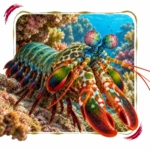
Whiteleg Shrimp Fact Highlight
From the full animal facts page
More Animal Comparisons
Pick another animal matchup and keep exploring. Compare appearances, habitats, diets, abilities, and surprising differences.



Make an Animal Story
Create an ocean story with a mantis shrimp and whiteleg shrimp
Source notes: References used for this comparison. See more See less
Try Another Matchup
Explore this comparison →