
Mayfly vs Dragonfly for Kids: Two River and Pond Insects
Common Mayflies and Emperor Dragonflies both begin as aquatic nymphs, climb out of water, and become four-winged adults. Their adult lives then split sharply. The mayfly is delicate, does not feed, holds its wings upright, and lives briefly to reproduce. The much larger emperor is a fast territorial hunter that keeps flying, catches insects in midair, and may remain airborne while eating.
About Common Mayfly
- Type Insect
- Diet Detritivore as a nymph; adult does not feed
- Group Mayfly order, Ephemeroptera
- Known for Three tail filaments and an unusually short winged adult life
- Special skill Moults once after gaining functional wings, a unique insect stage called the subimago
About Emperor Dragonfly
- Type Insect
- Diet Carnivore
- Group Dragonfly order, Odonata
- Known for Large size, blue or green body, huge eyes, and aerial hunting
- Special skill Catches and may eat insect prey in flight with four independently controlled wings
Quick Answer
Quick answer: A Common Mayfly has delicate upright wings, three long tail filaments, tiny antennae, and a brief nonfeeding adult stage. An Emperor Dragonfly is much larger and stronger, with enormous eyes, four wings held open, no tail filaments, and a long predatory adult stage built for catching insects in flight.
Common Mayfly vs Emperor Dragonfly: Quick Comparison
| Feature | Common Mayfly | Emperor Dragonfly |
|---|---|---|
| Scientific name | Ephemera danica | Anax imperator |
| Insect order | Ephemeroptera | Odonata |
| Adult length | About 2.5 cm, plus long tail filaments | About 7.8 cm |
| Resting wings | Usually held upright above the body | Usually held open sideways |
| Tail tip | Three long threadlike filaments | No long tail filaments |
| Eyes | Large, with males often having enlarged upper eye parts | Enormous compound eyes covering much of the head |
| Adult food | Does not feed | Flying insects, sometimes eaten in the air |
| Aquatic young | Burrowing nymph that filters or gathers organic matter | Predatory nymph with an extendable catching mask |
| Winged life | Usually hours to a few days, including a subimago stage | Several weeks during the warm flight season |
| Special movement | Synchronized emergence and dancing mating swarms | Fast patrols, hovering, sharp turns, and territorial chases |
How Mayflies and Dragonflies Are Alike
- Both are insects with six legs, two pairs of wings, and three main body sections.
- Both spend their immature nymph stage in fresh water.
- Both crawl out of the water and leave an empty nymph skin behind.
- Both are important food for fish, birds, and other wildlife.
- Both need healthy freshwater habitats to complete their life cycles.
How Mayflies and Dragonflies Are Different
- An Emperor Dragonfly is roughly three times the body length of a Common Mayfly.
- Adult mayflies do not feed, while adult emperor dragonflies actively hunt insects.
- A mayfly holds its wings upright and has three tail filaments, while a dragonfly holds its wings sideways and lacks those threads.
- Mayflies have a unique winged subimago that moults again, while dragonflies emerge directly as the final winged adult.
- Common Mayfly nymphs burrow and eat organic material, while Emperor Dragonfly nymphs ambush animal prey.
Mayfly vs Dragonfly Adaptation Showdown
Adaptation showdown: Emperor Dragonfly wins size because its 7.8 cm body is about three times the Common Mayfly’s body length. Emperor Dragonfly wins speed because four independently controlled wings power hovering, quick turns, and fast aerial pursuit. Emperor Dragonfly wins strength because both its nymph and adult capture animal prey. Common Mayfly wins stealth because its burrowing nymph stays hidden in sand or gravel. Social behavior is a Tie because adults may gather or swarm, but neither forms a cooperative society. Emperor Dragonfly wins swimming because its predatory nymph can propel itself by forcefully expelling water. Common Mayfly wins weirdest because it is the only kind of insect that moults again after developing working wings.
Fun Common Mayfly vs Emperor Dragonfly Facts
Wings Before the Final Moult
A mayfly first emerges as a dull, hairy-winged subimago. After a short rest it moults once more into the shiny final adult, something no other living winged insect does.
Years Below, Days Above
A Common Mayfly may spend one or two years, sometimes longer, growing underwater. Its winged adult phase lasts only a tiny fraction of that time.
A Hunter’s Folding Mask
A dragonfly nymph has a hinged lower lip that shoots forward to seize tadpoles and small aquatic animals. At rest, the tool folds beneath the head like a mask.
Eating While Flying
An Emperor Dragonfly patrols high over ponds and catches insects in midair. It rarely settles and can even chew prey while continuing to fly.
Three Trailing Threads
The Common Mayfly has three long tail filaments. Together with upright triangular wings, the threads make a clear silhouette for identification.
Mayfly vs Dragonfly Quiz
- Which insect is much larger? Answer: The Emperor Dragonfly.
- Which adult does not eat? Answer: The Common Mayfly.
- What are the three threads behind a mayfly called? Answer: Tail filaments.
- Where do both insects spend their nymph stage? Answer: In fresh water.
- What is unusual about a mayfly subimago? Answer: It has working wings but later moults again into the final adult.
Common Mayfly vs Emperor Dragonfly FAQ
Is a mayfly a small dragonfly?
No. Mayflies and dragonflies belong to different insect orders and have different wings, tails, diets, and life cycles.
Does a mayfly really live for only one day?
Some winged adults live only hours, while others survive several days. The underwater nymph stage may last one or more years.
Which insect is faster?
The Emperor Dragonfly is the far more powerful and maneuverable flier.
Do dragonflies bite people?
They are not dangerous to people. Their hunting mouthparts are designed for small animal prey, and they usually avoid us.
Why are these insects useful to rivers and ponds?
They move energy through freshwater food webs, eat or process other organisms, and provide food for many animals.
Animal Words to Know
- Nymph: An immature insect stage that resembles no winged adult and grows through several moults.
- Subimago: A mayfly’s first winged stage before its final moult.
- Detritus: Tiny pieces of dead plants, animals, and other organic material.
- Compound eye: An eye made of many small visual units that together detect a wide view and movement.
- Emergence: The event when an aquatic insect leaves the water and becomes winged.
Compare Two Freshwater Flight Plans
Compare Two Freshwater Flight Plans
Draw exactly one adult Common Mayfly and exactly one adult Emperor Dragonfly at honest relative scale, making the emperor about three times longer in body. Add upright mayfly wings and three tail filaments, then open dragonfly wings and huge eyes. Build matching nymph cards below each adult and connect stages with arrows. Observe without people handling insects.
Meet Each Animal
Want the full fact file? Here are quick highlights from each animal’s own facts page.
Common Mayfly Fact Highlight
From the full animal facts page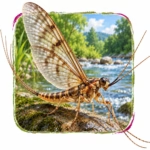
Emperor Dragonfly Fact Highlight
From the full animal facts page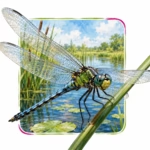
More Animal Comparisons
Pick another animal matchup and keep exploring. Compare appearances, habitats, diets, abilities, and surprising differences.





Make an Animal Story
Send a one-day Mayfly and a sky-patrolling Dragonfly through a pondside adventure with our free Animal Story Generator.