
Millipede vs Earthworm for Kids
Millipedes and Common Earthworms are long, segmented invertebrates often found in damp soil and leaf litter. Both help recycle dead plant material, but their bodies come from very different animal groups. A millipede is an arthropod with a hard exoskeleton and many jointed legs. An earthworm is a soft annelid with no legs, no exoskeleton, and tiny gripping bristles.
About Millipede
- Type Arthropod
- Diet Mostly detritivore; decaying leaves, wood, and other dead plant material
- Group Class Diplopoda; a many-legged myriapod
- Known for A hard segmented exoskeleton, two pairs of legs on most apparent body segments, slow walking, and defensive coiling
- Special skill Coordinates many short legs in traveling waves and coils its armored body when threatened
About Common Earthworm
- Type Segmented worm
- Diet Detritivore; decaying leaves and other organic matter swallowed with soil
- Group Phylum Annelida; family Lumbricidae
- Known for A soft legless segmented body, deep burrows, soil mixing, castings, and breathing through moist skin
- Special skill Uses circular and lengthwise muscles with tiny bristles called setae to grip soil and burrow
Quick Answer
Quick answer: A millipede is a many-legged arthropod. Most of its apparent body segments carry two pairs of legs, and its hard exoskeleton can coil into armor. A Common Earthworm is a legless annelid that moves by squeezing muscles against a fluid-supported body and anchoring tiny setae in the soil. Both are decomposer partners, but they are not close relatives.
Millipede vs Common Earthworm: Quick Comparison
| Feature | Millipede | Common Earthworm |
|---|---|---|
| Scientific identity | Class Diplopoda; many species | Lumbricus terrestris |
| Animal group | Arthropod and myriapod | Annelid, or segmented worm |
| Outer support | Hard exoskeleton that must be molted | Soft skin around a fluid-supported skeleton |
| Legs | Many jointed legs; two pairs on most apparent segments | No legs; tiny bristles called setae grip the soil |
| Movement | Many legs step in coordinated waves | Circular and lengthwise muscles stretch and shorten the body |
| Breathing | Air enters through openings linked to tracheal tubes | Oxygen passes through moist skin |
| Main food | Mostly decaying leaves, wood, and plant debris | Decaying organic matter, often swallowed with soil |
| Defence | Coils tightly; some species release irritating defensive chemicals | Retreats into a burrow and can anchor its body with setae |
| Reproduction | Lays eggs; juveniles hatch with fewer segments and legs | Usually mates with another hermaphrodite and forms egg cocoons |
| Ecosystem job | Shreds leaf litter and helps decomposition | Mixes and aerates soil, pulls down leaves, and leaves nutrient-rich castings |
How Are Millipedes and Earthworms Alike?
- Both are invertebrates with long bodies divided into many repeated segments.
- Both prefer damp places because dry conditions can harm them.
- Both feed heavily on dead and decaying organic matter.
- Both help return nutrients from fallen plants to the soil ecosystem.
- Both hatch from eggs and grow through juvenile stages.
How Are Millipedes and Earthworms Different?
- A millipede is an arthropod with an exoskeleton; an earthworm is a soft-bodied annelid.
- Millipedes have many jointed legs, while earthworms have no legs and move with muscles and setae.
- A millipede breathes with a tracheal system, while an earthworm exchanges gases through moist skin.
- A threatened millipede can coil into armor, while an earthworm usually retreats or anchors itself in a burrow.
- Millipedes mainly shred surface litter, while Common Earthworms also make deep vertical burrows and mix surface material into soil.
Millipede vs Earthworm Showdown
Adaptation showdown: Size is a Tie because both names cover or resemble animals with wide size variation, and even familiar species overlap. Speed is a Tie because both move slowly and the sources provide no fair matched race. Common Earthworm wins strength because its muscular, fluid-supported body can force through soil and pull leaves into a deep burrow. Common Earthworm wins stealth because it can spend daylight hidden underground. Social behavior is a Tie because both usually act independently but may gather in rich damp habitat. Swimming is a Tie because neither comparison animal is an aquatic specialist. Millipede wins weirdest because most apparent body rings carry two pairs of legs, and dozens or hundreds of legs can move in coordinated waves.
Fun Millipede vs Common Earthworm Facts
Not Really a Thousand Legs
The name millipede means thousand feet, but familiar species usually have far fewer. Depending on species, counts may range from a few dozen to several hundred legs.
Two Pairs on Most Rings
Most of a millipede’s apparent body rings are diplosegments formed when two ancestral segments fused. Each usually carries two pairs of legs.
A Walking Wave
A millipede coordinates its short legs so that waves of stepping travel along the body. The pattern keeps many feet from colliding as the animal pushes through litter.
Breathing Through Skin
An earthworm has no lungs. Oxygen dissolves in moisture on its skin and passes into blood vessels, so the skin must stay damp for breathing to work.
Eggs Inside Cocoons
Most earthworms have both male and female reproductive organs but usually mate with another worm. A thick band called the clitellum produces a cocoon from which small young worms hatch.
Millipede vs Earthworm Quiz
- Which animal has jointed legs? Answer: The millipede.
- Which animal breathes through moist skin? Answer: The Common Earthworm.
- What covers a millipede’s body? Answer: A hard exoskeleton.
- What tiny bristles help an earthworm grip soil? Answer: Setae.
- How do both animals help soil ecosystems? Answer: They break down or process decaying organic matter and help recycle nutrients.
Millipede vs Common Earthworm FAQ
Is a millipede a worm?
No. A millipede is an arthropod with jointed legs and an exoskeleton.
Does a millipede have one thousand legs?
Usually not. Leg numbers vary widely, and familiar species generally have far fewer than one thousand.
Why must an earthworm stay moist?
Its skin must remain damp so oxygen can pass through it.
Do millipedes bite people?
Millipedes do not use venomous jaws to hunt people. Some species release defensive chemicals, so wild animals should be observed without handling.
Which animal makes soil burrows?
The Common Earthworm is the deeper burrower in this comparison, although millipedes also hide and move through loose soil and litter.
Animal Words to Know
- Arthropod: An invertebrate with a segmented body, jointed appendages, and an exoskeleton.
- Annelid: A member of the animal phylum that includes segmented worms.
- Exoskeleton: A hard outer covering that supports and protects an arthropod’s body.
- Setae: Tiny bristles that help an earthworm grip the ground.
- Detritivore: An animal that eats dead and decaying organic material.
Model Legs, Muscles, and Soil Movement
Model Legs, Muscles, and Soil Movement
Create exactly one paper millipede with paired leg tabs and exactly one yarn Common Earthworm with short setae marks at honest relative scale. Move the millipede model with a wave of leg taps, then stretch and shorten the earthworm model through a cardboard soil tunnel. Add leaf-litter cards for both. Observe real soil animals without people handling them.
Meet Each Animal
Want the full fact file? Here are quick highlights from each animal’s own facts page.
Millipede Fact Highlight
From the full animal facts page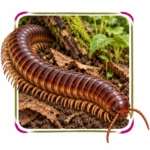
Common Earthworm Fact Highlight
From the full animal facts page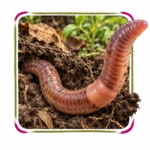
More Animal Comparisons
Pick another animal matchup and keep exploring. Compare appearances, habitats, diets, abilities, and surprising differences.






Make an Animal Story
Send a many-legged Millipede and a burrowing Earthworm into a leaf-litter recycling mystery with our free Animal Story Generator.