
Mole vs Naked Mole-Rat for Kids
An Eastern Mole and a Naked Mole-Rat both spend nearly all their lives underground, but the name is the trick. The Eastern Mole is a true mole, not a rodent, and digs with huge outward-facing forefeet. The Naked Mole-Rat is a rodent, not a true mole or rat, and digs with powerful incisors. One usually tunnels alone in North America; the other works in a large East African colony.
About Eastern Mole
- Type Mammal
- Diet Carnivore and insectivore; earthworms, grubs, ants, centipedes, and other soil animals
- Group True mole; family Talpidae
- Known for Shovel-like forefeet and fast soil tunneling
- Special skill Swimming through soil with broad outward-facing forefeet and velvety reversible fur
About Naked Mole-Rat
- Type Mammal
- Diet Herbivore; mainly underground roots, bulbs, and tubers
- Group Burrowing rodent; family Heterocephalidae
- Known for Nearly hairless skin and eusocial colonies led by a queen
- Special skill Digging hard soil with exposed incisors while colony members move dirt assembly-line style
Quick Answer
Quick answer: The Eastern Mole is generally larger and heavier, covered in velvety fur, and equipped with broad shovel-like front paws for loose soil. The Naked Mole-Rat is smaller, nearly hairless, and uses ever-growing front teeth to cut through hard ground. Their diets and societies are opposites: the mole hunts soil animals alone, while mole-rat colonies cooperate to find roots and tubers.
Eastern Mole vs Naked Mole-Rat: Quick Comparison
| Feature | Eastern Mole | Naked Mole-Rat |
|---|---|---|
| Scientific identity | Scalopus aquaticus | Heterocephalus glaber |
| Mammal group | True mole; family Talpidae | Rodent; family Heterocephalidae |
| Published adult mass | About 65-140 g | Usually about 28-42 g; soldiers and queens can be heavier |
| Published length | About 144-187 mm total in one account | Usually about 75 mm in the Smithsonian account |
| Range | Central and eastern North America | Eastern Africa |
| Digging tool | Broad outward-facing forefeet with large claws | Large exposed incisors and powerful jaw muscles |
| Body covering | Dense velvety fur that can lie in either direction | Wrinkled pinkish skin with sparse sensory hairs |
| Food | Earthworms, grubs, ants, centipedes, and other soil animals | Underground roots, bulbs, and tubers |
| Social life | Usually solitary outside breeding | Eusocial colony with a queen, breeders, workers, and defenders |
| Tunnel system | One mole’s shallow feeding runs and deeper permanent passages | A colony’s branching rooms and tunnels, sometimes kilometers long |
How Are Moles and Naked Mole-Rats Alike?
- Both are mammals highly specialized for life underground.
- Both have tiny eyes and rely strongly on touch, smell, and vibration clues.
- Both build branching tunnel systems with deeper sheltered spaces.
- Both have powerful digging equipment at the front of the body.
- Both mix and aerate soil as they tunnel.
How Are Moles and Naked Mole-Rats Different?
- The Eastern Mole is a true mole in family Talpidae; the Naked Mole-Rat is a rodent in family Heterocephalidae.
- The mole digs mainly with broad forefeet, while the mole-rat cuts soil with large incisors.
- The mole has dense velvety fur, while the mole-rat has nearly hairless wrinkled skin and sparse sensory hairs.
- The mole eats mostly soil animals, while the mole-rat eats underground plant parts.
- The mole usually lives alone, while Naked Mole-Rats form eusocial colonies with specialized jobs.
Eastern Mole vs Naked Mole-Rat Showdown
Adaptation showdown: Eastern Mole wins size because its published adult mass range is generally much heavier. Speed is a Tie because tunnel pace changes with soil and the sources do not provide a matched race. Strength is a Tie because the mole’s powerful forefeet and the mole-rat’s powerful jaws do different digging jobs; this is not a fight prediction. Stealth is a Tie because both remain hidden underground in different habitats. Naked Mole-Rat wins social behavior because many colony members cooperate in specialized roles. Eastern Mole wins swimming because it is documented as swimming well, while neither species is an aquatic specialist. Naked Mole-Rat wins weirdest for a queen-led eusocial society, body-temperature huddles, and front teeth that dig outside closed lips.
Fun Eastern Mole vs Naked Mole-Rat Facts
The Name Is a Double Trick
An Eastern Mole is a true mole and not a rodent. A Naked Mole-Rat is a rodent, but it is neither a true mole nor a true rat despite the common name.
Fur With No Wrong Way
Each Eastern Mole hair can bend so the coat lies forward or backward. That velvety flexibility reduces drag when the mole reverses through a narrow tunnel.
Eighteen Feet of Tunnel
The Tennessee Wildlife Resources Agency reports that an Eastern Mole can tunnel up to 18 feet in an hour in loose, well-drained soil. Its broad forefeet push soil aside like paddles.
Teeth Outside, Lips Closed
A Naked Mole-Rat’s large incisors sit in front of lips that can close behind them. The animal can cut soil without filling its mouth with dirt.
A Mammal Society Like a Hive
Naked Mole-Rats are eusocial. One queen produces the young, while many nonbreeding colony members dig, gather food, care for pups, and defend the tunnel system.
Mole vs Naked Mole-Rat Quiz
- Which animal is a true mole? Answer: The Eastern Mole.
- Which animal is a rodent? Answer: The Naked Mole-Rat.
- What does an Eastern Mole use as its main digging tool? Answer: Broad outward-facing front feet and claws.
- What does a Naked Mole-Rat use to cut soil? Answer: Large ever-growing incisors.
- Which animal lives in a queen-led eusocial colony? Answer: The Naked Mole-Rat.
Eastern Mole vs Naked Mole-Rat FAQ
Is a Naked Mole-Rat a mole?
No. It is a burrowing rodent in family Heterocephalidae, while the Eastern Mole belongs to family Talpidae.
Which is bigger, an Eastern Mole or Naked Mole-Rat?
The Eastern Mole is generally heavier. Queens and soldiers are larger than typical Naked Mole-Rat workers, but the mole’s published adult mass range is still usually greater.
Are Naked Mole-Rats completely hairless?
No. They have sparse sensory hairs on the body and hairs between the toes that help sweep soil.
Why does mole fur feel velvety?
Its hairs can bend in either direction, letting the animal move forward or backward through a tunnel with less resistance.
Can Eastern Moles swim?
Yes. Eastern Moles can swim, but they normally live in soil and are not aquatic mammals.
Animal Words to Know
- Fossorial: Adapted for digging and living mostly underground.
- Eusocial: A highly organized society with cooperative care and only a few breeding animals.
- Incisor: A front tooth used for cutting or gnawing.
- Insectivore: An animal that eats many insects and other small invertebrates.
- Thermoregulate: To control body temperature through body processes or behavior.
Engineer Two Underground Transit Maps
Engineer Two Underground Transit Maps
On one page, draw exactly one adult Eastern Mole and one adult Naked Mole-Rat at honest relative scale in cutaway tunnels. Give the mole a shallow feeding run, deep nest chamber, worm clue, broad digging paws, and reversible-fur arrow. Give the mole-rat a root pantry, nursery, toilet chamber, incisor-digging clue, and colony-job cards without adding extra animals. Trace how each system moves food and soil, then explain why one tunnel map belongs to a solitary hunter and the other to a social plant eater. No people handling wildlife.
Meet Each Animal
Want the full fact file? Here are quick highlights from each animal’s own facts page.
Eastern Mole Fact Highlight
From the full animal facts pageNaked Mole-Rat Fact Highlight
From the full animal facts page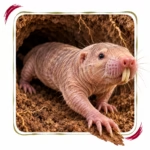
More Animal Comparisons
Pick another animal matchup and keep exploring. Compare appearances, habitats, diets, abilities, and surprising differences.






Make an Animal Story
Send a shovel-pawed Eastern Mole and a tooth-digging Naked Mole-Rat into an underground mystery with our free Animal Story Generator.