
Mugger Crocodile vs Saltwater Crocodile: Asian Crocodile Comparison
Mugger crocodiles and saltwater crocodiles overlap in a few parts of South Asia, but they are built for different watery worlds. The Mugger Crocodile has an unusually broad snout and favors freshwater lakes, rivers and ponds. The Saltwater Crocodile is the largest living reptile and can move between rivers, estuaries, coasts and the open sea. Both are wild ambush predators that must be viewed only from a safe distance.
About Mugger Crocodile
- Type Living
- Diet Carnivore
- Group Freshwater crocodile species (Crocodylus palustris)
- Known for Very broad snout, freshwater ponds, heat-sheltering burrows and rare stick-lure behavior
- Special skill Digs deep bank burrows that buffer extreme heat, cold and drought
About Saltwater Crocodile
- Type Living
- Diet Carnivore
- Group Largest living reptile species (Crocodylus porosus)
- Known for Enormous males, powerful swimming, coastal habitats and long-distance sea travel
- Special skill Uses salt glands, a powerful tail and ocean currents to travel between coasts and islands
Mugger Crocodile vs Saltwater Crocodile: Quick Answer
The Mugger Crocodile is a medium-to-large freshwater species with the broadest snout among living crocodiles. It may dig a bank burrow to escape dangerous heat or drying water. The Saltwater Crocodile is much larger, has a longer-looking head with ridges between the eyes and snout, and can travel through salty coastal water and the open sea. Both hide almost completely underwater with their eyes and nostrils above the surface.
Where Do They Fit?
Follow the branches to see how Mugger Crocodile and Saltwater Crocodile are classified and related.
Mugger Crocodile vs Saltwater Crocodile: Quick Comparison
| Feature | Mugger Crocodile | Saltwater Crocodile |
|---|---|---|
| Scientific name | Crocodylus palustris | Crocodylus porosus |
| Native range | Iran, Pakistan, India, Nepal, Sri Lanka and nearby South Asian areas | From South Asia through Southeast Asia to northern Australia and Pacific islands |
| Adult length | Often about 2.5-4 m; exceptional males may approach 5 m | Adults often 3-5 m; large males can reach about 6 m |
| Size class | Medium-to-large crocodile | Largest living reptile |
| Snout clue | Extremely broad, rounded snout | Broad but longer-looking snout with a pair of ridges from the eyes |
| Favorite water | Freshwater rivers, lakes, marshes, reservoirs and village ponds | Estuaries, tidal rivers, mangroves, coasts, sea and also freshwater |
| Dry-season shelter | May dig a deep bank burrow where temperature stays steadier | Usually remains in suitable waterways and may travel widely to find territory |
| Nest type | Female digs a hole nest in sand or soil | Female builds a mound nest from vegetation and mud |
| Travel style | Can walk over land between shrinking freshwater pools | Powerful swimmer that can ride currents across long coastal distances |
| Conservation status | Vulnerable | Least Concern globally, though some regional populations remain threatened |
How Are Mugger and Saltwater Crocodiles Alike?
- Both are true crocodiles in the genus Crocodylus.
- Both are carnivorous ambush hunters with powerful tails and webbed feet.
- Both have eyes, ears and nostrils high on the head for hiding almost underwater.
- Both lay eggs on land, and females guard nests and help hatchlings reach water.
- Both control body temperature by moving between sun, shade and water.
How Are Mugger and Saltwater Crocodiles Different?
- The Saltwater Crocodile grows much larger and heavier.
- The Mugger Crocodile has a shorter, exceptionally broad snout.
- Muggers mainly favor freshwater; saltwater crocodiles use fresh, brackish and marine water.
- Muggers dig hole nests and shelter burrows; saltwater crocodiles build mound nests.
- Saltwater crocodiles can make long sea journeys, while muggers usually move between inland wetlands and over nearby land.
Mugger vs Saltwater Crocodile Adaptation Showdown
- Size – Saltwater Crocodile: It is the largest living reptile, and a big male can be far longer and heavier than a typical mugger.
- Speed – Tie: Both can burst forward quickly in water or over a short distance, but neither is built for a long land race.
- Strength – Saltwater Crocodile: Its much larger maximum body and skull give it more total power; this is anatomy, not a predicted fight.
- Stealth – Tie: Both can sink until only the eyes, ears and nostrils show, making a fair visibility contest impossible.
- Social – Tie: Both are mostly solitary, defend space and show strong parental care around nests and hatchlings.
- Swimming – Saltwater Crocodile: It is specially successful in tidal water and can use ocean currents for long coastal or island journeys.
- Weirdest – Mugger Crocodile: It digs a crocodile-sized bank burrow, and some have even been observed balancing sticks as possible lures for nesting birds.
Fun Mugger Crocodile vs Saltwater Crocodile Facts
The Broadest Crocodile Snout
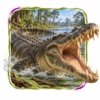
The Mugger Crocodile has the broadest snout of any living crocodile. The shape suits its varied diet in shallow freshwater.
A Burrow for Bad Weather
Muggers dig tunnels into banks. A chamber inside can stay steadier when air outside becomes dangerously hot, cold or dry.
A Crocodile at Sea
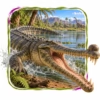
Saltwater crocodiles can leave river mouths, enter open sea and ride favorable currents for long distances.
Only the Top of the Head Shows
Eyes, ears and nostrils sit high on a crocodile’s head. It can watch, hear and breathe while most of the body stays hidden.
Possible Stick Lures
Researchers observed mugger crocodiles lying with sticks on their snouts near nesting bird colonies. Birds searching for twigs could come closer, although scientists continue to study this behavior.
Mugger vs Saltwater Crocodile Quiz
Which is the largest living reptile? A) Mugger Crocodile B) Saltwater Crocodile C) Both Answer: B) Saltwater Crocodile
Which crocodile has the broadest snout? A) Mugger Crocodile B) Saltwater Crocodile C) Neither Answer: A) Mugger Crocodile
Which crocodile may dig a shelter burrow? A) Mugger Crocodile B) Saltwater Crocodile C) Neither Answer: A) Mugger Crocodile
Where can a saltwater crocodile travel? A) Only deserts B) Rivers, coasts and sea C) Only mountaintops Answer: B) Rivers, coasts and sea
What sits high on both crocodiles’ heads? A) Eyes and nostrils B) Antlers C) Feathers Answer: A) Eyes and nostrils
Mugger Crocodile vs Saltwater Crocodile FAQ
Are mugger and saltwater crocodiles the same species?
No. They are separate species with different average size, snout shape and habitat use.
Which crocodile is bigger?
The Saltwater Crocodile is much bigger and is the largest living reptile.
Can a saltwater crocodile live in fresh water?
Yes. Its name is misleading because it uses freshwater rivers and swamps as well as salty coasts.
Why does a mugger crocodile dig a burrow?
The tunnel provides shelter when temperature or water conditions become harsh.
Is it safe to approach either crocodile?
No. Stay well back from banks and water in crocodile country and always obey local safety signs and adults.
Animal Words to Know
- Ambush predator: An animal that hides and attacks suddenly when prey comes close.
- Brackish: Water containing a mix of fresh water and seawater.
- Estuary: A coastal place where river water mixes with the sea.
- Mound nest: A pile of plants, soil and mud built around eggs.
- Thermoregulation: Controlling body temperature by changing behavior or location.
Map Two Crocodile Waterways
Map Two Crocodile Waterways
Draw a freshwater lake and bank burrow for the Mugger Crocodile on one side. Draw a mangrove estuary flowing into the sea for the Saltwater Crocodile on the other. Add arrows showing overland movement, ocean currents, basking places and safe human viewing zones far from the water.
Meet Each Animal
Want the full fact file? Here are quick highlights from each animal’s own facts page.
Mugger Crocodile Fact Highlight
From the full animal facts page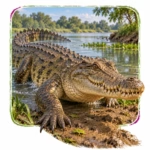
Saltwater Crocodile Fact Highlight
From the full animal facts page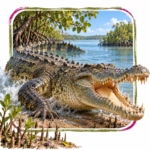
More Animal Comparisons
Pick another animal matchup and keep exploring. Compare appearances, habitats, diets, abilities, and surprising differences.

Make an Animal Story
Create a crocodile story that travels from a quiet inland lake to a tidal mangrove coast!
Source notes: References used for this comparison. See more See less
Try Another Matchup
Explore this comparison →