
Narwhal vs Beluga: Arctic Toothed Whale Comparison
Narwhals and belugas are close Arctic relatives in the small whale family Monodontidae, but they are easy to tell apart. Narwhals are mottled gray whales famous for a long spiral tusk, especially in males. Belugas become white as adults, have no tusk, can turn their heads, and are nicknamed sea canaries because of their many calls.
About Narwhal
- Type Mammal
- Diet Carnivore
- Group Toothed Whale
- Known for Long spiral tusk, mottled skin, Arctic life, deep diving, and under-ice travel
- Special skill Diving deeply beneath Arctic ice and using a sensitive tusk to detect changes in the surrounding environment
About Beluga
- Type Mammal
- Diet Carnivore
- Group Toothed Whale
- Known for White adult color, rounded melon, flexible neck, many vocal sounds, and Arctic social life
- Special skill Turning its head with an unusually flexible neck and producing a broad range of whistles, clicks, chirps, and other calls
Narwhal vs Beluga: Quick Answer
Narwhals are usually mottled gray and many males grow one long spiral tusk, which is actually an enlarged tooth. Belugas become white as adults, have no tusk, possess flexible necks, and produce an extraordinary range of sounds. Both are social Arctic toothed whales with calves.
Where Do They Fit?
Follow the branches to see how Narwhal and Beluga are classified and related.
Narwhal vs Beluga: Quick Comparison
| Feature | Narwhal | Beluga |
|---|---|---|
| Animal type | Marine mammal | Marine mammal |
| Animal group | Toothed whale | Toothed whale |
| Known for | Spiral tusk, mottled skin, deep diving, and Arctic ice | White color, flexible neck, rounded melon, and many calls |
| Main habitat | Arctic offshore waters, fjords, and pack ice | Arctic and subarctic coasts, bays, estuaries, and pack ice |
| Adult color | Mottled gray, black, cream, and white | Mostly white |
| Famous feature | Long spiral tusk, usually in males | Flexible neck and rounded forehead |
| Diet | Fish, squid, and crustaceans | Fish, squid, worms, and crustaceans |
| Baby name | Calf | Calf |
| Social group | Pod | Pod |
| Special skill | Deep diving beneath ice | Vocal communication and head movement |
How Are Narwhals and Belugas Alike?
- Both narwhals and belugas are mammals in the family Monodontidae.
- Both live mainly in Arctic and subarctic waters.
- Both breathe air through a blowhole and give birth to calves that drink milk.
- Both are toothed whales that use echolocation to navigate and locate prey.
- Both form pods and make seasonal movements through icy seas.
How Are Narwhals and Belugas Different?
- Narwhals are mottled gray, while adult belugas are mostly white.
- Many male narwhals grow a long spiral tusk, while belugas do not.
- Belugas have flexible necks, while narwhal neck vertebrae are more firmly joined like those of most whales.
- Narwhals often use deeper offshore habitats, while belugas frequently enter bays, estuaries, and river mouths.
- Belugas are especially famous for varied vocal sounds, while narwhals are better known for deep diving and under-ice travel.
Narwhal vs Beluga Showdown
Arctic-whale showdown: The beluga wins for typical size, strength, and social life because large males can outweigh many narwhals and belugas often form busy, vocal gatherings. Speed and swimming are ties because both are capable Arctic travelers. The narwhal takes stealth with its mottled camouflage beneath broken ice and wins our weirdest-fact prize for carrying a tusk that is actually a giant sensory tooth.
Fun Narwhal vs Beluga Facts
Spiral Tusk vs Tuskless Smile
A narwhal tusk is an enlarged upper tooth that grows in a left-handed spiral, usually in males. Belugas do not grow tusks and instead have rows of ordinary conical teeth for gripping slippery prey.
Mottled Gray vs Arctic White
Narwhals have dark and pale mottled patterns that change with age. Beluga calves are born gray or brownish and gradually become white as they mature, helping adults blend with sea ice and snowy water.
Stiff Neck vs Flexible Neck
Like most whales, narwhals have neck vertebrae that allow limited head movement. Belugas have unfused neck vertebrae, so they can nod, tilt, and turn their heads more freely.
Deep Offshore Diver vs Coastal Explorer
Narwhals make deep dives in offshore Arctic waters and may descend well beyond 1,000 meters while feeding. Belugas also dive strongly but are often seen in shallower bays, estuaries, river mouths, and coastal migration routes.
A Narwhal Tusk Can Sense the Water
A narwhal tusk contains millions of nerve endings connected to tiny channels in the tooth. Research suggests it can detect changes in salinity, temperature, pressure, and other features of the surrounding water.
Narwhal vs Beluga Quiz
- Which whale may grow a long spiral tusk? Answer: Narwhal.
- Which whale becomes mostly white as an adult? Answer: Beluga.
- What are baby narwhals and belugas called? Answer: Calves.
- Which whale can turn its head more freely? Answer: Beluga.
- What sound-based sense do both whales use? Answer: Echolocation.
Narwhal vs Beluga FAQ
What is the main difference between a narwhal and a beluga?
Narwhals are mottled Arctic whales, and many males grow a long spiral tusk. Belugas become white as adults, have no tusk, possess flexible necks, and make many different sounds.
Are narwhals and belugas related?
Yes. They are the two living members of the whale family Monodontidae and are close relatives.
Is a narwhal tusk really a horn?
No. It is an enlarged tooth, usually the left upper canine, that grows through the lip in a spiral.
Why are belugas called sea canaries?
Belugas produce many whistles, chirps, clicks, squeals, and other sounds, reminding early sailors of singing birds.
Can narwhals and belugas have hybrid calves?
Yes. Genetic research has confirmed at least one narwhal-beluga hybrid, sometimes nicknamed a narluga, although such hybrids appear to be rare.
Animal Words to Know
- Monodontidae: The toothed whale family containing narwhals and belugas.
- Tusk: A greatly enlarged tooth that projects outside the mouth.
- Melon: The rounded fatty forehead structure used in echolocation by toothed whales.
- Echolocation: Finding objects by sending out sounds and listening for returning echoes.
- Pack ice: Floating sea ice that has been driven together into large areas.
Narwhal and Beluga Arctic Detective Activity
Narwhal and Beluga Arctic Detective Activity
Draw a narwhal and beluga beneath Arctic sea ice. Give the narwhal mottled coloring, a small dorsal ridge, and a spiral tusk on an adult male. Give the beluga a white body, rounded forehead, flexible neck, and a pod filled with sound symbols. Label tusk, forehead, neck, echolocation, and pack ice.
Meet Each Animal
Want the full fact file? Here are quick highlights from each animal’s own facts page.
Narwhal Fact Highlight
From the full animal facts page
Beluga Fact Highlight
From the full animal facts page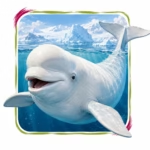
More Animal Comparisons
Pick another animal matchup and keep exploring. Compare appearances, habitats, diets, abilities, and surprising differences.





Make an Animal Story
Turn this narwhal vs beluga comparison into a sparkling Arctic adventure with our free Animal Story Generator.
Source notes: References used for this comparison. See more See less
Try Another Matchup
Explore this comparison →