
Numbat vs Bilby for Kids: Termite Hunter and Desert Digger
Numbats and Greater Bilbies are Australian marsupials with pointed snouts, strong claws, and remarkably short pregnancies. Yet their schedules and menus are almost opposites. A striped Numbat searches for termites in daylight, while a big-eared bilby emerges at night to dig for many different foods.
About Numbat
- Type Termite-eating marsupial
- Diet Termite specialist
- Group Numbat family, Myrmecobiidae
- Known for Daytime termite hunting, white back bands, and a long sticky tongue
- Special skill Uses a tongue about 10 to 11 cm long to collect thousands of termites
About Greater Bilby
- Type Long-eared burrowing marsupial
- Diet Omnivore
- Group Bilby and bandicoot family, Thylacomyidae
- Known for Huge ears, powerful claws, and deep spiral burrows
- Special skill Excavates deep spiral burrows and gains much of its water from food
Quick Answer
Quick answer: A Numbat is a small, striped, daytime marsupial that can eat up to about 20,000 termites a day with a long sticky tongue. A Greater Bilby is larger, nocturnal, and omnivorous, with enormous ears and powerful claws for deep spiral burrows. Female numbats do not have a true pouch, while female bilbies have a rear-opening pouch.
Numbat vs Greater Bilby: Quick Comparison
| Feature | Numbat | Greater Bilby |
|---|---|---|
| Scientific name | Myrmecobius fasciatus | Macrotis lagotis |
| Marsupial group | Order Dasyuromorphia; family Myrmecobiidae | Order Peramelemorphia; family Thylacomyidae |
| Body size | Body about 20 to 29 cm; usually about 0.4 to 0.7 kg | Body about 29 to 55 cm; mass about 0.6 to 2.5 kg |
| Appearance | Reddish or grey-brown with white back bands and a bushy tail | Silky blue-grey with huge ears and a black-and-white tail |
| Active time | Diurnal, following termites near the soil surface | Nocturnal, resting in a burrow by day |
| Main food | Almost entirely termites | Termites, larvae, seeds, fungi, bulbs, and fruit |
| Feeding tool | A sticky tongue about 10 to 11 cm long | Long tongue, pointed snout, and powerful digging claws |
| Main shelter | A hollow log, hollow tree, or short underground nest chamber | A deep spiral burrow, with several shelters in its home area |
| Pouch | No true pouch; skinfolds and long guard hairs protect the young | Rear-opening pouch helps keep digging soil away |
| Typical young | Usually four attached to the mother’s teats | Usually one or two carried in the pouch |
How Numbats and Bilbies Are Alike
- Both are Australian marsupials with pointed snouts and long tongues.
- Both use strong front claws to open soil or insect shelters while searching for food.
- Both eat termites, although termites dominate the Numbat’s diet much more strongly.
- Both are usually solitary outside breeding and a mother caring for young.
- Both have pregnancies of only about two weeks before extremely undeveloped young are born.
How Numbats and Bilbies Are Different
- The Numbat searches for food in daylight, while the Greater Bilby is active mainly at night.
- The Numbat is a termite specialist, while the bilby eats insects, seeds, fungi, bulbs, and fruit.
- A Numbat has white back bands and a bushy tail, while a bilby has huge ears and a black-and-white tail.
- A female Numbat has no true pouch, while a female bilby carries young in a rear-opening pouch.
- A bilby is generally larger and digs deep spiral burrows, while a Numbat often nests in a hollow log.
Numbat vs Bilby Adaptation Showdown
Adaptation showdown: Greater Bilby wins size because a large adult can reach about 2.5 kg, several times the mass of a Numbat. Speed is a Tie because no fair matched top-speed evidence is available. Greater Bilby wins strength because its powerful limbs and claws dig long, deep spiral burrows. Stealth is a Tie because Numbat stripes break up its outline among logs while a bilby hides underground by day. Social behavior is a Tie because both are usually solitary. Swimming is a Tie because neither is adapted for life in water. Numbat wins weirdest for eating up to about 20,000 termites a day and raising four young without a true pouch.
Fun Numbat vs Greater Bilby Facts
Twenty Thousand Tiny Meals
A Numbat may eat as many as about 20,000 termites in one day. It opens shallow termite galleries with its claws and sweeps up the insects with a sticky tongue.
A Marsupial Without a True Pouch
A female Numbat has four teats but no enclosing pouch. Folds of skin and long protective belly hairs shield the tiny young while they remain attached.
A Daytime Exception
Most Australian marsupials of similar size are active at night, but Numbats forage by day. Their schedule follows the times when termites move close enough to the surface.
Fourteen Fast Days
Greater Bilby pregnancy lasts only about 14 days, one of the shortest mammal pregnancies. The tiny newborns then continue developing in the pouch.
Ears for Sound and Cooling
A bilby’s enormous ears help detect quiet movements and release heat. The animal also relies on excellent smell because its eyesight is not especially sharp.
Numbat vs Bilby Quiz
- Which animal is active mainly in daylight? Answer: The Numbat.
- About how many termites can a Numbat eat in a day? Answer: Up to about 20,000.
- Which animal digs a deep spiral burrow? Answer: The Greater Bilby.
- Does a female Numbat have a true pouch? Answer: No. Skinfolds and long belly hairs help protect her attached young.
- How do a bilby’s ears help it? Answer: They collect faint sounds and help release body heat.
Numbat vs Greater Bilby FAQ
Is a Numbat an anteater?
It is sometimes called a banded anteater, but it is a unique Australian marsupial, not a true anteater.
Which animal is bigger?
The Greater Bilby is generally longer and heavier than the Numbat.
Do bilbies eat termites too?
Yes, but bilbies are omnivores with a much broader diet, while Numbats specialize almost entirely on termites.
Why is a Numbat active during the day?
It times its foraging to when termites are moving near the surface and are easiest to reach.
Do both animals live in Australia?
Yes. Numbats now survive mainly in parts of western and southern Australia, while bilbies occupy scattered inland drylands.
Animal Words to Know
- Diurnal: Mainly active during daylight.
- Specialist: An animal that relies on a narrow range of foods or habitats.
- Termite gallery: A protected passage made by termites in soil, wood, or their nest.
- Guard hair: A longer outer hair that protects the softer fur or skin beneath.
- Radiator: A surface that releases heat; large ears can act like biological radiators.
Build a Marsupial Daily Schedule
Build a Marsupial Daily Schedule
Draw exactly one adult Numbat and exactly one adult Greater Bilby at honest relative scale. Make a 24-hour clock and mark when each animal feeds and rests. Add termite galleries and a hollow log for the Numbat, plus a spiral burrow and mixed foods for the bilby. Label stripes, ears, tongue, claws, tail, and pouch clues. Never open wild nests, burrows, or termite homes.
Meet Each Animal
Want the full fact file? Here are quick highlights from each animal’s own facts page.
Numbat Fact Highlight
From the full animal facts page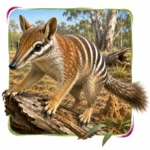
Greater Bilby Fact Highlight
From the full animal facts page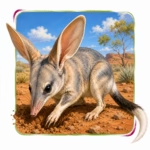
More Animal Comparisons
Pick another animal matchup and keep exploring. Compare appearances, habitats, diets, abilities, and surprising differences.


Make an Animal Story
Send a termite-tracking Numbat and a big-eared Bilby through an Australian time-of-day quest with our free Animal Story Generator.