
Lowland Nyala vs Cape Bushbuck: Antelope Species Comparison
Nyala and bushbuck are close spiral-horned relatives, but the names need care. Nyala here means the Lowland Nyala, Tragelaphus angasii, not Mountain Nyala. Bushbuck here means the southern or Cape Bushbuck, often recognized as Tragelaphus sylvaticus; some scientists instead join bushbuck populations as Tragelaphus scriptus. The Lowland Nyala is larger and more social. The Cape Bushbuck is smaller, usually solitary and strongly attached to thick cover.
About Lowland Nyala
- Type Living
- Diet Herbivore and mixed feeder; browses leaves, twigs, flowers and fruit and grazes fresh rainy-season grass
- Group Spiral-horned antelope species in genus Tragelaphus (Tragelaphus angasii)
- Known for Rusty striped females, much larger shaggy gray males, male-only spiral horns and a sharp barking alarm call
- Special skill Listens to alarm calls from other species and disappears into thickets instead of relying only on speed
About Cape Bushbuck
- Type Living
- Diet Herbivore and browser; eats leaves, herbs, twigs and flowers with occasional fresh grass
- Group Southern or Cape Bushbuck in genus Tragelaphus; often listed as Tragelaphus sylvaticus
- Known for Compact body, highly variable reddish-to-dark coat, scattered white spots or stripes and short male-only spiral horns
- Special skill Keeps dense cover only a quick bound away and can swim strongly when crossing rivers or escaping danger
Lowland Nyala vs Cape Bushbuck: Quick Answer
A Lowland Nyala is the larger animal. Adult males are shaggy slate-gray with long spiral horns, while females are much smaller, rusty orange and striped. A male Cape Bushbuck is compact, reddish-brown to very dark, with shorter horns that make about one spiral. Females of both animals are hornless. Nyalas form loose herds; Bushbucks are more often seen alone near dense cover.
Where Do They Fit?
Follow the branches to see how Lowland Nyala and Cape Bushbuck are classified and related.
Lowland Nyala vs Cape Bushbuck: Quick Comparison
| Feature | Lowland Nyala | Cape Bushbuck |
|---|---|---|
| Scientific name | Tragelaphus angasii | Often Tragelaphus sylvaticus; some lists use a broader T. scriptus |
| Adult mass | Females about 55-68 kg; males about 98-125 kg | Females often about 25-60 kg; males about 40-80 kg in broader bushbuck data |
| Sex difference | Extreme: small rusty female and large shaggy gray male | Male larger and darker, but the size contrast is less dramatic |
| Horns | Males only; long open spirals up to about 80 cm | Males only; shorter, straighter horns with about one spiral |
| White pattern | Several vertical stripes and spots, clearest on females and young | Variable white spots and short stripes |
| Coat texture | Adult male has long crest and belly fringe | Shorter coat without the Nyala’s deep hanging fringe |
| Habitat | Thickets beside savanna woodland and feeding grass | Forest edges and river thickets with dense cover |
| Food | Browses and grazes | Mainly browses, with occasional grass |
| Social life | Loose groups of two to 30 | Usually solitary or in tiny loose groups |
| Active time | Often evening and night, but also active by day | Mainly dusk, night and dawn, hiding by day |
How Are Lowland Nyalas and Cape Bushbucks Alike?
- Both are African spiral-horned antelopes in the genus Tragelaphus.
- Both rely on stripes, spots, brown tones and thick vegetation for camouflage.
- Both have horns only on males, while females are naturally hornless.
- Both eat leaves, twigs, herbs, flowers and some fresh grass.
- Both hide a single young calf in vegetation during its earliest days.
How Are Lowland Nyalas and Cape Bushbucks Different?
- The Lowland Nyala is larger, especially when adult males are compared.
- Male and female Nyalas look dramatically different; Bushbuck sexes share a more similar body pattern.
- Nyala males have longer open spirals and a shaggy fringe; male Bushbucks have shorter horns and less fringe.
- Nyalas often form loose herds, while Bushbucks are among the least social African antelopes.
- Bushbucks stay closer to dense forest or river cover and are more strongly nocturnal.
Nyala vs Bushbuck Adaptation Showdown
- Size – Lowland Nyala: An adult male can exceed 120 kg, clearly above the usual mass of a male Cape Bushbuck.
- Speed – Tie: Both depend on short bursts and cover, and no matched speed evidence supports a dependable winner.
- Strength – Lowland Nyala: Its much larger adult male body and longer horns provide more total power; this is not a fight prediction.
- Stealth – Cape Bushbuck: Its compact body, variable spots and solitary low-light habits make it a master of dense river thickets.
- Social – Lowland Nyala: It regularly forms loose groups of up to 30, while the Cape Bushbuck is usually alone.
- Swimming – Cape Bushbuck: Bushbucks are documented as capable swimmers and live closely around rivers and streamside cover.
- Weirdest – Lowland Nyala: A rusty striped female and a huge shaggy gray male look so different that beginners may mistake them for separate species.
Fun Lowland Nyala vs Cape Bushbuck Facts
Two Looks, One Nyala
A female Lowland Nyala is small, hornless, rusty-red and clearly striped. A mature male is nearly twice her mass, slate-gray, shaggy and horned.
A Bark in the Bush
Nyalas give a sharp barking alarm. They also react to warnings from Impalas, baboons and Kudus sharing the same landscape.
The Bushbuck Name Puzzle
Modern mammal lists may split northern and southern Bushbucks, while other research supports one highly varied species. Cape Bushbuck is the southern benchmark here.
A Coat That Changes by Place
Cape Bushbuck coats can be reddish, brown or nearly black, with many or few white marks. Local populations do not all wear the same pattern.
Fruit from Above
Lowland Nyalas sometimes follow feeding monkeys and eat fruit or leaves dropped from branches overhead.
Nyala vs Bushbuck Quiz
Which animal is larger? A) Lowland Nyala B) Cape Bushbuck C) They are identical Answer: A) Lowland Nyala
Which animal usually forms larger groups? A) Lowland Nyala B) Cape Bushbuck C) Neither Answer: A) Lowland Nyala
Which adults grow horns? A) Males B) Females C) Every adult Answer: A) Males
Which animal is more often solitary? A) Lowland Nyala B) Cape Bushbuck C) Both always live alone Answer: B) Cape Bushbuck
Why can Bushbuck scientific names differ? A) Taxonomy is debated B) They are insects C) They change species each season Answer: A) Taxonomy is debated
Lowland Nyala vs Cape Bushbuck FAQ
Is Nyala the same as Mountain Nyala?
No. This page uses Lowland Nyala, a southern African species. Mountain Nyala is a different Ethiopian antelope.
Why is Cape Bushbuck also called Southern Bushbuck?
Both names refer to the southern bushbuck group, which some mammal lists recognize as Tragelaphus sylvaticus.
Why do some sources call Bushbuck Tragelaphus scriptus?
Scientists still study whether northern and southern forms should be one species or two. Different references follow different treatments.
Do female Nyalas and Bushbucks have horns?
No. In both comparisons, males grow the spiral horns and females remain hornless.
Can Nyalas and Bushbucks live near one another?
Yes. Their ranges and wooded habitats can overlap, but different body sizes, diets and social habits help divide resources.
Animal Words to Know
- Browse: To eat leaves, twigs, flowers or fruit from shrubs and trees.
- Dimorphism: A clear difference in appearance between two forms, such as adult males and females.
- Nocturnal: Most active during the night.
- Solitary: Living or spending much time alone.
- Taxonomy: The science of naming and grouping living things.
Create a Thicket Antelope Wardrobe
Create a Thicket Antelope Wardrobe
Make three removable paper coats: rusty striped female Nyala, shaggy slate-gray male Nyala and compact spotted Cape Bushbuck. Match each coat to a body silhouette, then add the correct horn shape and group size. Finish with a note explaining why coat pattern alone may not identify every Bushbuck.
Meet Each Animal
Want the full fact file? Here are quick highlights from each animal’s own facts page.
Lowland Nyala Fact Highlight
From the full animal facts page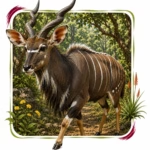
Cape Bushbuck Fact Highlight
From the full animal facts page
More Animal Comparisons
Pick another animal matchup and keep exploring. Compare appearances, habitats, diets, abilities, and surprising differences.





Make an Animal Story
Create a woodland story about a shaggy Nyala and a secretive Bushbuck trading clues in the thicket!
Source notes: References used for this comparison. See more See less
Try Another Matchup
Explore this comparison →