
Platypus vs Beaver: Australian-Platypus-to-Northern-Beaver Freshwater-Mammal Comparison
Platypuses and beavers are brown semiaquatic mammals with broad tails, webbed feet, waterproof coats, burrows, and freshwater lives, so their silhouettes can look oddly similar. The resemblance stops quickly. A platypus is a small Australian monotreme that lays eggs, hunts aquatic invertebrates with an electrosensory bill, swims mainly with its front feet, and carries no gnawing incisors as an adult. A beaver is a much larger Northern Hemisphere rodent that gives birth to live kits, eats plants, swims mainly with webbed hind feet, and uses orange ever-growing incisors to cut vegetation and reshape waterways. The platypus does not build beaver dams, and a beaver does not have a duck-like bill, venom spur, or electrical prey detector.
About Platypus
- Type Mammal
- Diet Carnivorous bottom-forager eating aquatic insect larvae, worms, freshwater shrimp and crayfish, snails, and other small invertebrate prey. Adults lack functional teeth and crush food between keratinized grinding pads after storing prey in cheek pouches
- Group Platypus, Ornithorhynchus anatinus, the only living species in genus Ornithorhynchus and family Ornithorhynchidae; one of the five widely recognized living monotreme species and the only semiaquatic member of that surviving egg-laying mammal group
- Known for A small streamlined brown mammal with dense waterproof fur, a broad flexible sensory bill, tiny eyes, short limbs, strongly webbed front feet, less-webbed hind feet, and a broad flattened furry tail. Adults vary geographically and by sex, commonly measuring roughly 38–60 centimeters in total length and about 0.7–3 kilograms, with males usually larger
- Special skill The bill combines touch and electroreception to find prey while the eyes, ears, and nostrils are closed underwater. Broad front webs provide most propulsion; hind feet and tail help steer and stabilize. Dense fur traps air, cheek pouches carry food, females lay leathery eggs, and adult males carry venom-delivering ankle spurs
About Beaver
- Type Mammal
- Diet Herbivore eating leaves, shoots, twigs, bark and nutrient-rich cambium from woody plants plus water lilies, pondweed, sedges, grasses, roots, and other vegetation. Beavers cut wood but obtain food mainly from bark, cambium, leaves, shoots, and aquatic plants rather than digesting solid wood as a meal
- Group Beavers, genus Castor in family Castoridae and order Rodentia, represented by two living species: the North American beaver Castor canadensis and Eurasian beaver Castor fiber; this page compares shared beaver traits and uses the North American species for visual examples
- Known for A large heavy-bodied brown rodent with a blunt head, small closable ears and nostrils, dexterous front paws, large webbed hind feet, four orange front incisors, and a wide flattened scaly tail. Adults vary by species and region but are commonly around 90–120 centimeters including the tail and roughly 13–32 kilograms, making them far larger than platypuses
- Special skill Iron-rich orange enamel and softer rear dentine make ever-growing incisors self-sharpen as they gnaw. Lips close behind the incisors, ear and nostril valves exclude water, webbed hind feet propel swimming, front paws handle branches, dense fur insulates, and the broad tail supports steering, balance, fat storage, and alarm slaps
Platypus vs Beaver: Quick Answer
A platypus is a small egg-laying Australian mammal with a flexible electrosensory bill, strongly webbed front feet, adult grinding pads instead of teeth, and a furry fat-storing tail. A beaver is a much larger plant-eating rodent from North America or Eurasia with orange ever-growing incisors, webbed hind feet, a scaly paddle tail, live-born kits, and the ability to build lodges and sometimes dams.
Where Do They Fit?
Follow the branches to see how Platypus and Beaver are classified and related.
Platypus vs Beaver: Quick Comparison
| Feature | Platypus | Beaver |
|---|---|---|
| Scientific group | Ornithorhynchus anatinus, one living monotreme species | Genus Castor, with North American and Eurasian species |
| Adult size | Usually about 38–60 cm long and 0.7–3 kg | Often about 90–120 cm long and 13–32 kg |
| Native range | Eastern Australia and Tasmania | North America, Europe, and northern Asia depending on species |
| Reproduction | Lays one to three leathery eggs and nurses young without nipples | Gives birth to live kits and nurses them with nipples |
| Main food | Aquatic insects, worms, crustaceans, snails, and other small prey | Bark, cambium, twigs, leaves, grasses, roots, and aquatic plants |
| Mouth tool | Flexible bill with touch and electrical receptors; adults have grinding pads | Four orange ever-growing incisors that self-sharpen during gnawing |
| Swimming power | Mainly webbed front feet; hind feet and tail help steer | Mainly webbed hind feet; tail helps steer and stabilize |
| Tail | Broad, furry, flexible, and important for fat storage | Broad, flattened, mostly scaly, and used in swimming, balance, storage, and warning |
| Home | Resting or nesting burrow dug into a freshwater bank | Lodge or bank den; an underwater entrance often provides security |
| Water engineering | Uses existing freshwater habitat and does not build dams | May build dams and canals, though not every beaver or site requires a dam |
How Are Platypuses and Beavers Alike?
- Both are warm-blooded, fur-covered mammals adapted to spend much of their active time in freshwater and to return to land or a bank burrow for rest and reproduction.
- Both have streamlined bodies, broad flattened tails, webbing on the feet, closable nostrils, small external ear openings, dense insulating fur, and strong claws for digging into riverbanks.
- Both can be most active around dusk, night, or dawn, forage underwater, use underwater entrances to reduce danger, and depend on healthy connected waterways with food and stable banks.
- Both store energy in the tail, carry food or building material through water, groom a specialized water-resistant coat, and face threats from altered river flow, entangling litter, roads, drought, pollution, and habitat loss.
- Both can change what a human observer notices around a stream—platypuses stir bottom prey and connect aquatic food webs, while beavers create ponds and wetlands that can alter habitat for many other species.
How Are Platypuses and Beavers Different?
- The platypus is a monotreme on a very early-diverging mammal branch; the beaver is a placental rodent related to squirrels, mice, capybaras, and porcupines.
- A female platypus lays eggs and releases milk onto mammary skin patches because she has no nipples. A female beaver carries embryos internally, gives birth to live kits, and nurses them through nipples.
- The platypus is a small carnivorous hunter that detects weak electrical signals from moving prey. The beaver is a much larger herbivore that locates and cuts plants with powerful incisors and smell.
- A platypus has a soft flexible bill and loses its juvenile teeth, replacing them with grinding pads. A beaver has four prominent orange incisors that grow throughout life and wear into sharp cutting edges.
- The platypus’s front feet provide most swimming thrust, with webs folding back on land. The beaver’s rear feet carry the largest webs, while its front paws remain free to grasp and dig.
- Platypuses use existing streams, pools, and banks. Beavers can fell woody plants, dig canals, build lodges, and dam suitable channels, making them powerful ecosystem engineers.
Platypus vs Beaver Adaptation Showdown
Electrosensory hunter versus wetland engineer showdown: Beaver wins size because an ordinary adult is many times heavier than even a large platypus. Speed is a tie because published swimming figures come from different methods and neither species group has a standardized head-to-head trial. Beaver wins whole-body strength for its much greater mass, tree-felling bite system, and ability to push mud and timber; this is not a fight prediction. Stealth is a tie because a platypus closes its senses and searches quietly underwater while a beaver combines nocturnal activity, submerged entrances, scent awareness, and still-water travel. Beaver wins social behavior because stable pairs and several ages of offspring cooperate in family colonies, whereas platypuses are mainly solitary. Swimming is a tie because the platypus is a front-foot specialist and the beaver a hind-foot specialist, each superb in its own niche. Platypus wins strangest adaptation for combining egg laying, nipple-free milk, electroreception, adult tooth loss, and a male venom spur in one small mammal. These fields compare adaptations, not combat.
Fun Platypus vs Beaver Facts
A Platypus “Sees” Prey With Its Bill
When a platypus dives, skin folds cover its eyes and ears and the nostrils seal. Thousands of touch receptors and electroreceptors in the flexible bill detect water movement and tiny electrical signals produced by a prey animal’s muscles. The brain compares those signals to judge direction and distance while the platypus sweeps its head through stream-bottom gravel.
Beaver Teeth Carry Iron Armor
A beaver’s four front incisors never stop growing. Their orange outer enamel contains iron compounds and is harder than the dentine behind it. Because the two layers wear at different rates, gnawing preserves a chisel-like cutting edge instead of blunting the tooth evenly.
One Lays Eggs and One Has Live Kits
A female platypus normally lays a small clutch of leathery eggs inside a plugged nesting burrow, curls around them, and later feeds the hatchlings with milk that seeps onto specialized skin grooves. A beaver gives birth to furred, open-eyed kits that can enter water early but remain with a family for roughly two years.
They Put Their Biggest Webs on Opposite Feet
The platypus drives through water mainly with alternating strokes of heavily webbed front feet, using smaller hind webs and the tail for control. The beaver keeps nimble front paws for carrying and digging while its large webbed hind feet produce the strongest swimming thrust. Similar watery problems produced opposite limb solutions.
A Platypus Uses a Stream but a Beaver Can Rebuild It
A platypus digs into a bank and hunts in the water already present. A beaver may cut branches, build a lodge, dig channels, and dam a small stream so that deeper water covers an entrance. The pond can spread wetland habitat and alter sediment, temperature, nutrients, fish passage, and neighboring vegetation, so effects can be helpful or challenging depending on place and management.
Platypus vs Beaver Quiz
- Which animal lays eggs? Answer: The platypus.
- Which animal has four orange ever-growing incisors? Answer: The beaver.
- What unusual sense helps a platypus find prey? Answer: Electroreception in its bill.
- Which feet provide most swimming power for each animal? Answer: Front feet for the platypus and hind feet for the beaver.
- Does every beaver build a dam, and does any platypus build one? Answer: Not every beaver site needs a dam, and platypuses do not build beaver-style dams.
Platypus vs Beaver FAQ
Is a platypus related to a beaver?
Only distantly as fellow mammals. A platypus is a monotreme in order Monotremata, while a beaver is a placental rodent in order Rodentia. Their broad tails, dense fur, webbed feet, and burrowing reflect similar freshwater problems rather than close family membership.
Which is bigger, a platypus or beaver?
The beaver is much bigger. Platypuses are commonly around 0.7–3 kilograms, while adult beavers are often roughly 13–32 kilograms and can exceed that range. Sex, population, age, season, and species create variation, but ordinary adults do not overlap closely.
Does a platypus have a beaver tail?
No. The shorthand is visually tempting but anatomically misleading. A platypus tail is broad, flexible, and furred and stores fat. A beaver tail is wider, flatter, and mostly scaly and helps with swimming, balance, fat storage, and warning slaps.
Do platypuses build dams?
No. Platypuses dig resting and nesting burrows in banks and use natural or human-made freshwater pools. Beavers are the dam builders, although beavers living beside a deep lake or large river may use a bank den or lodge without damming the main waterway.
Are platypuses or beavers dangerous to approach?
Both are wild animals and should be watched from a respectful distance. A male platypus has venomous ankle spurs, and a beaver has powerful incisors and may defend itself if cornered. Never handle, feed, chase, trap, enter a burrow, or step onto a lodge or dam.
Animal Words to Know
- Monotreme: An egg-laying mammal; the living examples are the platypus and four widely recognized echidna species.
- Rodent: A mammal with one continuously growing pair of incisors in each jaw, including beavers, squirrels, mice, and capybaras.
- Electroreception: The ability to detect weak electrical fields, used by a platypus to locate moving prey underwater.
- Cambium: A living growth layer beneath bark that forms part of a beaver’s woody-plant diet.
- Ecosystem engineer: An animal that changes physical habitat in ways that affect many other organisms, as dam-building beavers can do.
Platypus and Beaver Freshwater Activity
Platypus and Beaver Freshwater Activity
Draw a platypus and North American beaver in the same river scene. Make the platypus smaller, with a flexible bill, large webbed front feet, a furry tail, a bank burrow, and an egg. Make the beaver much larger, with orange incisors, webbed hind feet, a flat scaly tail, a lodge, and live kits. Add arrows showing front-foot swimming for the platypus and hind-foot swimming for the beaver. Label monotreme, rodent, bill, incisors, webbing, and young.
Meet Each Animal
Want the full fact file? Here are quick highlights from each animal’s own facts page.
Platypus Fact Highlight
From the full animal facts page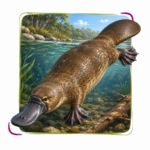
Beaver Fact Highlight
From the full animal facts page
More Animal Comparisons
Pick another animal matchup and keep exploring. Compare appearances, habitats, diets, abilities, and surprising differences.





Make an Animal Story
Turn this platypus vs beaver comparison into an electrosensory-stream and dam-building adventure with our free Animal Story Generator.
Source notes: References used for this comparison. See more See less
Try Another Matchup
Explore this comparison →