
Potoroo vs Bilby for Kids: Forest Hopper and Desert Digger
The Long-nosed Potoroo and Greater Bilby are night-active Australian marsupials with pointed snouts and strong digging claws. The potoroo is a compact forest animal that makes short bounds and searches for fungi beneath leaf litter. The larger bilby has enormous ears and digs deep spiral burrows in dry country.
About Long-nosed Potoroo
- Type Small rat-kangaroo marsupial
- Diet Omnivore with a strong taste for fungi
- Group Potoroo family, Potoroidae
- Known for Digging for underground fungi with a long nose
- Special skill Spreads helpful fungal spores through the forest while foraging
About Greater Bilby
- Type Long-eared burrowing marsupial
- Diet Omnivore
- Group Bilby and bandicoot family, Thylacomyidae
- Known for Huge ears, powerful claws, and deep spiral burrows
- Special skill Excavates deep spiral burrows and gains much of its water from food
Quick Answer
Quick answer: A Long-nosed Potoroo is a small rat-kangaroo relative of dense southeastern forests and heaths. It bounds on enlarged hind feet and often eats underground fungi. A Greater Bilby is a larger desert marsupial with huge ears, a black-and-white tail, and powerful foreclaws for deep burrows. Both are mostly solitary, nocturnal diggers with pouches.
Long-nosed Potoroo vs Greater Bilby: Quick Comparison
| Feature | Long-nosed Potoroo | Greater Bilby |
|---|---|---|
| Scientific name | Potorous tridactylus | Macrotis lagotis |
| Marsupial group | Order Diprotodontia; family Potoroidae | Order Peramelemorphia; family Thylacomyidae |
| Body size | Body about 34 to 38 cm; mass about 0.66 to 1.64 kg | Body about 29 to 55 cm; mass about 0.6 to 2.5 kg |
| Native home | Southeastern Australian mainland and Tasmania | Scattered dry regions of inland Australia |
| Main habitat | Dense forest, woodland, heath, and coastal shrubland | Desert grassland, shrubland, and open dry woodland |
| Movement | Walks on all fours and makes short kangaroo-like bounds | Gallops on four legs and digs quickly with strong forefeet |
| Main food | Especially underground fungi, plus roots, seeds, fruits, and invertebrates | Termites, insect larvae, seeds, fungi, bulbs, and fruit |
| Day shelter | A shallow nest hidden under dense vegetation | A deep spiral burrow that may reach about 2 m below ground |
| Pouch and young | Forward-opening pouch; usually one joey | Rear-opening pouch; usually one or two joeys |
| Best field clue | Long tapering nose and large hopping feet | Huge ears, silky blue-grey fur, and a black-and-white tail |
How Potoroos and Bilbies Are Alike
- Both are Australian marsupials whose tiny newborns continue growing while attached to teats in a pouch.
- Both are mainly nocturnal and rest in a hidden shelter during the day.
- Both use long snouts and strong foreclaws to find food beneath the soil surface.
- Both are omnivores that can eat fungi, seeds, roots, and small invertebrates.
- Both are generally solitary rather than living in permanent herds or packs.
How Potoroos and Bilbies Are Different
- The Long-nosed Potoroo lives in humid, densely covered forest and heath, while the Greater Bilby lives in dry inland country.
- The potoroo moves with short bounds on enlarged hind feet, while the bilby usually gallops on all four feet.
- A bilby can be larger and has enormous ears, while a potoroo has smaller rounded ears and a rat-kangaroo shape.
- The potoroo’s pouch opens forward, while the bilby’s pouch opens backward so digging soil stays out.
- A potoroo rests in a shallow vegetation nest, while a bilby excavates a deep spiraling burrow.
Potoroo vs Bilby Adaptation Showdown
Adaptation showdown: Greater Bilby wins size because the largest adults reach about 2.5 kg and have a longer body than most Long-nosed Potoroos. Speed is a Tie because reliable matched top speeds are not available and their movements suit different ground. Greater Bilby wins strength because its powerful forelimbs and claws excavate deep spiral burrows. Stealth is a Tie because the potoroo hides in dense vegetation while the bilby disappears underground and both move mainly at night. Social behavior is a Tie because both are usually solitary. Swimming is a Tie because neither animal is a water specialist. Greater Bilby wins weirdest for combining a pregnancy of about 14 days, a backward pouch, giant ears, and a corkscrew-like burrow.
Fun Long-nosed Potoroo vs Greater Bilby Facts
A Forest Fungus Gardener
Long-nosed Potoroos dig up underground fungi and later spread fungal spores in their droppings. Those fungi can help tree roots collect water and nutrients.
A Rat-kangaroo Bound
A potoroo usually moves slowly on all four feet but can escape with short bounds powered by enlarged hind feet. It is a small relative of kangaroos, not a rodent.
A Spiral Safe House
A Greater Bilby digs a spiraling burrow that may run about 3 metres long and descend roughly 2 metres. One bilby may use several burrows.
A Pouch Behind the Dirt
A female bilby’s pouch opens toward the rear. That direction helps keep loose soil away from tiny joeys while their mother digs.
A Desert Ecosystem Engineer
Bilbies turn over soil while digging for food and making burrows. Their pits catch water, seeds, leaves, and nutrients that can help desert plants grow.
Potoroo vs Bilby Quiz
- Which animal is especially important for spreading underground fungal spores? Answer: The Long-nosed Potoroo.
- Which animal has enormous ears and a black-and-white tail? Answer: The Greater Bilby.
- How does the bilby’s pouch help during digging? Answer: It opens backward, helping keep soil away from the joeys.
- Where does a potoroo usually spend the day? Answer: In a shallow nest hidden beneath dense vegetation.
- Are potoroos rodents? Answer: No. They are marsupials in the rat-kangaroo family.
Long-nosed Potoroo vs Greater Bilby FAQ
Which animal is bigger, a potoroo or a bilby?
The Greater Bilby has the larger maximum size, although the weights of small individuals can overlap.
Do potoroos and bilbies live together?
Their ranges can be in the same country, but potoroos favor dense, moister cover and bilbies favor arid inland habitats.
Can a bilby hear well?
Yes. Its huge ears collect faint sounds and also help release body heat.
Why are fungi important to potoroos?
Fungi are a major food, and the spores that pass through potoroos help form useful partnerships with plant roots.
Do both animals have pouches?
Yes, but the potoroo’s pouch opens forward and the bilby’s opens backward.
Animal Words to Know
- Arid: Very dry, with little rainfall.
- Fungal spore: A tiny reproductive cell that can grow into a new fungus.
- Marsupial: A mammal whose tiny newborn usually continues developing while attached to a teat, often inside a pouch.
- Nocturnal: Mainly active at night.
- Ecosystem engineer: An animal that changes its surroundings in ways that create or improve habitat for other living things.
Design Two Night-time Shelters
Design Two Night-time Shelters
Draw exactly one adult Long-nosed Potoroo and exactly one adult Greater Bilby at honest relative scale. Design a hidden leaf nest for the potoroo and a twisting cutaway burrow for the bilby. Label the nose, ears, foreclaws, hind feet, tail, pouch direction, food, and habitat clues. Observe wild marsupials from a respectful distance and never enter burrows or handle animals.
Meet Each Animal
Want the full fact file? Here are quick highlights from each animal’s own facts page.
Long-nosed Potoroo Fact Highlight
From the full animal facts page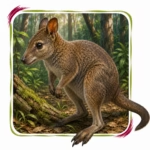
Greater Bilby Fact Highlight
From the full animal facts page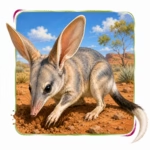
More Animal Comparisons
Pick another animal matchup and keep exploring. Compare appearances, habitats, diets, abilities, and surprising differences.



Make an Animal Story
Send a fungi-finding Potoroo and a big-eared Bilby through a moonlit Australian mystery with our free Animal Story Generator.