
Proboscis Monkey vs François’ Langur: Colobine Monkey Species Comparison
Proboscis Monkeys and langurs are close leaf-monkey relatives, but they are not the same kind of monkey. This page uses François’ Langur, Trachypithecus francoisi, for the broad name langur. The Proboscis Monkey, Nasalis larvatus, is much larger and lives only on Borneo near rivers. It has a huge male nose and swims superbly. François’ Langur is a smaller black monkey of limestone forests in China, Vietnam and Laos.
About Proboscis Monkey
- Type Living
- Diet Herbivore; eats young leaves, shoots, seeds and unripe fruit, with occasional caterpillars or other invertebrates
- Group Large Bornean leaf-eating monkey and only species in genus Nasalis (Nasalis larvatus)
- Known for Huge male nose, orange-brown coat, pale limbs, rounded belly, long tail, loud honks and excellent swimming
- Special skill Uses partly webbed feet to cross rivers and can swim about 20 m underwater
About François’ Langur
- Type Living
- Diet Herbivore and leaf specialist; eats young leaves, shoots, buds, flowers, fruit and bark
- Group Asian leaf monkey and true langur in genus Trachypithecus (Trachypithecus francoisi)
- Known for Glossy black adult coat, white brow and cheek stripes, very long white-tipped tail and bright orange newborns
- Special skill Climbs steep limestone forest and digests tough leaves in a chambered stomach helped by microbes
Proboscis Monkey vs François’ Langur: Quick Answer
A Proboscis Monkey is larger, orange-brown and famous for the adult male’s hanging nose. It lives beside Borneo’s rivers and swims with partly webbed feet. François’ Langur is smaller and mostly black, with pale face stripes and a long white-tipped tail. It climbs limestone forests, and its newborn infants wear bright orange fur.
Where Do They Fit?
Follow the branches to see how Proboscis Monkey and François’ Langur are classified and related.
Proboscis Monkey vs François’ Langur: Quick Comparison
| Feature | Proboscis Monkey | François’ Langur |
|---|---|---|
| Scientific name | Nasalis larvatus | Trachypithecus francoisi |
| Adult mass | Females about 7-12 kg; males about 16-22 kg | About 4-14 kg; males are slightly larger |
| Adult coat | Orange-brown back with grayish limbs and pale underparts | Glossy black or very dark brown with white face stripes |
| Face | Long nose; the adult male’s nose becomes enormous | Short dark face with white brows and cheek whiskers |
| Tail | Long plain tail | Very long black tail, often with a white tip |
| Range | Only the island of Borneo | Southern China, northern Vietnam and west-central Laos |
| Habitat | Mangroves, swamps and river-edge lowland forest | Forested limestone cliffs, caves and tropical valleys |
| Food | Young leaves, shoots, seeds and mostly unripe fruit | Mostly leaves and shoots, plus buds, flowers, fruit and bark |
| Social life | Small groups may gather into larger riverside bands | Small family troops; females may help carry infants |
| Special adaptation | Partly webbed feet and powerful swimming | Chambered stomach for fermenting fibrous leaves |
How Are Proboscis Monkeys and François’ Langurs Alike?
- Both are Asian Old World monkeys in the leaf-monkey subfamily Colobinae.
- Both spend much of their time in trees and use long tails for balance.
- Both have chambered digestive systems that help microbes break down leaves.
- Both eat mainly plants, especially leaves and shoots.
- Both live in social groups and use calls, grooming and body movements to communicate.
How Are Proboscis Monkeys and François’ Langurs Different?
- A male Proboscis Monkey can be much heavier than a François’ Langur.
- Proboscis Monkeys are orange-brown with giant male noses; adult François’ Langurs are black with white face stripes.
- Proboscis Monkeys live only on Borneo, while François’ Langurs live in China, Vietnam and Laos.
- Proboscis Monkeys depend on river and swamp forests; François’ Langurs specialize in limestone forest.
- Proboscis Monkeys are powerful swimmers, while François’ Langurs are best known as agile rock-and-tree climbers.
Proboscis Monkey vs François’ Langur Adaptation Showdown
- Size – Proboscis Monkey: Adult males commonly weigh 16-22 kg, above the François’ Langur’s published 4-14 kg range.
- Speed – Tie: Both move capably through trees, but the selected sources do not provide a fair matched speed test.
- Strength – Proboscis Monkey: Its much larger adult male body gives it more total pulling and pushing power.
- Stealth – François’ Langur: Its dark coat blends into deep forest and limestone shadows, helping the smaller monkey remain hard to spot.
- Social – Proboscis Monkey: Its small groups may join other groups in peaceful riverside bands containing dozens of monkeys.
- Swimming – Proboscis Monkey: It has partly webbed feet, crosses rivers and can travel about 20 m underwater.
- Weirdest – Proboscis Monkey: The adult male’s enormous nose helps deepen and amplify his calls like a living sound chamber.
Fun Proboscis Monkey vs François’ Langur Facts
A Nose That Boosts Sound
An adult male Proboscis Monkey’s large nose adds resonance to his calls, making honks sound deeper and louder.
An Underwater Monkey
Proboscis Monkeys leap from branches into rivers and can swim about 20 m below the surface.
Orange Baby, Black Adult
A François’ Langur is born bright orange, then its coat gradually changes to the dark color worn by adults.
Shared Baby Care
Females in a François’ Langur troop may hold, carry and watch an infant that is not their own.
Leaf-Fermenting Bellies
Both monkeys have complex stomachs where microbes help unlock energy from tough leaves.
Proboscis Monkey vs François’ Langur Quiz
Which monkey lives only on Borneo? A) Proboscis Monkey B) François’ Langur C) Both Answer: A) Proboscis Monkey
Which adult monkey is mostly black with white face stripes? A) Proboscis Monkey B) François’ Langur C) Neither Answer: B) François’ Langur
Which monkey is the stronger swimmer? A) Proboscis Monkey B) François’ Langur C) Neither can swim Answer: A) Proboscis Monkey
What color is a newborn François’ Langur? A) Bright orange B) Blue C) White Answer: A) Bright orange
What food do both monkeys eat often? A) Leaves B) Fish C) Grass only Answer: A) Leaves
Proboscis Monkey vs François’ Langur FAQ
Is a Proboscis Monkey a Langur?
It is a close leaf-monkey relative in subfamily Colobinae, but it belongs to genus Nasalis rather than a langur genus such as Trachypithecus.
Which Langur does this page compare?
It uses François’ Langur. Many other animals are called langurs, and their colors, sizes and ranges differ.
Why is a Proboscis Monkey’s nose so large?
In adult males, the large nose strengthens and deepens calls used in communication.
Can Proboscis Monkeys swim underwater?
Yes. They have partly webbed feet and have been recorded swimming about 20 m underwater.
Why are baby François’ Langurs orange?
The bright coat makes an infant easy for troop members to notice and may encourage females to help care for it.
Animal Words to Know
- Arboreal: Adapted for living or moving in trees.
- Colobine: A member of the leaf-monkey subfamily Colobinae.
- Fermentation: The breakdown of food by microbes inside a digestive chamber.
- Langur: A common name used for several kinds of long-tailed Asian leaf monkeys.
- Resonance: The strengthening or deepening of a sound as it vibrates through a space.
Make a Leaf-Monkey Field Guide
Make a Leaf-Monkey Field Guide
Fold a page in half. Draw a large orange-brown Proboscis Monkey beside a Borneo river, adding its long nose and partly webbed feet. Draw a smaller black François’ Langur on a limestone branch, adding white cheek stripes and a tiny orange infant symbol. List three clues that identify each adult.
Meet Each Animal
Want the full fact file? Here are quick highlights from each animal’s own facts page.
Proboscis Monkey Fact Highlight
From the full animal facts page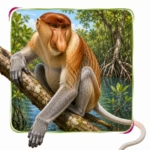
François’ Langur Fact Highlight
From the full animal facts page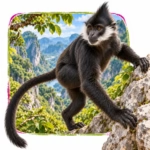
More Animal Comparisons
Pick another animal matchup and keep exploring. Compare appearances, habitats, diets, abilities, and surprising differences.


Make an Animal Story
Create a rainforest story about a swimming Proboscis Monkey and a cliff-climbing François’ Langur!
Source notes: References used for this comparison. See more See less
Try Another Matchup
Explore this comparison →