
Pronghorn vs Deer for Kids
A Pronghorn may be called an antelope, but it is not a true antelope and it is not a deer. It belongs to its own surviving family. A White-Tailed Deer belongs to the deer family. Both are alert, hoofed herbivores with tan-brown coats and white warning patches, yet their headgear, speed, habitat, and escape styles reveal two different North American specialists.
About Pronghorn
- Type Mammal
- Diet Herbivore; forbs, shrubs, sagebrush, grasses, and cactus
- Group Only living member of family Antilocapridae
- Known for Being North America’s fastest land mammal and shedding forked horn sheaths
- Special skill Sprinting near 55-60 mph and keeping high speeds for long distances
About White-Tailed Deer
- Type Mammal
- Diet Herbivore; leaves, buds, twigs, grasses, crops, nuts, and fruit
- Group Deer; family Cervidae
- Known for A white tail flashed as an alarm and branching antlers on adult males
- Special skill Agile bounding through dense vegetation and strong swimming across lakes and streams
Quick Answer
Quick answer: The Pronghorn is smaller, much faster, and built for long runs across open country. Its forked keratin horn sheaths grow over bony cores and fall off each year. The White-Tailed Deer is generally heavier, moves through forests and edges, and the adult male grows branching bone antlers that are shed yearly. Deer also swim strongly, while the Pronghorn relies most famously on speed and far-seeing eyes.
Pronghorn vs White-Tailed Deer: Quick Comparison
| Feature | Pronghorn | White-Tailed Deer |
|---|---|---|
| Scientific identity | Antilocapra americana | Odocoileus virginianus |
| Mammal family | Antilocapridae | Cervidae |
| Published adult mass | About 35-70 kg | About 57-137 kg |
| Headgear | Forked keratin sheaths over bony cores; sheaths shed yearly | Branching bone antlers on adult males; antlers shed yearly |
| Top speed | About 55-60 mph in published sources | About 30 mph in published sources |
| Best-known habitat | Open prairie, sage scrub, basins, and desert | Forest, forest edge, brushland, fields, swamps, and desert scrub |
| Food | Forbs, shrubs, sagebrush, grasses, and cactus | Leaves, buds, twigs, grasses, nuts, fruit, crops, and cactus |
| Alarm signal | Raises the bright white rump patch and releases alarm scent | Raises and waves the white underside of the tail |
| Social pattern | Large winter herds; smaller summer bands and territories | Often solitary in summer; family and bachelor groups occur |
| Escape specialty | Long, sustained running across open ground | Agile bounding through tangled cover and strong swimming |
How Are Pronghorn and White-Tailed Deer Alike?
- Both are hoofed mammals and ruminant herbivores.
- Both have tan-brown coats with bright white areas that can signal danger.
- Both give birth to fawns that hide in vegetation when very young.
- Both use sharp eyesight, hearing, smell, and fast movement to avoid predators.
- Both can form seasonal social groups even though their group patterns change through the year.
How Are Pronghorn and White-Tailed Deer Different?
- The Pronghorn belongs to family Antilocapridae; the White-Tailed Deer belongs to family Cervidae.
- Pronghorn shed keratin horn sheaths from bony cores; deer shed solid bone antlers.
- The Pronghorn can run near 55-60 miles per hour; the deer is documented near 30 miles per hour.
- The Pronghorn favors open western plains and deserts; the deer often uses forests, edges, brush, fields, and swamps.
- Pronghorn raise a white rump patch and alarm scent; deer lift and wave the white underside of the tail.
Pronghorn vs White-Tailed Deer Showdown
Adaptation showdown: White-Tailed Deer wins size because its published adult mass and length ranges extend above the Pronghorn ranges used here. Pronghorn wins speed because sources place its top speed near 55-60 miles per hour, compared with about 30 for the deer. Strength is a Tie because the animals use horns, antlers, and hooves differently and no matched test is available. White-Tailed Deer wins stealth because its coat, hidden fawns, and quiet bedding behavior fit dense vegetation. Pronghorn wins social behavior because its winter herds can reach hundreds or even about 1,000 animals. White-Tailed Deer wins swimming because it is specifically documented crossing large streams and lakes. Pronghorn wins weirdest because it is the only living member of its family and sheds forked horn sheaths each year.
Fun Pronghorn vs White-Tailed Deer Facts
Not a Deer or a True Antelope
The Pronghorn is the only living member of family Antilocapridae. Similar body shapes evolved in true antelopes on other continents, but the two groups are not close enough to share a family.
A Shedding Horn
Pronghorn horns have keratin sheaths over bony cores. A new sheath grows below the old one, and the old outer sheath splits and drops after the breeding season.
Built for Oxygen
Pronghorn have large lungs and circulation adapted for sustained running. Published sources place short sprints near 55-60 miles per hour and long runs near 45 miles per hour.
The White Flag Tail
When a White-Tailed Deer is startled, it raises its tail so the bright white underside flashes. Other deer can see the signal as the animal bounds away.
Water Is an Escape Route
White-Tailed Deer are good swimmers. They may enter large streams and lakes to escape predators or insects and can travel to islands.
Pronghorn vs Deer Quiz
- Is a Pronghorn a kind of deer? Answer: No. It belongs to family Antilocapridae.
- Which animal is faster? Answer: The Pronghorn.
- Which animal is generally heavier in the ranges used here? Answer: The White-Tailed Deer.
- What part of a Pronghorn horn is shed yearly? Answer: The outer keratin sheath.
- How does a White-Tailed Deer give a visual alarm? Answer: It raises and flashes the white underside of its tail.
Pronghorn vs White-Tailed Deer FAQ
Is a Pronghorn an antelope?
No. It resembles true antelopes, but it belongs to a different family found only in North America.
Is a Pronghorn a deer?
No. Pronghorn and deer are different families of hoofed mammals.
Which is faster, a Pronghorn or White-Tailed Deer?
The Pronghorn, with published top speeds near 55-60 miles per hour compared with about 30 for the deer.
Do Pronghorn have antlers?
No. They have horns with keratin sheaths over bony cores, and the sheaths are shed yearly.
Can White-Tailed Deer swim?
Yes. They are good swimmers and may cross streams or lakes.
Animal Words to Know
- Ruminant: A hoofed herbivore with a multi-chambered stomach that chews cud.
- Keratin: The tough protein that forms hair, nails, hooves, and horn sheaths.
- Antler: A branching structure made of bone that is grown and shed.
- Convergent evolution: The separate evolution of similar traits in groups that are not close relatives.
- Fawn: A young deer, Pronghorn, or certain other hoofed mammal.
Sort the Horn, Antler, and Alarm Clues
Sort the Horn, Antler, and Alarm Clues
Draw exactly one adult male Pronghorn and exactly one adult male White-Tailed Deer at honest relative scale, with the deer heavier and the Pronghorn leaner. Make clue cards for forked sheath, branching bone, white rump patch, white tail, open prairie, forest edge, fast endurance, strong swimming, and fawn hiding. Sort them under Pronghorn, Deer, or Both and explain your choices. Observe wildlife from a distance without people handling animals.
Meet Each Animal
Want the full fact file? Here are quick highlights from each animal’s own facts page.
Pronghorn Fact Highlight
From the full animal facts page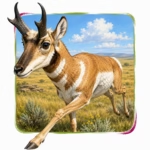
White-Tailed Deer Fact Highlight
From the full animal facts page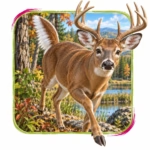
More Animal Comparisons
Pick another animal matchup and keep exploring. Compare appearances, habitats, diets, abilities, and surprising differences.





Make an Animal Story
Send a racing Pronghorn and a forest-bounding White-Tailed Deer into a clue-filled adventure with our free Animal Story Generator.