
Pronghorn vs Thomson’s Gazelle: Grassland Runner Comparison
Pronghorn and Thomson’s Gazelles look like long-legged grassland cousins, but the resemblance is an example of convergent evolution. Pronghorn belong to a North American family with only one living species. Thomson’s Gazelles are true antelopes in the cattle family and live in East Africa. Both survive open country with speed, sharp senses, and visible alarm signals.
About Pronghorn
- Type Mammal
- Diet Herbivore; forbs, shrubs, sagebrush, grasses, and cactus
- Group Only living member of family Antilocapridae
- Known for Being North America’s fastest land mammal and shedding forked horn sheaths
- Special skill Sprinting near 55-60 mph and keeping high speeds for long distances
About Thomson’s Gazelle
- Type Mammal
- Diet Herbivore; mainly short grasses plus leaves, twigs, and seeds in dry times
- Group True antelope; family Bovidae
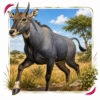
- Known for A bold black side stripe, fast turns, and stiff-legged alarm leaps called stotting
- Special skill Running near 70 km/h and stotting with high, stiff-legged leaps when alarmed
Pronghorn vs Thomson’s Gazelle: Quick Answer
The Pronghorn is larger and faster in the matched figures used here, reaching about 35-70 kilograms and roughly 55-60 miles per hour. Thomson’s Gazelles weigh about 15-35 kilograms and can reach about 70 kilometers per hour, or 43 miles per hour, in the university source. Pronghorn shed forked horn sheaths yearly; gazelles keep ringed, backward-curving horns. The gazelle’s signature alarm display is a stiff-legged leap called stotting.
Where Do They Fit?
Follow the branches to see how Pronghorn and Thomson’s Gazelle are classified and related.
Pronghorn vs Thomson’s Gazelle: Quick Comparison
| Feature | Pronghorn | Thomson’s Gazelle |
|---|---|---|
| Scientific identity | Antilocapra americana | Eudorcas thomsonii |
| Mammal family | Antilocapridae | Bovidae |
| Native region | Western North America | East Africa, especially Kenya and Tanzania |
| Published adult mass | About 35-70 kg | About 15-35 kg |
| Published top speed | About 55-60 mph in the sources used here | About 70 km/h or 43 mph in the university source |
| Coat clue | Tawny coat with white belly, neck patches, and rump | Reddish-tan back, white belly, bold black side stripe, and white rump |
| Horns | Forked keratin sheaths over bony cores; sheaths shed yearly | Ringed permanent horns curve back; strongest in males |
| Best-known habitat | Prairie, sage scrub, open basin, and desert | Dry short-grass plains and shrubby savanna |
| Social pattern | Large winter herds and smaller summer groups | Fluid herds of 5-60, temporary hundreds, and mixed-species groups |
| Alarm specialty | White rump fur rises and scent warns the herd | Stotting uses repeated high jumps with stiff legs |
How Are Pronghorn and Thomson’s Gazelles Alike?
- Both are hoofed, ruminant mammals that eat plants.
- Both live mainly in open grassland or dry scrub habitats.
- Both have tawny coats with white underparts and rump markings.
- Both rely on speed, alert senses, and herd signals to avoid predators.
- Both can form large, shifting social groups and give birth to young that hide at first.
How Are Pronghorn and Thomson’s Gazelles Different?
- The Pronghorn belongs to Antilocapridae in North America; the gazelle is a true antelope in Bovidae from East Africa.
- The Pronghorn is generally heavier in the published adult ranges used here.
- The Pronghorn reaches a higher published top speed in the sources used for this comparison.
- Pronghorn shed their forked horn sheaths yearly; Thomson’s Gazelles keep ringed horns that curve backward.
- Pronghorn raise white rump fur and release alarm scent; Thomson’s Gazelles perform high stiff-legged jumps called stotting.
Pronghorn vs Thomson’s Gazelle Showdown
Adaptation showdown: Pronghorn wins size because its 35-70-kilogram published range is above the gazelle’s 15-35-kilogram range. Pronghorn wins speed because sources used here place it near 55-60 miles per hour, above the gazelle’s 70 kilometers per hour, or about 43 miles per hour. Strength is a Tie because their hoof and horn adaptations have no fair matched test. Stealth is a Tie because both use tawny camouflage but depend heavily on early detection and flight. Social behavior is a Tie because both form changing herds that can reach hundreds, with different seasonal and mixed-species patterns. Swimming is a Tie because neither animal is presented by these sources as a water specialist. Pronghorn wins weirdest for being the only living member of its family and shedding a forked horn sheath each year.
Fun Pronghorn vs Thomson’s Gazelle Facts
Look-Alikes by Evolution
Pronghorn and true antelopes evolved similar slim legs, tan coats, white markings, and speed because open grasslands reward many of the same traits. This is convergent evolution, not close family membership.
The Fast North American
Pronghorn are North America’s fastest land mammals. Their large lungs, efficient circulation, light lower legs, and cushioned hooves help support both sprinting and endurance.
A Black Side Stripe
The Thomson’s Gazelle has a reddish-tan back and white belly divided by a bold black stripe along each side. The stripe is one of the quickest visual clues for identification.
A Leap Called Stotting
An alarmed Thomson’s Gazelle may make repeated high jumps while holding its legs stiff and head high. This visual signal is called stotting.
Two Kinds of Horn Story
Pronghorn grow forked keratin sheaths and drop the sheaths yearly. Thomson’s Gazelles keep ringed horns that curve backward and then forward near the tips in adult males.
Pronghorn vs Gazelle Quiz
- On which continent does the Pronghorn live naturally? Answer: North America.
- On which continent does the Thomson’s Gazelle live? Answer: Africa.
- Which animal is a true antelope? Answer: The Thomson’s Gazelle.
- What is stotting? Answer: A series of high, stiff-legged alarm jumps.
- Which animal sheds the outer sheath of its horns each year? Answer: The Pronghorn.
Pronghorn vs Thomson’s Gazelle FAQ
Is a Pronghorn a gazelle?
No. A Pronghorn is the only living member of Antilocapridae, while a Thomson’s Gazelle is a true antelope in Bovidae.
Which is faster, a Pronghorn or Thomson’s Gazelle?
The Pronghorn in the published figures used here, with roughly 55-60 miles per hour compared with about 43 for the gazelle.
Which is bigger?
The Pronghorn is generally heavier, with a published range of about 35-70 kilograms compared with 15-35 for the gazelle.
Do both animals have horns?
Yes, but Pronghorn shed forked outer sheaths yearly, while Thomson’s Gazelles keep ringed curved horns.
Why do Thomson’s Gazelles stot?
Stotting is a visual alarm display of repeated high jumps that can communicate danger.
Animal Words to Know
- Antelope: A varied group of hoofed mammals in the cattle family, Bovidae.
- Convergent evolution: The separate evolution of similar traits in unrelated groups facing similar conditions.
- Stotting: Repeated high jumps made with the legs held stiff.
- Horn sheath: A tough keratin covering that grows over a bony horn core.
- Savanna: A tropical or subtropical grassland with scattered trees or shrubs.
Map Two Grassland Speed Specialists
Map Two Grassland Speed Specialists
Draw exactly one adult male Pronghorn on a North American prairie and exactly one adult male Thomson’s Gazelle on an East African short-grass plain at honest relative scale, with the Pronghorn larger. Add clue cards for forked shedding sheath, ringed curved horn, white rump flare, black side stripe, sustained sprint, stotting, winter herd, and mixed-species herd. Sort and explain each clue. Observe wildlife from a distance without people handling animals.
Meet Each Animal
Want the full fact file? Here are quick highlights from each animal’s own facts page.
Pronghorn Fact Highlight
From the full animal facts page
Thomson’s Gazelle Fact Highlight
From the full animal facts page
More Animal Comparisons
Pick another animal matchup and keep exploring. Compare appearances, habitats, diets, abilities, and surprising differences.





Make an Animal Story
Send a long-distance Pronghorn and a stotting Thomson’s Gazelle into a grassland mystery with our free Animal Story Generator.
Source notes: References used for this comparison. See more See less
Try Another Matchup
Explore this comparison →