
Quokka vs Wallaby: Living Australian Macropod Species Comparison
A quokka and a red-necked wallaby are plant-eating marsupials in the kangaroo family Macropodidae. Both hop on strong hind legs, carry a joey in a forward-opening pouch, and use smaller forepaws to handle food. The quokka is a compact short-tailed specialist of southwestern Western Australia. The red-necked wallaby is several times heavier, has a much longer balancing tail, and ranges through eastern forests, woodlands, scrub, and grassy edges. Wallaby is an informal size-based name, not one single scientific group.
About Quokka
- Type Mammal
- Diet Herbivore and browser; leaves, stems, grasses, sedges, bark, and succulent plants, with the menu changing between islands and mainland habitats
- Group Quokka (Setonix brachyurus; Family Macropodidae)
- Known for Small compact macropod with rounded head, short broad face, small rounded ears, thick grizzled brown-gray fur, strong hind legs, small forepaws, large dark nose, and a relatively short sparsely furred tail
- Special skill Moving through dense low cover with a compact body, surviving dry island periods with moisture-rich foods, and using powerful hind legs for hopping and scrambling
About Wallaby
- Type Mammal
- Diet Herbivore that grazes grasses and herbs and browses leaves, shrubs, roots, and other vegetation depending on season and location
- Group Red-necked Wallaby (Notamacropus rufogriseus; Family Macropodidae; older sources Macropus rufogriseus)
- Known for Medium-sized macropod with gray-brown body, reddish neck and shoulders, pale underside, dark muzzle and paw tips, upright ears, muscular hind legs, smaller forelimbs, and a long thick balancing tail
- Special skill Covering open ground with long energy-saving hops while the large feet, elastic tendons, muscular tail, and upright senses support speed and balance
Quokka vs Wallaby: Quick Answer
A quokka is a very small, compact macropod from southwestern Western Australia, famous for its rounded face and relatively short tail. For a fair comparison, this page uses the red-necked wallaby, a much larger eastern Australian species with a reddish neck, long powerful legs, and a long balancing tail. Both are herbivorous marsupials, carry joeys in pouches, and belong to the same kangaroo family.
Where Do They Fit?
Follow the branches to see how Quokka and Wallaby are classified and related.
Quokka vs Wallaby: Quick Comparison
| Feature | Quokka | Red-necked Wallaby |
|---|---|---|
| Scientific name | Setonix brachyurus | Notamacropus rufogriseus |
| Macropod size | Small and compact, commonly about 2.5–5 kg | Medium-sized, commonly about 11–27 kg depending on sex and region |
| Tail | Relatively short and sparsely furred | Long, thick, and important for balance |
| Face and ears | Broad short face and small rounded ears | Longer muzzle and taller upright ears |
| Native range | Southwestern Western Australia | Eastern and southeastern Australia and Tasmania |
| Habitat | Dense thickets, heath, forest, swamp edges, and island scrub | Forest, woodland, scrub, heath, and grassy edges |
| Food | Browses leaves, stems, grasses, sedges, bark, and succulents | Grazes grass and herbs and browses varied vegetation |
| Social pattern | Loose gatherings can form around key resources | Usually solitary or loosely associated while feeding |
| Young | One joey usually develops in the pouch | One joey usually develops in the pouch |
| Main movement advantage | Compact hopping and scrambling in dense cover | Long fast hops across clearings and open ground |
How Are Quokkas and Wallabies Alike?
- Both are marsupials in Macropodidae, the family containing kangaroos and their smaller relatives.
- Both have large hind legs, elongated feet, smaller forepaws, and a hopping style powered by elastic tendons.
- Both are herbivores that browse or graze and use a chambered stomach with microbes to ferment fibrous plants.
- Both carry a tiny newborn joey in a forward-opening pouch and continue nursing it after it begins exploring outside.
- Both are most active from late afternoon through night or early morning and use vegetation as shelter.
How Are Quokkas and Wallabies Different?
- A red-necked wallaby is several times heavier and taller than a quokka.
- The wallaby has a long thick balancing tail; the quokka’s scientific name brachyurus means short-tailed.
- Quokkas are native only to southwestern Western Australia, while red-necked wallabies are native to eastern and southeastern Australia and Tasmania.
- A quokka has a rounder head, smaller rounded ears, and short broad face; a red-necked wallaby has taller ears and a longer muzzle.
- Quokkas often stay close to dense wet cover or island shelter; red-necked wallabies commonly rest in forest and emerge to feed along grassy edges.
- Red-necked wallabies are built for longer, faster hops across open ground, while quokkas maneuver through low tangled vegetation.
Quokka vs Wallaby Adaptation Showdown
Macropod adaptation showdown: Red-necked wallaby wins size, speed, and strength through its much larger body, long feet, and powerful open-ground hops. Quokka wins stealth and social flexibility because its compact build disappears into dense cover and island animals often tolerate loose gatherings around resources. Swimming is a tie because both can cross water but neither is aquatic. Quokka wins weirdest fact because its famous smile is a resting facial shape, not proof of a human-like mood. These categories compare survival adaptations, not combat.
Fun Quokka vs Wallaby Facts
A Quokka Is Already a Kind of Wallaby Relative
Wallaby is an informal name usually applied to smaller members of the kangaroo family, not a single branch with one defining scientific boundary. The quokka was once called the short-tailed scrub wallaby and shares Macropodidae with red-necked wallabies. This comparison therefore contrasts two species and body plans, not two completely separate animal categories.
A Quokka Smile Does Not Prove Happiness
The quokka’s short muzzle, rounded cheeks, dark eyes, and slightly upturned mouth can look like a human smile in photographs. That expression is part of its normal face and can appear in many situations. Scientists judge welfare from posture, movement, feeding, health, and context rather than one smile-shaped snapshot.
Quokkas Do Not Live Only on Rottnest Island
Rottnest Island supports the best-known large quokka population, and Bald Island has another important island population. Smaller fragmented groups also survive on the southwestern Australian mainland in dense forest and wetland refuges. Protecting those mainland habitats matters even when tourists rarely see their residents.
A Joey Can Pause Before Birth
Quokkas and many wallabies can use embryonic diapause. After mating, a microscopic embryo may pause development while another joey occupies the pouch or conditions are unsuitable. Hormonal changes later restart growth. The pause helps a mother time an energy-demanding pregnancy and pouch life to her own condition and environment.
A Long Tail Is a Moving Support
During fast hopping, a red-necked wallaby’s tail balances the body but usually does not push against the ground. During slow five-limbed movement, the tail braces like a powerful supporting limb while the hind feet swing forward. A quokka uses the same basic macropod system with a proportionally much shorter tail.
Quokka vs Wallaby Quiz
- Which species is much larger? Answer: The red-necked wallaby.
- Where are quokkas native? Answer: Southwestern Western Australia.
- What does a macropod mother carry in her pouch? Answer: A joey.
- Does a quokka’s smile-shaped face prove that it feels happy? Answer: No; behavior and context are needed.
- What does wallaby mean scientifically? Answer: It is an informal name for various smaller macropods, not one single taxonomic group.
Quokka vs Wallaby FAQ
Is a quokka a wallaby?
A quokka is a small macropod and was historically called a short-tailed scrub wallaby. Wallaby is an informal size-based name rather than one exact taxonomic group.
Which wallaby does this page compare?
It uses the red-necked wallaby, Notamacropus rufogriseus, a distinct and much larger species from eastern and southeastern Australia and Tasmania.
Which is bigger, a quokka or red-necked wallaby?
The red-necked wallaby is several times heavier and has substantially longer legs and tail.
Are quokkas always smiling and friendly?
Their face can look smile-shaped, but that does not reveal emotion or make a wild quokka safe to touch or feed.
Do quokkas live anywhere besides Rottnest Island?
Yes. They also live on Bald Island and in small fragmented mainland populations in southwestern Western Australia.
Animal Words to Know
- Macropod: A member of the kangaroo family, a name meaning large foot.
- Wallaby: An informal name for various macropods generally smaller than animals called kangaroos.
- Joey: A young marsupial.
- Browser: A plant eater that selects leaves, shoots, stems, and shrubs.
- Embryonic diapause: A temporary pause in the development of a very early embryo.
Quokka and Wallaby Map Activity
Quokka and Wallaby Map Activity
Draw a simple map of Australia. Place a small quokka in southwestern Western Australia and a much larger red-necked wallaby in eastern Australia and Tasmania. Give the quokka a short broad face and rounded ears; give the wallaby longer ears, a longer muzzle, and a long powerful tail. Label macropod, pouch, joey, island, forest, and grassland.
Meet Each Animal
Want the full fact file? Here are quick highlights from each animal’s own facts page.
Quokka Fact Highlight
From the full animal facts page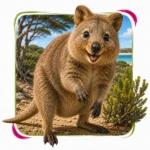
Wallaby Fact Highlight
From the full animal facts page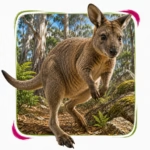
More Animal Comparisons
Pick another animal matchup and keep exploring. Compare appearances, habitats, diets, abilities, and surprising differences.



Make an Animal Story
Turn this quokka vs wallaby comparison into an island-and-forest hopping adventure with our free Animal Story Generator.
Source notes: References used for this comparison. See more See less
Try Another Matchup
Explore this comparison →