
Raccoon vs Skunk for Kids
Raccoons and striped skunks are stocky, adaptable North American mammals that often begin searching for food around twilight. Both are omnivores, use dens, dig or pry for food, and can live near farms, suburbs, and cities. Their markings and special skills are very different. A raccoon has a dark eye mask, ringed tail, agile climbing feet, and sensitive hand-like forepaws. A striped skunk has bold warning stripes, long digging claws, and enlarged scent glands that can spray a powerful musk after stomping and raising the tail.
About Raccoon
- Type Mammal
- Diet Omnivore
- Group Raccoon; family Procyonidae
- Known for A dark face mask, ringed tail, sensitive five-fingered forepaws, climbing, and curiosity
- Special skill Using highly sensitive forepaws to feel, grasp, pry, climb, and handle food
About Striped Skunk
- Type Mammal
- Diet Omnivore; mainly animal food
- Group Skunk; family Mephitidae
- Known for Black-and-white warning colors, a raised tail, foot stomps, and defensive spray
- Special skill Aiming powerful scent-gland spray after giving warning displays
Quick Answer
Quick answer: The raccoon is generally larger, with a published mass of about 1.8-10.4 kilograms compared with about 0.7-6.3 kilograms for the striped skunk. Raccoons are agile climbers, strong swimmers, and dexterous food handlers. Striped skunks are strong diggers with warning colors and defensive spray that can travel up to 6 metres. Both are nocturnal omnivores that use many habitats and usually live alone, though mothers care for young and skunks may share winter dens.
Raccoon vs Striped Skunk: Quick Comparison
| Feature | Raccoon | Striped Skunk |
|---|---|---|
| Scientific identity | Procyon lotor | Mephitis mephitis |
| Animal family | Procyonidae | Mephitidae |
| Published adult length | About 60.3-95 cm, including a long ringed tail | About 46.5-81.5 cm, including a bushy tail |
| Published adult mass | About 1.8-10.4 kg; some sources give higher regional figures | About 0.7-6.3 kg |
| Adult appearance | Gray-brown stocky body, dark eye mask, ringed tail | Black body, bold white V-shaped stripes, bushy tail |
| Front feet | Sensitive, flexible five-toed paws for grasping and prying | Stout five-toed feet with long foreclaws for digging |
| Main habitat | Especially moist woods and places near water; also farms and cities | Open woods, grasslands, farms, suburbs, cities, and areas near water |
| Movement | Agile climber, ground speed up to about 24 km/h, strong swimmer | Ground forager and digger; swimming is uncommon |
| Social life | Mainly solitary except a mother with cubs | Mainly solitary, but several may share a winter den |
| Memorable defense | Climbs, hides, uses alert senses, and may defend itself | Stomps, arches, raises the tail, and may release aimed musk |
How Are Raccoons and Striped Skunks Alike?
- Both are North American mammals in order Carnivora even though both eat plant and animal foods.
- Both are mostly nocturnal and begin much of their activity around dusk.
- Both live in woodlands, farms, suburbs, cities, and other landscapes changed by people.
- Both use dens in hollow trees, burrows, brush piles, rocks, or spaces under buildings.
- Both have five toes, strong senses, flexible diets, and mothers that protect and teach their young.
How Are Raccoons and Striped Skunks Different?
- A raccoon belongs to family Procyonidae, while a striped skunk belongs to family Mephitidae.
- The raccoon wears a dark eye mask and ringed tail, while the skunk has bold white warning stripes on black fur.
- Raccoons use highly sensitive flexible forepaws for handling and climbing, while skunks use long foreclaws mainly for digging.
- Raccoons are agile climbers and strong swimmers, while striped skunks swim only uncommonly.
- Raccoons usually escape or defend themselves with teeth and claws, while skunks warn with stomps and posture before aiming scent-gland spray.
Raccoon vs Striped Skunk Showdown
Adaptation showdown: Raccoon wins size because its published length and mass ranges generally extend above the striped skunk’s. Speed is a Tie because the raccoon has a published ground figure but the cited sources do not provide a matched skunk sprint. Raccoon wins whole-body strength for its larger average build, agile climbing, and powerful grasping and prying; this is not a fight prediction. Stealth is a Tie because both are nighttime foragers without a matched concealment test. Striped Skunk wins social behavior narrowly because several may share a winter den, while the raccoon’s main group is a mother with young. Raccoon wins swimming because it is described as a strong swimmer, whereas swimming is uncommon for the skunk. Striped Skunk wins weirdest for a warning sequence that can end in accurately aimed scent spray traveling up to 6 metres.
Fun Raccoon vs Striped Skunk Facts
Forepaws Packed With Touch
Raccoon forepaws are unusually sensitive and flexible. Five long toes help a raccoon pick up food, feel surfaces, pry at objects, and climb, while excellent hearing and night vision add more information.
Climber and Strong Swimmer
Raccoons climb with great agility and can swim strongly, even though their fur is not waterproof. Animal Diversity Web also reports a ground speed of up to 15 miles per hour.
Mask and Rings Make an ID
The dark face mask and bushy ringed tail are the easiest raccoon clues. San Diego Zoo notes five to seven complete dark rings, while other references describe broader regional variation.
Spray Can Travel 6 Metres
Enlarged scent glands hold a powerful yellowish musk that a threatened striped skunk can aim. BioKIDS reports that the spray may travel up to 6 metres and can cause intense irritation.
Warnings Come Before the Spray
A striped skunk usually gives signals first: it may stomp, arch its back, raise its tail, hiss, or briefly balance in a handstand-like pose. After weaning, young skunks follow their mother in single file to learn foraging.
Raccoon vs Striped Skunk Quiz
- Which animal has a dark face mask and ringed tail? Answer: The raccoon.
- Which animal has bold white warning stripes? Answer: The striped skunk.
- Which is the stronger swimmer? Answer: The raccoon.
- How far may striped skunk spray travel? Answer: Up to about 6 metres.
- Why can a skunk win the social category? Answer: Several skunks may share a winter den.
Raccoon vs Striped Skunk FAQ
Which is bigger, a raccoon or skunk?
The raccoon is generally larger. Published figures extend to about 10.4 kilograms for raccoons and about 6.3 kilograms for striped skunks, though size varies by region and season.
Do raccoons really wash food?
Raccoons often handle food in or near water, and their scientific name includes a word meaning washer. They do not need to wash every item before eating it.
Do skunks spray without warning?
Usually a striped skunk warns first by stomping, arching, raising its tail, or hissing. Sudden surprises can still trigger a fast response, so wild skunks need space.
Can raccoons and skunks swim?
Both can swim, but the comparison favors the raccoon because it is described as a strong swimmer. San Diego Zoo calls swimming uncommon for striped skunks.
Are raccoons and skunks good pets?
They are wild animals with specialized needs and can carry diseases. Observe them from a safe distance and never feed, touch, or corner them.
Animal Words to Know
- Nocturnal: Most active during the night.
- Omnivore: An animal that eats both plant and animal foods.
- Dexterous: Skillful at using the paws or hands to handle objects.
- Warning coloration: Bold colors or patterns that signal an animal has a strong defense.
- Communal den: A shelter shared by several animals.
Make a Nighttime Adaptation Board
Make a Nighttime Adaptation Board
Draw one adult raccoon and one adult striped skunk at honest relative scale in one woodland-edge scene. Add close-up panels for mask, tail rings, flexible five-toed paw, long digging claw, white V stripe, raised-tail warning, tree den, underground den, swimming route, and winter den group. Sort the cards under Raccoon, Skunk, or Both, then explain why the skunk’s warning sequence helps it avoid using spray.
Meet Each Animal
Want the full fact file? Here are quick highlights from each animal’s own facts page.
Raccoon Fact Highlight
From the full animal facts page
Striped Skunk Fact Highlight
From the full animal facts page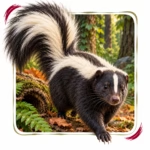
More Animal Comparisons
Pick another animal matchup and keep exploring. Compare appearances, habitats, diets, abilities, and surprising differences.





Make an Animal Story
Send a clever raccoon and a warning-striped skunk into a moonlit mystery with our free Animal Story Generator.