
Red Deer vs Reeves’s Muntjac: Deer Comparison
Red Deer and Reeves’s Muntjac belong to the same deer family, but their scale and lifestyles are strikingly different. A Red Deer stag can tower over a tiny muntjac and carry a wide rack of branching antlers. A male muntjac has short antlers, long facial ridges, tusk-like upper canines, and a bark that sounds like a dog.
About Red Deer
- Type Hoofed mammal
- Diet Herbivore
- Group Deer family, Cervidae
- Known for Large size, branching stag antlers, and autumn rutting roars
- Special skill Grows and sheds a large branching set of antlers each year
About Reeves’s Muntjac
- Type Hoofed mammal
- Diet Mostly herbivore and opportunistic omnivore
- Group Deer family, Cervidae
- Known for Dog-like barks, tiny size, short antlers, and tusk-like canines
- Special skill Barks loudly and uses long upper canine teeth in territorial contests
Red Deer vs Reeves’s Muntjac: Quick Answer
Red Deer are much larger, stronger, and more social, with stags carrying large branching antlers. Reeves’s Muntjac are small, secretive, mostly solitary woodland deer. Males have short antlers and long upper canine teeth, and both sexes can make repeated dog-like barks.
Where Do They Fit?
Follow the branches to see how Red Deer and Reeves’s Muntjac are classified and related.
Red Deer vs Reeves’s Muntjac: Quick Comparison
| Feature | Red Deer | Reeves’s Muntjac |
|---|---|---|
| Scientific name | Cervus elaphus | Muntiacus reevesi |
| Native range | Europe, western Asia, and North Africa | Southeastern China and Taiwan |
| Shoulder height | UK stags about 107 to 137 cm | About 43 to 52 cm |
| Weight | UK stags about 90 to 190 kg | Roughly 10 to 28 kg across cited ranges |
| Male headgear | Large, branching antlers | Short antlers plus long upper canine teeth |
| Coat | Reddish in summer and browner in winter, with a pale rump | Chestnut to ginger-brown with facial stripes and a white tail underside |
| Main sounds | Deep roaring during the autumn rut | Sharp, repeated dog-like barking |
| Social life | Often gathers in herds | Usually solitary and territorial |
| Breeding season | A distinct autumn rut, usually followed by one spring calf | Can breed throughout the year, usually producing one kid |
| Habitat style | Woodland and broad open habitats | Dense cover, scrub, parks, gardens, and woodland edges |
How Red Deer and Muntjac Are Alike
- Both are hoofed mammals in the deer family Cervidae.
- Both are mostly plant eaters that browse leaves, shoots, herbs, and other vegetation.
- Males of both species grow antlers and shed them before growing replacements.
- Both use scent and calls to communicate with other deer.
- Both usually give birth to a single spotted young deer.
How Red Deer and Muntjac Are Different
- A Red Deer stag may weigh well over ten times as much as a Reeves’s Muntjac.
- Red Deer stags have large branching antlers, while male muntjac have short antlers and protruding upper canine teeth.
- Red Deer often live in herds, while Reeves’s Muntjac are usually solitary and territorial.
- Red Deer have a seasonal autumn rut, while Reeves’s Muntjac can breed at any time of year.
- A stag roars during the rut, while a muntjac is famous for a sharp dog-like bark.
Red Deer vs Muntjac Adaptation Showdown
Adaptation showdown: Red Deer wins size because a UK stag can stand 107 to 137 cm at the shoulder and weigh 90 to 190 kg, far beyond the muntjac. Speed is a Tie because the sources do not offer a fair matched running test. Red Deer wins strength because its much larger body and great branching antlers power demanding rut displays. Reeves’s Muntjac wins stealth because its small body and solitary habits suit dense woodland cover. Red Deer wins social behavior because it commonly forms herds, unlike the territorial muntjac. Swimming is a Tie because both can cross water but neither is a specialist swimmer. Reeves’s Muntjac wins weirdest for combining dog-like barks, tiny antlers, tusk-like upper canines, and year-round breeding.
Fun Red Deer vs Reeves’s Muntjac Facts
A Huge Size Gap
British Deer Society figures place a UK Red Deer stag at roughly 90 to 190 kilograms and 107 to 137 centimetres at the shoulder. Reeves’s Muntjac may be only 10 to 28 kilograms and around half a metre tall.
Antlers Plus Tusks
A male Reeves’s Muntjac has short antlers on long bony bases and upper canine teeth that project like small tusks. The teeth are used in close territorial contests.
The Barking Deer
Reeves’s Muntjac can give loud, repeated barks that sound surprisingly dog-like. Barks may warn of disturbance or advertise the deer’s presence.
Antlers Rebuilt Yearly
A Red Deer stag grows a new set of antlers under soft velvet skin, rubs the velvet away when growth is complete, and later sheds the antlers. The cycle repeats each year.
No Fixed Muntjac Rut
Unlike Red Deer with a distinct autumn rut, Reeves’s Muntjac can breed in every month. A female usually has one young after a pregnancy lasting about seven months.
Red Deer vs Muntjac Quiz
- Which deer is much larger? Answer: The Red Deer.
- Which deer makes a dog-like bark? Answer: Reeves’s Muntjac.
- What extra feature does a male muntjac have besides antlers? Answer: Long upper canine teeth that look like small tusks.
- Which deer often gathers in herds? Answer: The Red Deer.
- When can Reeves’s Muntjac breed? Answer: At any time of year.
Red Deer vs Reeves’s Muntjac FAQ
Is a muntjac really a deer?
Yes. Reeves’s Muntjac is a small member of the deer family Cervidae.
Which is bigger, a Red Deer or a muntjac?
A Red Deer is far bigger. A large stag may weigh more than ten muntjac.
Why does a muntjac have tusks?
The projecting upper canine teeth help males in close contests and displays.
Do female Red Deer have antlers?
Female Red Deer, called hinds, normally do not grow antlers. Adult stags carry them.
Are Reeves’s Muntjac native to Britain?
No. They are native to southeastern China and Taiwan and were introduced to Britain.
Animal Words to Know
- Antler: A branching bone structure that is grown and shed, usually every year.
- Canine tooth: A pointed tooth; in male muntjac the upper canines project like tusks.
- Rut: The breeding season when male deer display and compete.
- Territorial: Defending an area against others of the same species.
- Browse: Leaves, shoots, twigs, and other plant parts eaten by herbivores.
Measure the Deer Size Gap
Measure the Deer Size Gap
Use removable tape or chalk to mark a 137-centimetre Red Deer shoulder height and a 50-centimetre Reeves’s Muntjac shoulder height. Draw exactly one adult male of each species at honest relative scale, adding branching stag antlers and short muntjac antlers with visible canine teeth. Compare silhouettes without approaching, feeding, or handling wild deer.
Meet Each Animal
Want the full fact file? Here are quick highlights from each animal’s own facts page.
Red Deer Fact Highlight
From the full animal facts page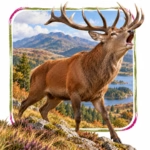
Reeves’s Muntjac Fact Highlight
From the full animal facts page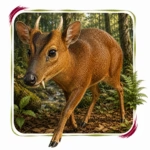
More Animal Comparisons
Pick another animal matchup and keep exploring. Compare appearances, habitats, diets, abilities, and surprising differences.

Make an Animal Story
Lead a mighty Red Deer and a barking little Muntjac into a woodland puzzle with our free Animal Story Generator.
Source notes: References used for this comparison. See more See less
Try Another Matchup
Explore this comparison →