
Red Squirrel vs Grey Squirrel: Red and Grey Tree Squirrel Comparison
The red squirrel in this comparison is the Eurasian Red Squirrel, Sciurus vulgaris. The grey is the larger Eastern Gray Squirrel, Sciurus carolinensis, a North American species introduced to Britain and parts of continental Europe. Color alone can fool you: red squirrels may look dark, and grey squirrels can show reddish patches. Size, ear tufts and the tail’s pattern give better clues when used together.
About Eurasian Red Squirrel
- Type Living
- Diet Omnivore; mostly seeds, nuts, fungi and plant foods
- Group Eurasian tree squirrel species (Sciurus vulgaris)
- Known for Small body, variable reddish-to-dark coat, winter ear tufts and a fluffy single-colored tail
- Special skill Moves lightly through narrow branches and sometimes stores fungi in trees for later meals
About Eastern Gray Squirrel
- Type Living
- Diet Omnivore; mostly nuts, seeds, buds, fungi and plant foods
- Group North American tree squirrel species (Sciurus carolinensis)
- Known for Large body, grizzled gray coat, white-fringed tail and success in parks and broadleaf woodland
- Special skill Rotates its hind feet backward to descend trunks headfirst and hides many separate food caches
Eurasian Red Squirrel vs Eastern Gray Squirrel: Quick Answer
The Eurasian Red Squirrel is usually smaller and lighter. It often grows long ear tufts in winter and has a fluffy tail that looks mostly one color. The Eastern Gray Squirrel is larger and lacks the red species’ long seasonal ear tufts. Its mixed gray tail often has a pale or silvery outer fringe. Both build leafy nests called dreys and hide food for later.
Where Do They Fit?
Follow the branches to see how Eurasian Red Squirrel and Eastern Gray Squirrel are classified and related.
Eurasian Red Squirrel vs Eastern Gray Squirrel: Quick Comparison
| Feature | Eurasian Red Squirrel | Eastern Gray Squirrel |
|---|---|---|
| Scientific name | Sciurus vulgaris | Sciurus carolinensis |
| Native range | Europe and northern Asia | Eastern and central North America |
| Typical adult mass | Often about 250-350 g in Britain, with regional variation | Often about 340-750 g |
| Coat clue | Can be red, brown, grayish or almost black, usually with a pale belly | Usually grizzled gray with a pale belly, but may show brown, red, black or white forms |
| Ear clue | Long ear tufts are especially noticeable in winter | No long seasonal ear tufts |
| Tail clue | Fluffy tail usually looks fairly even in color | Broad mixed-color tail often edged by a silvery-white halo |
| Favorite woodland | Coniferous, mixed and deciduous forest | Mature broadleaf and mixed forest with oaks, beeches, hickories or walnuts |
| Food storage | Buries nuts and seeds and may wedge fungi in trees | Scatter-hoards many nuts and seeds in separate ground caches |
| Nest | Leaf-and-twig drey or a tree cavity | Leaf-and-twig drey or a tree cavity |
| Britain clue | Native but now restricted mainly to Scotland, northern England, islands and a few protected areas | Introduced and widespread across most of Britain |
How Are Red and Grey Squirrels Alike?
- Both are tree squirrels in the genus Sciurus.
- Both have sharp curved claws, flexible ankles and long tails for balancing in trees.
- Both eat mostly seeds, nuts, buds, fungi and other plant foods, with occasional animal food.
- Both build round twig-and-leaf nests called dreys and may also use tree holes.
- Both stay active through winter instead of truly hibernating.
How Are Red and Grey Squirrels Different?
- The Eastern Gray Squirrel is usually larger and heavier.
- Eurasian red squirrels often have long winter ear tufts; eastern gray squirrels do not.
- A red squirrel’s tail is usually more evenly colored, while a grey squirrel’s tail often has a pale outer fringe.
- The Eurasian Red Squirrel is native across Eurasia; the Eastern Gray Squirrel is native to North America.
- In Britain, introduced grey squirrels compete with reds and can carry squirrelpox, a disease that is often deadly to red squirrels.
Red Squirrel vs Grey Squirrel Adaptation Showdown
- Size – Eastern Gray Squirrel: It is generally much heavier, although ages and individual sizes overlap.
- Speed – Tie: Both are fast, agile tree runners, and no reliable same-course test proves a species winner.
- Strength – Eastern Gray Squirrel: Its larger body gives it more total power, helping it use some foods before smaller reds can; this is not a fight prediction.
- Stealth – Tie: Reds blend with bark and conifer shadows, while grizzled greys disappear against broadleaf trunks and branches.
- Social – Tie: Both usually forage alone but tolerate overlapping ranges and temporary groups where food is plentiful.
- Swimming – Tie: Both can swim when necessary, but neither is a water specialist with a proven advantage.
- Weirdest – Eurasian Red Squirrel: It can tuck fungi into branch forks and leave them to dry, creating a tiny tree-top pantry for later.
Fun Red Squirrel vs Grey Squirrel Facts
Red Does Not Always Mean Red
Across Eurasia, red squirrel coats range from orange-red through brown to nearly black. A pale belly is a steadier clue than back color alone.
Winter Ear Brushes
The Eurasian Red Squirrel’s ear tufts become longest and most obvious in its winter coat, then shrink with the seasonal molt.
A Silver Tail Halo
An Eastern Gray Squirrel’s tail mixes several shades, and pale hair tips often form a bright fringe around the edge.
Forgotten Seeds Grow
Both squirrels bury more nuts and seeds than they recover. Some forgotten caches can sprout into new forest plants.
A Dangerous Virus in Britain
Many grey squirrels can carry squirrelpox without obvious illness. When the virus reaches red squirrels, it can spread quickly and is often fatal.
Red Squirrel vs Grey Squirrel Quiz
Which squirrel is usually larger? A) Eurasian Red Squirrel B) Eastern Gray Squirrel C) They are always equal Answer: B) Eastern Gray Squirrel
Which squirrel often has long winter ear tufts? A) Eurasian Red Squirrel B) Eastern Gray Squirrel C) Neither Answer: A) Eurasian Red Squirrel
What is a squirrel’s twig nest called? A) Lodge B) Drey C) Sett Answer: B) Drey
Do these squirrels hibernate all winter? A) Yes B) No C) Only greys do Answer: B) No
What disease can grey squirrels carry in Britain? A) Squirrelpox B) Malaria C) Rabies only Answer: A) Squirrelpox
Red Squirrel vs Grey Squirrel FAQ
Are red and grey squirrels the same species?
No. This comparison uses the Eurasian Red Squirrel and the Eastern Gray Squirrel, two separate species.
Can a red squirrel look gray?
Yes. Eurasian red squirrel coats vary widely, so color alone is not a reliable identification.
Which squirrel is bigger?
The Eastern Gray Squirrel is usually larger and heavier.
Do grey squirrels directly attack red squirrels?
Their main effects in Britain are competition for food and the spread of squirrelpox, not regular direct killing of reds.
Should people feed wild squirrels by hand?
No. Watch from a respectful distance and use wildlife-friendly habitat or properly managed feeders instead of hand-feeding.
Animal Words to Know
- Cache: Food hidden for later use.
- Drey: A round squirrel nest made mainly from twigs and leaves.
- Introduced species: A species moved by people outside its native range.
- Squirrelpox: A virus often carried without illness by grey squirrels but dangerous to red squirrels.
- Tuft: A small bunch of hair or fur growing together.
Make a Squirrel Clue Wheel
Make a Squirrel Clue Wheel
Cut two paper circles with adult help and fasten them at the center. Around the top wheel, draw windows labeled size, ears, tail, coat, range and favorite trees. Turn the wheel to reveal a red-squirrel clue and a grey-squirrel clue beneath each window. Add a reminder that color alone is not enough.
Meet Each Animal
Want the full fact file? Here are quick highlights from each animal’s own facts page.
Eurasian Red Squirrel Fact Highlight
From the full animal facts page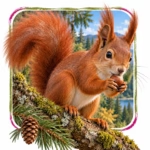
Eastern Gray Squirrel Fact Highlight
From the full animal facts page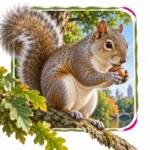
More Animal Comparisons
Pick another animal matchup and keep exploring. Compare appearances, habitats, diets, abilities, and surprising differences.

Make an Animal Story
Create a squirrel story about two woodland neighbors hiding very different winter pantries!
Source notes: References used for this comparison. See more See less
Try Another Matchup
Explore this comparison →