
American Robin vs Northern House Wren: Backyard Bird Comparison
American Robins and Northern House Wrens are both backyard songbirds, but a careful look makes them easy to tell apart. The robin is a large thrush with a warm orange breast and yellow bill. The wren is tiny, plain brown, and often holds its short tail upright. One searches open lawns and fruiting trees; the other darts through shrubs and nests inside holes.
About American Robin
- Type Bird
- Diet Omnivore; earthworms, insects, snails, and many fruits and berries
- Group Thrush; family Turdidae
- Known for A warm orange breast, yellow bill, spring song, and running across lawns for worms
- Special skill Sharp sight and stop-and-run foraging help locate small animals in short grass
About Northern House Wren
- Type Bird
- Diet Mostly insectivore; beetles, caterpillars, grasshoppers, crickets, true bugs, spiders, and other invertebrates
- Group Wren; family Troglodytidae
- Known for A tiny plain-brown body, upright tail, energetic movement, and surprisingly loud bubbling song
- Special skill A huge song collection comes from a tiny body, and narrow cavities provide safe nest sites
American Robin vs Northern House Wren: Quick Answer
The American Robin is much larger, about 23-28 centimeters long and roughly 77 grams on average. The Northern House Wren is only about 11-13 centimeters and 10-12 grams. Robins show an orange breast, eat both animals and fruit, and may gather in huge winter roosts. Wrens are plain brown insect hunters with cocked tails, cavity nests, and very loud varied songs.
Where Do They Fit?
Follow the branches to see how American Robin and Northern House Wren are classified and related.
American Robin vs Northern House Wren: Quick Comparison
| Feature | American Robin | Northern House Wren |
|---|---|---|
| Scientific identity | Turdus migratorius | Troglodytes aedon |
| Bird family | Turdidae, the thrushes | Troglodytidae, the wrens |
| Published adult size | About 23-28 cm and roughly 77 g on average | About 11-13 cm and roughly 10-12 g |
| Color clue | Gray-brown above with a warm orange breast and yellow bill | Plain warm brown with subtle bars, a thin bill, and a pale eyebrow |
| Tail | Fairly long and dark with white corners | Short and often held upright |
| Best-known habitat | Lawns, gardens, fields, orchards, towns, and woodland edges | Shrubby yards, parks, open woods, thickets, and gardens with cavities |
| Food | Earthworms, insects, snails, fruit, and berries | Mainly insects and spiders |
| Nest | Mud-lined cup on a branch, ledge, or building | Twig-filled cavity in a tree hole, nest box, building gap, or odd container |
| Eggs | Usually 3-5 smooth blue eggs | Often 4-8 pale eggs marked with reddish brown |
| Social pattern | Breeding territories; large flocks and communal roosts outside breeding | Breeding territories; usually alone, paired, or in small family groups |
How Are Robins and Wrens Alike?
- Both are North American songbirds often found in gardens, parks, and neighborhoods.
- Both eat insects and spiders that they find among plants or on the ground.
- Both build nests, lay eggs, and have two parents that feed fast-growing chicks.
- Both sing to advertise territory and communicate during the breeding season.
- Both can migrate seasonally, although some populations or individuals remain year-round.
How Are Robins and Wrens Different?
- The American Robin is roughly twice as long and many times heavier than the Northern House Wren.
- The robin has a warm orange breast and yellow bill; the wren is mostly plain brown with a thin bill.
- Robins build open mud-lined cups, while wrens hide twig nests inside cavities.
- Robins eat large amounts of fruit as well as animals; wrens feed mainly on insects and spiders.
- Robins can form enormous winter flocks and roosts, while wrens are more often alone, paired, or in family groups.
Robin vs Wren Showdown
Adaptation showdown: American Robin wins size because it is about twice as long and many times heavier. Speed is a Tie because the sources provide no fair matched flight-speed test. Strength is a Tie because larger robin size and nimble wren movement are not a matched strength measure. Northern House Wren wins stealth because its tiny plain-brown body slips through dense shrubs and narrow nest cavities. American Robin wins social behavior because winter flocks may gather at enormous communal roosts. Swimming is a Tie because neither is a water specialist. Northern House Wren wins weirdest for packing cavities with twigs and producing a repertoire reported at well over one hundred song types.
Fun American Robin vs Northern House Wren Facts
A Robin Changes Its Menu
American Robins often hunt earthworms and insects on lawns in the morning, then switch toward fruit later in the day. Across the year, ripe berries become especially important.
A Blue Egg in a Mud Cup
A female American Robin builds a cup of grass and twigs, then presses in a smooth inner bowl of mud and lines it with fine grass. Her eggs are famously blue.
A Tiny Bird With Many Songs
A male Northern House Wren may sing a rapid bubbling series of trills and chatters. University sources report repertoires that can include more than one hundred song types.
A Home in an Odd Hole
House Wrens use natural tree hollows, old woodpecker holes, nest boxes, and sometimes unexpected sheltered objects. A male often stuffs several possible cavities with twigs before a mate helps choose one.
A Winter Robin City
Outside breeding season, American Robins become highly social. They may feed in flocks and sleep in communal roosts containing thousands of birds, with the largest reports reaching hundreds of thousands.
Robin vs Wren Quiz
- Which bird is larger? Answer: The American Robin.
- Which bird often holds its short tail upright? Answer: The Northern House Wren.
- What material lines the inner wall of a robin’s cup nest? Answer: Mud.
- Where does a House Wren build its nest? Answer: Inside a cavity such as a tree hole, nest box, or sheltered gap.
- Which bird may join enormous winter roosts? Answer: The American Robin.
American Robin vs Northern House Wren FAQ
Is an American Robin a wren?
No. The robin is a thrush in Turdidae, while the Northern House Wren belongs to Troglodytidae.
Which bird is bigger?
The American Robin is about twice as long and many times heavier than the Northern House Wren.
Do both birds eat worms?
Robins often eat earthworms. Wrens mainly take insects and spiders, though both are flexible enough to eat varied small invertebrates.
Why is the House Wren name now Northern House Wren?
The former House Wren was split into several species in 2024, and the widespread North American form is now called Northern House Wren.
Can both birds live in a backyard?
Yes. Robins use lawns, trees, and ledges, while wrens favor shrubs and nesting cavities such as birdhouses.
Animal Words to Know
- Thrush: A member of a songbird family that includes robins, bluebirds, and many spotted forest birds.
- Cavity nester: A bird that places its nest inside a hole or enclosed space.
- Communal roost: A place where many birds gather to sleep.
- Invertebrate: An animal without a backbone, such as an insect, spider, or worm.
- Repertoire: The complete set of different songs or sounds an animal can produce.
Make a Backyard Bird Detective Chart
Make a Backyard Bird Detective Chart
Draw exactly one adult American Robin on a lawn edge and exactly one adult Northern House Wren beside shrubs and a nest cavity at honest relative scale, with the robin much larger. Add clue cards for orange breast, plain brown body, mud cup, twig cavity, fruit, insects, large winter flock, and loud varied song. Sort the clues and explain which ones identify each bird. Watch birds quietly without people handling them.
Meet Each Animal
Want the full fact file? Here are quick highlights from each animal’s own facts page.
American Robin Fact Highlight
From the full animal facts page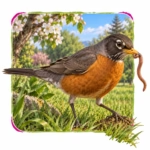
Northern House Wren Fact Highlight
From the full animal facts page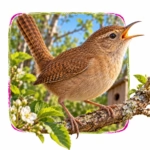
More Animal Comparisons
Pick another animal matchup and keep exploring. Compare appearances, habitats, diets, abilities, and surprising differences.




Make an Animal Story
Send an earthworm-searching Robin and a singing little Wren into a backyard adventure with our free Animal Story Generator.
Source notes: References used for this comparison. See more See less
Try Another Matchup
Explore this comparison →