
Saber-Toothed Tiger vs Tiger: Extinct vs Living Big Cat Comparison
The animal popularly called a saber-toothed tiger was not a true tiger. This comparison uses Smilodon fatalis, a famous North American saber-toothed cat from an extinct felid branch called Machairodontinae. The living tiger, Panthera tigris, belongs to Pantherinae. Both were large ambush-hunting cats, but Smilodon had a stocky grappling build and enormous flattened upper canines, while the tiger has a longer, more agile body, shorter sturdier canines, a long tail, and striped camouflage.
About Saber-Toothed Tiger
- Type Extinct Mammal
- Diet Carnivore; large herbivores such as bison, horses, camels, ground sloths, and young proboscideans inferred from fossils and chemical evidence
- Group Saber-Toothed Cat (Smilodon fatalis; Family Felidae; Subfamily Machairodontinae)
- Known for Long flattened upper canine teeth, an exceptionally wide gape, a deep skull, powerful neck, very robust forelimbs, a stocky body, relatively short legs and tail, retractable claws, and an unknown coat color or pattern
- Special skill Grappling with unusually powerful forelimbs and delivering a careful bite with long blade-like upper canines
About Tiger
- Type Mammal
- Diet Carnivore; mainly deer, wild pigs, and other hoofed mammals, plus smaller or larger animals depending on habitat and opportunity
- Group Tiger (Panthera tigris; Family Felidae; Subfamily Pantherinae)
- Known for An orange or pale coat with individually unique dark stripes, white underside, muscular agile body, rounded ears, long balancing tail, retractable claws, strong jaws, shorter conical canines, keen senses, and excellent swimming ability
- Special skill Using unique striped camouflage for close ambushes and swimming strongly across rivers and lakes
Saber-Toothed Tiger vs Tiger: Quick Answer
A saber-toothed tiger was really an extinct saber-toothed cat, not a kind of tiger. Smilodon fatalis had a short tail, immensely strong forelimbs, a very wide-opening jaw, and long flattened canine teeth. A living tiger has much shorter conical canines, a longer tail, a more agile running body, unique stripes, and proven swimming skill. Their weight ranges overlapped, so neither was automatically bigger.
Where Do They Fit?
Follow the branches to see how Saber-Toothed Tiger and Tiger are classified and related.
Saber-Toothed Tiger vs Tiger: Quick Comparison
| Feature | Saber-Toothed Tiger | Tiger |
|---|---|---|
| Scientific name | Smilodon fatalis | Panthera tigris |
| Felid branch | Machairodontinae, an extinct saber-toothed branch | Pantherinae, the branch containing living tigers and several other big cats |
| Status | Extinct near the end of the last Ice Age | Living and classified as Endangered |
| Body mass | Often estimated around 160–280 kg, with uncertainty among specimens | Varies greatly by sex and population; roughly 75–300 kg across living tigers |
| Upper canines | Long, flattened, blade-like sabers; total tooth length could approach 28 cm including the root | Shorter, thick, conical canines built to withstand strong forces |
| Build | Stocky, short-legged, with huge forelimbs and a short tail | Longer-bodied and more agile, with powerful hind limbs and a long tail |
| Coat | Color and pattern unknown because skin and fur have not been preserved | Orange to pale coat with dark individually unique stripes |
| Hunting style | Inferred ambush and close-range grappling followed by a careful bite | Observed stalk, ambush, pounce, grapple, and throat or neck bite |
| Social life | Debated; some fossils suggest possible care, but the evidence is incomplete | Usually solitary except for mating and mothers with cubs |
| Swimming | Unknown from fossils | Adept swimmer that readily enters water and can cross wide rivers or lakes |
How Were Saber-Toothed Tigers and Tigers Alike?
- Both belong to Felidae, the biological cat family.
- Both had retractable claws, padded paws, forward-facing eyes, whiskers, carnassial teeth, and flexible bodies adapted for hunting.
- Both were large meat-eating ambush predators that approached prey before making a short powerful attack.
- Both could grapple with muscular forelimbs and use canine teeth to help subdue prey.
- Both occupied the top levels of their food webs and depended on landscapes with enough large prey.
How Were Saber-Toothed Tigers and Tigers Different?
- Smilodon fatalis belonged to the extinct Machairodontinae, while Panthera tigris belongs to the living Pantherinae.
- Smilodon had extremely long flattened upper canines and an unusually wide gape; tiger canines are shorter, thicker, and more conical.
- Smilodon was stockier with more robust forelimbs, shorter legs, and a bobcat-like short tail; a tiger is longer and more agile with a long balancing tail.
- Smilodon’s coat appearance and swimming ability are unknown, while every tiger has a distinctive striped coat and tigers are excellent swimmers.
- Smilodon lived in the Americas and became extinct near the Ice Age’s end; tigers survive only in fragmented parts of Asia and are Endangered.
Saber-Toothed Tiger vs Tiger Showdown
Big-cat showdown: Size is a tie because estimated Smilodon fatalis masses overlap the wide size range of living tigers. The tiger wins speed and swimming because its agility and water crossings can be observed, while Smilodon was built more for short ambushes and its swimming cannot be measured. Smilodon wins our strength category for its unusually robust forelimbs and specialized grappling build, not as a prediction of a fight. Stealth and social behavior are ties because Smilodon’s coat, sound, and group life remain uncertain. Smilodon takes the weirdest-fact prize for upper canines so long that its jaw needed to open far wider than a modern big cat’s.
Fun Saber-Toothed Tiger vs Tiger Facts
A Saber-Toothed Tiger Was Not a Tiger
Smilodon and Panthera are separate genera on different branches of the cat family tree. Smilodon belonged to Machairodontinae, whose members evolved lengthened saber-like canines. Tigers belong to Pantherinae with lions, leopards, jaguars, and snow leopards. The familiar nickname describes the teeth, not a close tiger relationship.
The Sabers Needed an Extra-Wide Gape
Smilodon fatalis could open its jaws far wider than living big cats, allowing its long upper canines to clear the lower jaw. Those teeth were flattened from side to side and vulnerable to damaging sideways forces, so powerful forelimbs likely helped control prey before a precise bite to softer tissue.
Smilodon Was a Grappler, Not a Long-Distance Chaser
Thick limb bones, strong muscle attachments, relatively short legs, and a short tail point to forceful close-range ambushes rather than prolonged high-speed pursuit. A tiger is also an ambush predator, but its longer body, hind limbs, and tail support more agile running, leaping, and turning.
A Tiger’s Stripes Are Individual ID Cards
No two tigers have exactly the same stripe pattern. Researchers can match camera-trap photographs by those markings to identify individuals. Stripes also break up the tiger’s outline among vegetation and bands of light and shadow, helping it approach prey without being noticed.
Fossils Cannot Show Every Smilodon Secret
Bones reveal Smilodon’s size, muscles, teeth, injuries, growth, and movement, while chemical traces reveal parts of its diet. They do not preserve a reliable fur color or stripe pattern at La Brea. Healed injuries may suggest care from other cats, but social behavior remains a debated interpretation rather than a directly observed fact.
Saber-Toothed Tiger vs Tiger Quiz
- Was Smilodon a true tiger? Answer: No; it belonged to a different, extinct branch of the cat family.
- Which cat had the much longer upper canine teeth? Answer: Smilodon fatalis, the saber-toothed cat.
- Which cat’s swimming ability can scientists observe today? Answer: The tiger.
- Why were Smilodon’s forelimbs so important? Answer: They probably helped grapple and restrain prey before a careful bite.
- Do scientists know Smilodon’s fur color or pattern? Answer: No; those soft tissues have not been preserved well enough.
Saber-Toothed Tiger vs Tiger FAQ
Was a saber-toothed tiger really a tiger?
No. Smilodon was a saber-toothed cat in the extinct subfamily Machairodontinae. True tigers are Panthera tigris in Pantherinae.
Which was bigger, Smilodon or a tiger?
Their estimated weight ranges overlapped. Smilodon fatalis was often around the mass of a large modern big cat, while tiger size varies greatly by sex and population. Individual size matters more than the nickname.
Why did Smilodon have such long teeth?
The sabers probably helped make a precise deep wound after the cat’s powerful forelimbs controlled its prey. They were specialized cutting tools, not strong pry bars or bone-crushing tusks.
Was Smilodon striped?
Scientists do not know. Skin and fur patterns are not preserved in the famous fossils, so stripes, spots, and plain coats in artwork are informed guesses.
Could Smilodon and a modern tiger ever meet?
No in nature. Smilodon lived in the Americas and vanished around the end of the last Ice Age, while wild tigers live in Asia today.
Animal Words to Know
- Felid: Any member of the biological cat family, Felidae.
- Machairodontinae: The extinct branch of felids containing Smilodon and other saber-toothed cats.
- Pantherinae: The living big-cat branch containing tigers, lions, leopards, jaguars, and snow leopards.
- Canine: A pointed tooth used by carnivores to grip, pierce, or help kill prey.
- Ambush predator: A hunter that uses concealment and a sudden short attack instead of a long chase.
Saber-Toothed Cat and Tiger Drawing Activity
Saber-Toothed Cat and Tiger Drawing Activity
Draw Smilodon fatalis beside a tiger at a similar scale. Give Smilodon a stocky chest, powerful forelegs, short tail, and long flattened upper canine teeth. Use a plain or uncertain coat because its real pattern is unknown. Give the tiger a longer body, long balancing tail, shorter conical canines, and dark stripes. Add a note explaining that Smilodon was a saber-toothed cat, not a tiger. Label Smilodon, tiger, canine, forelegs, tail, and fossil evidence.
Meet Each Animal
Want the full fact file? Here are quick highlights from each animal’s own facts page.
Saber-Toothed Tiger Fact Highlight
From the full animal facts page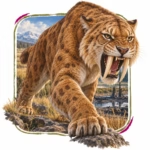
Tiger Fact Highlight
From the full animal facts page
More Animal Comparisons
Pick another animal matchup and keep exploring. Compare appearances, habitats, diets, abilities, and surprising differences.






Make an Animal Story
Turn this saber-toothed tiger vs tiger comparison into an evidence-filled Ice Age and jungle adventure with our free Animal Story Generator.
Source notes: References used for this comparison. See more See less
Try Another Matchup
Explore this comparison →