
Sambar Deer vs Chital: Asian Deer Comparison
Sambar deer and chital often share forests in the Indian subcontinent, yet they look and behave very differently. Sambar are much larger, darker and more strongly built, and they are often seen alone or in small groups. Chital are smaller, reddish deer covered in white spots throughout life, and they commonly form busy herds near grassy forest openings.
About Sambar Deer
- Type Living
- Diet Herbivore
- Group Large deer species (Rusa unicolor)
- Known for Heavy body, dark shaggy coat and rugged three-tined antlers on males
- Special skill Powerful movement through dense forest and confident use of water
About Chital
- Type Living
- Diet Herbivore
- Group Spotted deer species (Axis axis)
- Known for White spots kept through adulthood and lively social herds
- Special skill Uses lifelong spots and shared alarm information in open forest
Sambar Deer vs Chital: Quick Answer
Sambar deer are the larger and stronger animals, with dark coarse coats, a neck mane on many adults and rugged antlers on males. Chital are smaller, slimmer and permanently spotted, with males carrying three-tined antlers. Sambar win size, strength and swimming; chital win social life and the weirdest teamwork fact. Speed and stealth are ties because their skills fit different habitats and have not been fairly tested together.
Where Do They Fit?
Follow the branches to see how Sambar Deer and Chital are classified and related.
Sambar Deer vs Chital: Quick Comparison
| Feature | Sambar Deer | Chital |
|---|---|---|
| Scientific name | Rusa unicolor | Axis axis |
| Common alternate name | Sambar | Axis deer or spotted deer |
| Native range | South Asia through southern China and Southeast Asia | Indian subcontinent, including India, Nepal and Sri Lanka |
| Adult size | A very large Asian deer; many adults weigh well over 100 kg | A medium deer usually weighing tens, not hundreds, of kilograms |
| Coat clue | Coarse dark brown to grey-brown coat, often with a neck mane | Reddish-brown coat with rows of white spots kept through adulthood |
| Antlers | Males grow rugged antlers, usually with three main tines | Males grow slender antlers with three main tines |
| Habitat | Dense forest, wooded hills, wetlands and forest edges | Open woodland, grassy clearings and riverine forest |
| Food | Browses leaves, shoots and fruit and also grazes grass or aquatic plants | Grazes grass and browses leaves, fruits and fallen foods |
| Social life | Often alone or in groups of fewer than six | Flexible herds divided by sex, age and breeding activity |
| Special clue | Often stays near water and can swim well | Often feeds near langur monkeys and responds to their alarm calls |
How Are Sambar Deer and Chital Alike?
- Both are living Asian deer in the family Cervidae.
- Both are ruminant herbivores that graze and browse.
- Both have antlers on males rather than permanent horns.
- Both use alarm calls, scent and body signals to communicate.
- Both can live in forests where tigers, leopards and dholes are natural predators.
How Are Sambar Deer and Chital Different?
- Sambar deer are much larger and heavier than chital.
- Adult sambar are mostly plain and dark; adult chital keep bright white spots.
- Sambar often use dense cover and small groups; chital favour more open forest and larger herds.
- Sambar have a heavier body and coarser antlers; chital are slimmer with lighter-looking antlers.
- Chital often gain feeding and warning clues near langur monkeys, a partnership not famous in sambar.
Sambar Deer vs Chital Adaptation Showdown
- Size – Sambar Deer: Sambar are among Asia’s largest deer and are far heavier than chital across ordinary adult ranges.
- Speed – Tie: Both can run quickly, but no fair same-course test compares them across forest cover, distance, age and sex.
- Strength – Sambar Deer: Its much greater mass, heavy neck and robust frame give sambar the whole-body power advantage, not a fight prediction.
- Stealth – Tie: A sambar’s dark coat suits deep shade, while a chital’s white spots break up its outline in dappled woodland light.
- Social – Chital: Chital regularly use larger, changing herds with female-young groups, bachelor groups and mixed gatherings.
- Swimming – Sambar Deer: Sambar commonly use wet forest, feed on aquatic plants and are strong swimmers, giving them the clearer water edge.
- Weirdest – Chital: Chital can feed near langur monkeys and react to their alarm calls, sharing extra information about food and danger.
Fun Sambar Deer vs Chital Facts
Sambar Are Giant Forest Deer
Rusa unicolor is described as the largest Oriental deer. Body size varies greatly across its wide range, and western populations tend to be larger than eastern ones.
Both Males Usually Carry Three-Tined Antlers
A mature male sambar usually has heavy antlers with a brow tine and a forked beam. A male chital also has three main tines, but its antlers look slimmer and more sweeping.
Chital Keep Their Spots
Many deer lose their fawn spots as they grow. Chital are different: males and females keep rows of white spots throughout adulthood.
Chital Listen to Langurs
Chital often feed near langur monkeys. Monkeys can drop fruit and leaves, and chital pay attention to langur alarm calls that may reveal a nearby predator.
Sambar Usually Prefer Small Groups
Sambar are often solitary or seen in small family groups of fewer than six. Large gatherings do occur, but field researchers describe them as unusual.
Sambar Deer vs Chital Quiz
Which deer is much larger? A) Sambar deer B) Chital C) They are always the same size Answer: A) Sambar deer
Which deer keeps white spots as an adult? A) Sambar deer B) Chital C) Neither Answer: B) Chital
Which deer is more often found in larger herds? A) Sambar deer B) Chital C) Neither uses groups Answer: B) Chital
Which deer is the stronger swimmer in this comparison? A) Sambar deer B) Chital C) Neither enters water Answer: A) Sambar deer
Which animal may give chital useful alarm information? A) Langur monkey B) Penguin C) Camel Answer: A) Langur monkey
Sambar Deer vs Chital FAQ
Are sambar deer and chital the same species?
No. Sambar are Rusa unicolor, while chital are Axis axis.
Which is bigger, a sambar or a chital?
Sambar are much larger and can weigh several times as much as chital.
Do female sambar and chital have antlers?
Females of both species normally lack antlers. The antlers are a male feature.
Why do chital have spots?
The spots break up the body’s outline in patches of sunlight and shade under woodland trees.
Do sambar and chital live in the same places?
Their ranges and habitats overlap in parts of South Asia, but sambar often use denser forest and chital commonly favour open woodland and grassy clearings.
Animal Words to Know
- Antler: A branching bone structure grown and shed by deer, usually by males.
- Browse: Leaves, shoots, twigs and fruit eaten from shrubs or trees.
- Dappled: Marked with mixed patches of light and shadow.
- Ruminant: A plant eater that brings up cud and chews it again.
- Tine: One point or branch of an antler.
Sambar and Chital Forest-Camouflage Activity
Sambar and Chital Forest-Camouflage Activity
Draw a shaded forest with one dark, large sambar near water and a smaller spotted chital in a sunny clearing. Add five labels: coarse coat, white spots, small group, large herd and three-tined antlers. Use torn brown and green paper to test which patterns disappear best in deep shade and dappled light.
Meet Each Animal
Want the full fact file? Here are quick highlights from each animal’s own facts page.
Sambar Deer Fact Highlight
From the full animal facts page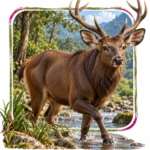
Chital Fact Highlight
From the full animal facts page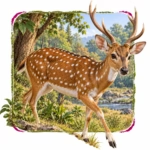
More Animal Comparisons
Pick another animal matchup and keep exploring. Compare appearances, habitats, diets, abilities, and surprising differences.



Make an Animal Story
Create a forest story with a water-loving sambar and a spotted chital herd!
Source notes: References used for this comparison. See more See less
Try Another Matchup
Explore this comparison →