
Shrimp vs Prawn: Decapod Crustacean Comparison
Shrimp and prawns look so similar that their names are often swapped in shops, restaurants, and different countries. In a scientific comparison, shrimp usually refers to caridean decapods, while prawns usually refers to dendrobranchiate decapods. Their gills, body plates, clawed legs, and egg-carrying methods reveal the hidden differences.
About Shrimp
- Type Crustacean
- Diet Omnivore
- Group Caridean Decapod
- Known for Curved body, swimming legs, long antennae, egg carrying, and life in marine or freshwater habitats
- Special skill Swimming backward rapidly by snapping the abdomen and tail fan beneath the body
About Prawn
- Type Crustacean
- Diet Omnivore
- Group Dendrobranchiate Decapod
- Known for Branching gills, long legs, claws on three leg pairs, large size in many species, and free-spawned eggs
- Special skill Using long walking legs and three pairs of claw-bearing legs to search, grasp, and handle food
Shrimp vs Prawn: Quick Answer
Shrimp and prawns are related ten-legged crustaceans, but they belong to different major groups. Shrimp usually have plate-like gills, claws on two pairs of legs, a strongly bent abdomen, and females carry eggs beneath the body. Prawns have branching gills, claws on three leg pairs, a straighter body, and usually release eggs into the water. Everyday names vary by region, so size alone cannot identify them.
Where Do They Fit?
Follow the branches to see how Shrimp and Prawn are classified and related.
Shrimp vs Prawn: Quick Comparison
| Feature | Shrimp | Prawn |
|---|---|---|
| Animal type | Crustacean | Crustacean |
| Scientific group | Usually Caridea | Usually Dendrobranchiata |
| Known for | Curved abdomen, swimming, and carrying eggs | Branching gills, long legs, and free-spawned eggs |
| Main habitat | Marine and freshwater habitats worldwide | Marine and freshwater habitats worldwide |
| Gill shape | Usually plate-like | Branching and tree-like |
| Clawed leg pairs | Usually two | Usually three |
| Body plates | Second abdominal plate overlaps the first and third | Abdominal plates overlap in a more orderly front-to-back pattern |
| Eggs | Females usually carry eggs beneath the abdomen | Females usually release eggs into the water |
| Baby name | Larva | Larva |
| Reliable size rule | No | No |
How Are Shrimp and Prawns Alike?
- Both shrimp and prawns are decapod crustaceans with ten walking legs.
- Both have hard exoskeletons, jointed limbs, long antennae, and compound eyes.
- Both breathe with gills and must molt their shells to grow.
- Both eat mixtures of algae, plant material, plankton, detritus, and small animals depending on species.
- Both are important prey for fish, birds, marine mammals, and many other animals.
How Are Shrimp and Prawns Different?
- Shrimp usually belong to Caridea, while true prawns belong to Dendrobranchiata.
- Shrimp usually have plate-like gills, while prawns have branching gills.
- Shrimp typically have claws on two pairs of legs, while prawns have claws on three pairs.
- Female shrimp usually carry eggs beneath the abdomen, while prawns generally release eggs into the water.
- Shrimp often have a more sharply bent abdomen, while prawns tend to look straighter.
Shrimp vs Prawn Showdown
Crustacean showdown: The prawn wins for typical size and leg-powered strength because many familiar prawn species are larger and have claws on three pairs of legs. Speed and swimming are ties because both groups contain quick swimmers and bottom-walkers. Shrimp takes stealth because many species hide among reefs, plants, sand, or other animals. Social life is a tie because both range from solitary species to large groups. Shrimp wins our weirdest-fact prize because the second abdominal plate overlaps both neighboring plates like a tiny piece of shell armor clipped across two panels.
Fun Shrimp vs Prawn Facts
Two Major Decapod Groups
Animals scientifically called shrimp usually belong to the infraorder Caridea. True prawns belong to Dendrobranchiata, a separate branch of the decapod family tree.
Plate Gills vs Branching Gills
Shrimp generally have flattened, plate-like gills. Prawn gills branch repeatedly, creating a feathery or tree-like structure that inspired the name Dendrobranchiata.
Two Clawed Pairs vs Three
Shrimp usually have pincers on the first two pairs of walking legs. Prawns generally have small claws on the first three pairs, although their exact size and shape vary among species.
Carried Eggs vs Released Eggs
Female caridean shrimp attach fertilized eggs beneath the abdomen and fan them with swimming legs. Dendrobranchiate prawns usually release fertilized eggs directly into the surrounding water.
Shrimp Names Change Around the World
In everyday English, shrimp and prawn are often market names rather than strict scientific labels. In some countries, prawn commonly means a larger animal, but that rule does not reliably match anatomy or evolutionary relationships.
Shrimp vs Prawn Quiz
- How many walking legs do shrimp and prawns have? Answer: Ten.
- Which group usually has branching gills? Answer: Prawns.
- Which animal usually carries eggs beneath the abdomen? Answer: Shrimp.
- Which animal usually has claws on three pairs of legs? Answer: Prawn.
- Can size alone reliably separate shrimp from prawns? Answer: No.
Shrimp vs Prawn FAQ
What is the main difference between a shrimp and a prawn?
Scientific shrimp and prawns belong to different decapod groups. They differ in gill structure, abdominal plates, clawed legs, and how females handle their eggs.
Are prawns just large shrimp?
No. Prawn is sometimes used for larger animals in cooking and trade, but body size is not a dependable scientific test.
Which is bigger, a shrimp or a prawn?
Many familiar prawns are larger than many familiar shrimp, but both groups include a wide range of sizes and there are large shrimp as well as small prawns.
Do shrimp and prawns live in fresh water?
Yes. Both groups contain marine and freshwater species, although individual species may be restricted to one habitat.
Can shrimp and prawns swim backward?
Many can escape backward by rapidly flexing the abdomen and tail fan. Swimming style and speed vary greatly among species.
Animal Words to Know
- Decapod: A crustacean belonging to an order whose members typically have ten walking legs.
- Caridea: The major decapod group containing most animals scientifically called shrimp.
- Dendrobranchiata: The decapod group containing true prawns and related animals with branching gills.
- Exoskeleton: A hard outer covering that supports and protects an animal’s body.
- Molt: To shed an old outer skeleton so the body can grow.
Shrimp and Prawn Body Detective Activity
Shrimp and Prawn Body Detective Activity
First add a note that the everyday names shrimp and prawn vary by country and do not always identify two exact scientific groups. For a body comparison, draw a caridean shrimp beside a dendrobranchiate prawn. Compare the bend of the abdomen, gill shape, clawed legs, and how eggs are carried or released. Label common name, body, gills, legs, and eggs.
Meet Each Animal
Want the full fact file? Here are quick highlights from each animal’s own facts page.
Shrimp Fact Highlight
From the full animal facts page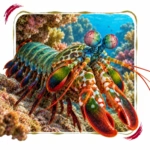
Prawn Fact Highlight
From the full animal facts page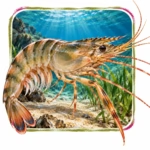
More Animal Comparisons
Pick another animal matchup and keep exploring. Compare appearances, habitats, diets, abilities, and surprising differences.




Make an Animal Story
Turn this shrimp vs prawn comparison into a tiny underwater adventure with our free Animal Story Generator.
Source notes: References used for this comparison. See more See less
Try Another Matchup
Explore this comparison →