
Silverfish vs Earwig for Kids: Common Insect Comparison
A Common Silverfish and Common Earwig are both quick, flattened insects that hide by day and explore at night. Yet a silverfish is a primitively wingless starch-eater with three tail filaments, while an earwig is an omnivore with forceps-like cerci, tightly folded wings, and remarkable maternal care.
About Common Silverfish
- Type Wingless insect
- Diet Scavenger that favors starchy material
- Group Silverfish family, Lepismatidae
- Known for Silvery scales and three long tail filaments
- Special skill Darts rapidly into narrow cracks with a flat, flexible body
About Common Earwig
- Type Winged insect
- Diet Omnivore, scavenger, and small predator
- Group Earwig family, Forficulidae
- Known for Forceps-like cerci and unusually caring mothers
- Special skill Folds broad hind wings into a tiny package beneath short forewings
Quick Answer
Quick answer: The Common Silverfish is a silvery, wingless insect with three long tail filaments that often feeds on starches, paper glues, and crumbs. The Common Earwig is usually brown, has a pair of forceps at its rear, and eats both plant and animal material. Neither insect normally harms people.
Common Silverfish vs Common Earwig: Quick Comparison
| Feature | Common Silverfish | Common Earwig |
|---|---|---|
| Scientific name | Lepisma saccharinum | Forficula auricularia |
| Typical length | Roughly 12 to 19 mm | Roughly 13 to 19 mm |
| Body clue | Tapered, silvery body covered with tiny scales | Long, flattened brown body with forceps at the rear |
| Rear appendages | Three long, threadlike tail filaments | Two forceps-like cerci, usually more curved in males |
| Wings | No wings at any life stage | Short forewings cover intricately folded hind wings; flight is rare |
| Main food | Starches, paper glue, flour, cereal, textiles, fungi, and tiny dead insects | Plants, algae, fungi, decaying matter, aphids, and other small arthropods |
| Favorite shelter | Damp indoor cracks and sheltered places beneath bark, rocks, or leaf litter | Cool moist spaces beneath stones, bark, boards, mulch, or garden debris |
| Daily rhythm | Hides by day and runs quickly at night | Hides by day and forages mainly at night |
| Life cycle | Egg, nymph, and adult; even adults keep molting | Egg, nymph, and adult through incomplete metamorphosis |
| Parent care | No extended guarding of a brood | The female cleans, moves, and guards her eggs and early nymphs |
How Silverfish and Earwigs Are Alike
- Both are insects with six legs, two antennae, and segmented bodies.
- Both have flattened bodies that fit into narrow hiding places.
- Both usually rest in dark shelters during the day and become active at night.
- Both prefer protected places with moisture nearby.
- Both hatch as small nymphs that resemble adults rather than as caterpillar-like larvae.
How Silverfish and Earwigs Are Different
- A silverfish has three slender tail filaments, while an earwig has one pair of forceps-like cerci.
- A silverfish never has wings, while an adult earwig has short forewings and tightly folded hind wings.
- Silverfish often eat starchy household materials, while earwigs have a broader diet that includes plants and small arthropods.
- An adult silverfish keeps molting, while an earwig stops growing after its final molt.
- A female earwig guards and tends her brood, but a silverfish does not provide comparable extended care.
Silverfish vs Earwig Adaptation Showdown
Adaptation showdown: Size is a Tie because the usual adult length ranges overlap closely. Common Silverfish wins speed for its famously rapid darting run. Common Earwig wins strength because its forceps can grip during defense and contests. Common Silverfish wins stealth because its flat body slips deep into hairline cracks. Common Earwig wins social behavior because a mother guards, cleans, and moves her eggs and tends newly hatched nymphs. Swimming is a Tie because neither insect is an aquatic specialist. Common Earwig wins weirdest for folding large fanlike hind wings into a tiny space beneath very short covers.
Fun Common Silverfish vs Common Earwig Facts
Three Tails, Not One
A Common Silverfish carries two side cerci and one central filament at the end of its abdomen. Together they look like three long tails.
Adults That Keep Molting
Most insects stop molting after becoming adults, but silverfish can shed their outer covering throughout adult life. A silverfish may molt many times.
Pocket-Folded Wings
An earwig’s delicate hind wings are much larger than their short covers. The insect folds each wing along many creases before tucking it away.
A Watchful Insect Mother
A female earwig stays with her eggs, cleaning them and moving them if the nest becomes unsafe. She continues caring for the first young nymphs.
Forceps, Not Stingers
The curved structures at an earwig’s rear are cerci used in defense, wing handling, and contests. They are not stingers, and earwigs do not crawl into ears on purpose.
Silverfish vs Earwig Quiz
- Which insect has three long tail filaments? Answer: The Common Silverfish.
- Which insect has forceps-like cerci? Answer: The Common Earwig.
- Which one can have folded hind wings? Answer: The Common Earwig.
- What food do silverfish especially favor? Answer: Starchy materials such as flour, cereal, paper glue, and book bindings.
- Which insect mother guards and cleans her eggs? Answer: The Common Earwig.
Common Silverfish vs Common Earwig FAQ
Do earwigs crawl into people’s ears?
No. Earwigs prefer cool, moist shelters and do not seek human ears.
Can a silverfish fly?
No. Silverfish are wingless throughout their lives.
Can an earwig fly?
It has wings, but the Common Earwig rarely flies and usually runs instead.
Do silverfish or earwigs sting?
No. Neither has a stinger, and both normally avoid people.
Why are both found in damp places?
Moist shelters help keep their small bodies from drying out and provide food and hiding spaces.
Animal Words to Know
- Cerci: Paired appendages at the rear of an insect’s abdomen.
- Nymph: A young insect that resembles a smaller, less developed adult.
- Incomplete metamorphosis: A life cycle with egg, nymph, and adult stages but no pupal stage.
- Scavenger: An animal that eats dead organisms or leftover organic material.
- Molt: To shed an old outer covering so the body can grow or renew it.
Sketch the Tails and Forceps
Sketch the Tails and Forceps
Draw exactly one adult Common Silverfish and exactly one adult Common Earwig at honest relative scale. Add labels for antennae, six legs, three silverfish tail filaments, earwig forceps, and earwig wing covers. Then circle the shared traits and use arrows to show each insect slipping into a safe, damp shelter. Observe insects without touching or trapping them.
Meet Each Animal
Want the full fact file? Here are quick highlights from each animal’s own facts page.
Common Silverfish Fact Highlight
From the full animal facts page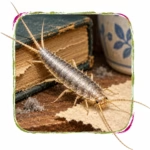
Common Earwig Fact Highlight
From the full animal facts page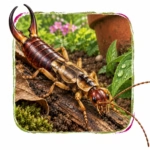
More Animal Comparisons
Pick another animal matchup and keep exploring. Compare appearances, habitats, diets, abilities, and surprising differences.






Make an Animal Story
Send a speedy Silverfish and a caring Earwig on a tiny nighttime adventure with our free Animal Story Generator.