
Sloth Bear vs Asiatic Black Bear: Asian Bear Comparison
Sloth bears and Asiatic black bears can both be black with a pale chest mark, and their ranges overlap in parts of South Asia. Look closer and they are easy to separate. The sloth bear has a shaggy coat, a long pale muzzle and huge digging claws for eating colonial insects. The Asiatic black bear has a more rounded head, large ears and a strong all-purpose body for climbing, swimming and seasonal feeding.
About Sloth Bear
- Type Living
- Diet Omnivore with strong ant-and-termite specialisation
- Group South Asian bear species (Melursus ursinus)
- Known for Shaggy coat, pale muzzle, huge claws, termite suction and cubs riding on mothers
- Special skill Blows soil away and vacuums insects through flexible lips and a gap in the front teeth
About Asiatic Black Bear
- Type Living
- Diet Omnivore
- Group Widespread Asian bear species (Ursus thibetanus)
- Known for White moon-shaped chest mark, large ears, powerful climbing and seasonal forest travel
- Special skill Climbs trees with strong forelimbs, swims powerfully and may den through cold winters
Sloth Bear vs Asiatic Black Bear: Quick Answer
Sloth bears are specialised ant-and-termite hunters. They use long claws, closable nostrils, flexible lips and a front-tooth gap to create strong suction. Asiatic black bears usually grow heavier, have large upright ears and eat a broader mix of fruits, nuts, plants, insects and other foods. They are skilled climbers and powerful swimmers, and colder populations may spend winter in dens. Asiatic Black Bear wins size, strength and swimming; Sloth Bear wins the weirdest adaptation.
Sloth Bear vs Asiatic Black Bear: Quick Comparison
| Feature | Sloth Bear | Asiatic Black Bear |
|---|---|---|
| Scientific name | Melursus ursinus | Ursus thibetanus |
| Native range | India, Nepal, Bhutan and Sri Lanka | From Iran, Pakistan and the Himalayas across East and Southeast Asia |
| Adult mass | About 55-140 kg | About 50-200 kg across adult sexes in the bear-specialist account |
| Head and ears | Long pale mobile muzzle with long hair around the ears | Large rounded head with conspicuously large upright ears |
| Coat | Long shaggy black, brownish or reddish hair without warm underfur | Long coarse black fur with a denser cold-weather coat |
| Chest mark | Usually cream U or Y shape | Usually cream or white crescent or V, giving the name moon bear |
| Claws | Very long curved front claws specialised for digging | Strong curved claws and powerful forelimbs specialised for climbing |
| Main foods | Especially termites and ants, plus fruit, honey and other foods | Fruit, nuts, vegetation, insects and many other seasonal foods |
| Water and trees | Can climb, especially when young, but is mainly a ground forager | Adept tree climber and described as a powerful swimmer |
| Winter strategy | Does not hibernate in its tropical and subtropical range | Some populations den or hibernate during the coldest part of winter |
How Are Sloth Bears and Asiatic Black Bears Alike?
- Both are living Asian bears in the family Ursidae.
- Both usually have black coats with pale marks on the chest.
- Both are omnivores that use a strong sense of smell to find food.
- Both have curved claws and can climb, especially while young.
- Both are mainly solitary, with mothers caring closely for cubs.
How Are Sloth Bears and Asiatic Black Bears Different?
- Asiatic black bears can grow heavier; sloth bears have a lower top mass in the main species accounts.
- Sloth bears have very shaggy coats and pale mobile muzzles; Asiatic black bears have rounder heads and much larger-looking ears.
- Sloth bears specialise in vacuuming ants and termites; Asiatic black bears have a broader seasonal diet.
- Sloth bear claws are extremely long for digging; Asiatic black bear claws and upper bodies are excellent for climbing.
- Some Asiatic black bears den through cold winters, while tropical sloth bears do not hibernate.
Sloth Bear vs Asiatic Black Bear Adaptation Showdown
- Size – Asiatic Black Bear: Its species-wide adult range reaches about 200 kilograms, above the commonly reported sloth bear maximum of about 140 kilograms.
- Speed – Tie: Both can move surprisingly quickly, but the sources do not provide a controlled same-ground race.
- Strength – Asiatic Black Bear: The larger maximum body mass and strong climbing forequarters give it the whole-body strength win, not a predicted fight result.
- Stealth – Tie: The sloth bear blends into dry scrub and rocky forest, while the Asiatic black bear disappears into dense wooded slopes and tree cover.
- Social – Tie: Adults of both species are mainly solitary, apart from mating and the long bond between a mother and her cubs.
- Swimming – Asiatic Black Bear: Species accounts specifically describe it as a powerful swimmer; no equally strong swimming specialisation is reported for the sloth bear.
- Weirdest – Sloth Bear: Its closable nostrils, flexible lips, missing upper incisors and forceful suction form a remarkable termite-extracting machine.
Fun Sloth Bear vs Asiatic Black Bear Facts
Two Pale Marks Can Look Similar
Both bears often carry a cream chest mark. A sloth bear’s is commonly U- or Y-shaped, while an Asiatic black bear often shows a sharp crescent or V.
One Bear Vacuums Its Dinner
A sloth bear can close its nostrils, blow loose dirt from a termite nest and suck insects through a gap left by missing upper incisors.
Moon Bears Are Built to Climb
Asiatic black bears have strong upper bodies, broad paws and curved claws. They climb to feed, rest and escape danger.
Winter Behaviour Changes by Climate
Not every Asiatic black bear hibernates. Bears in colder parts of the range may den for winter, while warmer populations can stay active.
Sloth Bear Cubs Ride on Mom
Young sloth bears cling to the long hair on their mother’s back during travel. Asiatic black bear cubs follow and climb but do not normally use this transport system.
Sloth Bear vs Asiatic Black Bear Quiz
Which bear specialises in sucking termites from nests? A) Sloth bear B) Asiatic black bear C) Both only eat leaves Answer: A) Sloth bear
Which bear usually has very large upright ears? A) Sloth bear B) Asiatic black bear C) Neither has ears Answer: B) Asiatic black bear
Which bear can reach the greater adult mass? A) Sloth bear B) Asiatic black bear C) They never vary Answer: B) Asiatic black bear
Which bear is specifically described as a powerful swimmer? A) Sloth bear B) Asiatic black bear C) Neither Answer: B) Asiatic black bear
What may a sloth bear cub do? A) Ride on its mother’s back B) Build a winter dam C) Fly Answer: A) Ride on its mother’s back
Sloth Bear vs Asiatic Black Bear FAQ
Are sloth bears and Asiatic black bears related?
Yes. Both belong to the bear family, but they are separate species in different genera.
How can I tell them apart?
Look for the sloth bear’s shaggy hair, pale mobile muzzle and enormous digging claws. The Asiatic black bear has a rounder head and larger upright ears.
Which bear is larger?
Asiatic black bears have the greater reported maximum mass, though the adult ranges overlap.
Do both bears eat termites?
Both may eat insects, but the sloth bear is far more specialised for opening nests and sucking up ants and termites.
Do Asiatic black bears always hibernate?
No. Winter denning varies with climate, food and location, and warmer populations may remain active.
Animal Words to Know
- Crescent: A curved shape like a young moon.
- Hibernate: To spend a long cold period in a low-energy resting state.
- Incisor: One of the front teeth used for biting or cutting.
- Mast crop: A seasonal supply of nuts and fruits from forest trees.
- Specialisation: A body feature or behaviour suited to a particular job.
Sloth Bear and Moon Bear Clue-Card Activity
Sloth Bear and Moon Bear Clue-Card Activity
Draw a shaggy sloth bear beside a broken termite mound and an Asiatic black bear resting on a thick forest branch. Give both a pale chest mark, then add the clues that separate them: pale tube-like muzzle and huge digging claws for the sloth bear; large ears, rounder head and climbing paws for the Asiatic black bear. Label five clues.
Meet Each Animal
Want the full fact file? Here are quick highlights from each animal’s own facts page.
Sloth Bear Fact Highlight
From the full animal facts page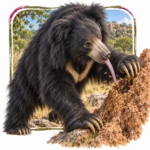
Asiatic Black Bear Fact Highlight
From the full animal facts page
More Animal Comparisons
Pick another animal matchup and keep exploring. Compare appearances, habitats, diets, abilities, and surprising differences.


Make an Animal Story
Create an Asian forest story with a termite vacuum bear and a moon-marked climber!
Source notes: References used for this comparison. See more See less
Try Another Matchup
Explore this comparison →