
Snowy Owl vs Great Horned Owl for Kids
Snowy Owls and Great Horned Owls are close relatives in the genus Bubo, yet they look built for different worlds. The Snowy Owl, Bubo scandiacus, is white, round-headed and thickly feathered for open Arctic tundra. It may hunt in full daylight. The Great Horned Owl, Bubo virginianus, is mottled brown with tall feather tufts. It usually hunts after dark from forest edges and other covered perches across the Americas.
About Snowy Owl
- Type Living
- Diet Carnivore; mainly lemmings and other small mammals, plus birds such as ptarmigan and waterfowl
- Group Large true owl in family Strigidae (Bubo scandiacus)
- Known for White plumage, yellow eyes, a smoothly rounded head and thick feathers covering the legs and feet
- Special skill Hunts during bright Arctic summer days as well as darkness and follows changing prey across huge distances
About Great Horned Owl
- Type Living
- Diet Carnivore; takes mammals, birds, reptiles, frogs, fish, insects and other prey from tiny to surprisingly large
- Group Large true owl in family Strigidae (Bubo virginianus)
- Known for Tall feather ear tufts, yellow eyes, mottled brown plumage, a white throat and a deep hooting voice
- Special skill Grips powerful prey with extremely strong talons and flies quietly through woodland on broad wings
Quick Answer
A Snowy Owl is usually longer and heavier, with a 52–71 cm body and white plumage that blends into tundra and snow. A Great Horned Owl is about 46–63 cm long, brown and heavily patterned, with obvious ear tufts that are not real horns. Their wingspans can overlap. The Snowy Owl favors open ground and variable hunting hours, while the Great Horned Owl favors wooded edges and night hunting.
Snowy Owl vs Great Horned Owl: Quick Comparison
| Feature | Snowy Owl | Great Horned Owl |
|---|---|---|
| Scientific name | Bubo scandiacus | Bubo virginianus |
| Adult size | About 52–71 cm long, 1.6–2.95 kg, with a 126–145 cm wingspan | About 46–63 cm long, 0.91–2.5 kg, with a 101–145 cm wingspan |
| Head and color | Smooth round head with tiny hidden tufts; white with dark bars or spots and yellow eyes | Large raised ear tufts; mottled gray-brown with a reddish face, white throat and yellow eyes |
| Main habitat | Wide-open tundra, winter fields, dunes, coasts and other nearly treeless ground | Woodland edges, forest, desert, wetland, farmland, parks and suburbs |
| Busy time | Can hunt by day or night and stays active through the Arctic’s continuous summer daylight | Mostly nocturnal, especially active around dusk and before dawn |
| Main food | Lemmings and other rodents, plus hares, ptarmigan, ducks and other birds | A very broad menu of mammals, birds, reptiles, amphibians, fish and invertebrates |
| Hunting style | Watches from the ground or a low rise, then flies or runs to pounce | Watches from a covered perch, then drops or flies after prey with powerful talons |
| Nest | A shallow scrape made by the female on a dry, windswept tundra rise | Usually an old stick nest built by another animal, but also cavities, ledges or buildings |
| Movement | Nomadic; winter numbers and destinations change as food supplies change | Mostly stays within a year-round territory, although some northern birds move |
| Voice | Deep hoots, barks, whistles and hissing sounds | A famous deep series of four or five hoots, plus hisses, screams and bill claps |
How Are Snowy Owls and Great Horned Owls Alike?
- Both are large true owls in the genus Bubo.
- Both have yellow eyes, hooked bills, strong talons and soft flight feathers.
- Both catch mammals and birds and swallow many small prey items whole.
- Both lay white eggs and care for helpless, down-covered owlets.
- Both can turn their heads far because their large eyes do not move inside the sockets.
How Are Snowy Owls and Great Horned Owls Different?
- The Snowy Owl is white and round-headed, while the Great Horned Owl is brown and has tall feather tufts.
- Snowy Owls live mainly in open tundra and fields; Great Horned Owls use forests and many mixed habitats.
- Snowy Owls may hunt at any hour, while Great Horned Owls are mainly night hunters.
- A Snowy Owl nests on bare ground; a Great Horned Owl usually takes over another animal’s nest.
- Snowy Owls wander with changing prey and seasons, while Great Horned Owl pairs often keep a year-round territory.
Snowy Owl vs Great Horned Owl Showdown
- Size – Snowy Owl: It reaches a greater measured length and weight, although the two species can have similar wingspans.
- Speed – Tie: Both make fast hunting flights, but no fair matched race proves a dependable winner.
- Strength – Great Horned Owl: Its huge talons can overpower a wider range of large and difficult prey.
- Stealth – Tie: White tundra camouflage helps one, while broken brown woodland camouflage helps the other.
- Social – Tie: Both usually hunt alone and form breeding pairs that cooperate around the nest.
- Swimming – Tie: Neither is an aquatic bird, even though either may take prey near water.
- Weirdest – Snowy Owl: It can spend the Arctic summer hunting in sunshine around the clock, with feather-covered feet for warmth.
Fun Snowy Owl vs Great Horned Owl Facts
Feathered Snow Boots
Dense feathers cover a Snowy Owl’s legs and toes, helping insulate them from Arctic cold.
The Horns Are Feathers
A Great Horned Owl’s pointed head tufts are display feathers, not horns and not its ears.
Daylight Night Hunter
Snowy Owls can hunt during the 24-hour daylight of an Arctic summer and at night in other seasons.
A Borrowed Nursery
Great Horned Owls usually use a nest made earlier by a hawk, crow, raven, heron or squirrel.
Color Changes With Age
Young male Snowy Owls are barred, but males usually grow whiter as they age; females keep more dark markings.
Snowy Owl vs Great Horned Owl Quiz
Which owl is mostly white? A) Snowy Owl B) Great Horned Owl C) Both Answer: A) Snowy Owl
Which owl has tall feather tufts? A) Snowy Owl B) Great Horned Owl C) Neither Answer: B) Great Horned Owl
Where does a Snowy Owl nest? A) On tundra ground B) In a coral reef C) Underwater Answer: A) On tundra ground
Which owl is mainly nocturnal? A) Snowy Owl B) Great Horned Owl C) Neither ever hunts at night Answer: B) Great Horned Owl
What do both owls eat? A) Animals B) Only grass C) Only fruit Answer: A) Animals
Snowy Owl vs Great Horned Owl FAQ
Are Snowy Owls and Great Horned Owls Related?
Yes. Both belong to the true-owl family Strigidae and the genus Bubo, but they are separate species adapted to different habitats.
Which Owl Is Bigger?
The Snowy Owl is usually heavier and can be longer. Their wingspans overlap, so some individuals can look similar in flight.
Can a Snowy Owl Hunt During the Day?
Yes. It hunts in daylight, darkness and the continuous summer light of the far north.
Are the Great Horned Owl’s Horns Real?
No. They are movable feather tufts. Its true ears are hidden under feathers on the sides of its head.
Would These Owls Fight?
Large owls defend territories and may treat other raptors as rivals or prey. This page compares their adaptations and does not predict a staged encounter.
Animal Words to Know
- Circumpolar: Found around the Arctic regions of the Northern Hemisphere.
- Irruption: An irregular movement of many birds beyond their usual winter range.
- Nocturnal: Mainly active at night.
- Plumage: All the feathers covering a bird.
- Tundra: Cold, open land where trees cannot grow tall.
Build Two Owl Camouflage Windows
Build Two Owl Camouflage Windows
Fold a sheet into two habitat windows. Fill one with white tundra, low snow shadows and a round-headed Snowy Owl. Fill the other with brown bark, branches and a tufted Great Horned Owl. Swap the owls between habitats and explain why each bird becomes easier to see when its background changes.
Meet Each Animal
Want the full fact file? Here are quick highlights from each animal’s own facts page.
Snowy Owl Fact Highlight
From the full animal facts page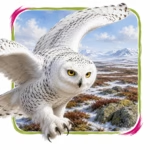
Great Horned Owl Fact Highlight
From the full animal facts page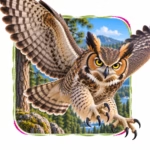
More Animal Comparisons
Pick another animal matchup and keep exploring. Compare appearances, habitats, diets, abilities, and surprising differences.



Make an Animal Story
Create an owl adventure about an Arctic day hunter and a woodland night hunter!