
Spider vs Scorpion: Arachnid Comparison
Spiders and scorpions are both eight-legged arachnids, but their bodies and hunting tools look very different. Spiders usually use silk, fangs, and venom to capture prey. Scorpions have large pincers, a long segmented tail, and a stinger that can inject venom. Neither animal is an insect.
About Spider
- Type Invertebrate
- Diet Carnivore
- Group Arachnid
- Known for Eight legs, silk, fangs, venom, web building, and hunting small animals
- Special skill Producing several kinds of silk for webs, egg sacs, safety lines, shelters, and prey capture
About Scorpion
- Type Invertebrate
- Diet Carnivore
- Group Arachnid
- Known for Large pincers, segmented tail, venomous stinger, night hunting, and desert survival
- Special skill Detecting tiny ground vibrations with sensory hairs and using pincers plus a venomous stinger to subdue prey
Spider vs Scorpion: Quick Answer
Spiders have two main body sections, silk-producing spinnerets, and fang-like chelicerae. Scorpions have a broader front body, large pincers, a segmented tail, and a venomous stinger. Both are arachnids with eight legs, exoskeletons, and no antennae.
Where Do They Fit?
Follow the branches to see how Spider and Scorpion are classified and related.
Spider vs Scorpion: Quick Comparison
| Feature | Spider | Scorpion |
|---|---|---|
| Animal type | Invertebrate | Invertebrate |
| Animal group | Arachnid | Arachnid |
| Known for | Silk, fangs, webs, and eight legs | Pincers, segmented tail, stinger, and eight legs |
| Main habitat | Nearly every land habitat depending on species | Mostly warm dry habitats, but also forests, caves, and grasslands |
| Main body plan | Cephalothorax and abdomen joined by a narrow waist | Cephalothorax, broad abdomen, and segmented tail |
| Front weapons | Chelicerae ending in fangs | Large pincers called pedipalps |
| Rear structure | Spinnerets that produce silk | Curved tail ending in a stinger |
| Baby name | Spiderling | Scorpling |
| Typical defense | Hiding, silk, camouflage, speed, and venom | Pincers, armor, hiding, and venomous sting |
| Special skill | Making different silk types | Sensing ground vibrations and glowing under ultraviolet light |
How Are Spiders and Scorpions Alike?
- Both spiders and scorpions are arachnids rather than insects.
- Both have eight walking legs, jointed limbs, and hard exoskeletons.
- Both lack antennae and wings.
- Both are predators that mainly eat insects and other small animals.
- Both molt their exoskeletons as they grow.
How Are Spiders and Scorpions Different?
- Spiders produce silk with spinnerets, while scorpions do not make capture webs.
- Spiders have fangs, while scorpions have large pincers and a tail stinger.
- Spider bodies have a narrow waist between two main sections, while scorpions have a broad abdomen followed by a segmented tail.
- Spider mothers usually guard or carry egg sacs, while scorpions give birth to live young that climb onto the mother’s back.
- Many spiders rely heavily on silk, while scorpions rely more on armor, pincers, vibration sensing, and their sting.
Spider vs Scorpion Showdown
Arachnid showdown: The scorpion wins for typical size and strength because many species have heavy pincers, thick armor, and muscular tails. The spider takes speed and stealth through rapid movement, camouflage, silk traps, and ambush tactics. Social life and swimming are ties because most species in both groups are solitary land animals, though exceptions exist. The scorpion wins our weirdest-fact prize because its outer covering glows blue-green under ultraviolet light.
Fun Spider vs Scorpion Facts
Fangs vs Pincers and Stinger
Spiders use chelicerae ending in fangs to inject venom or crush prey. Scorpions grasp prey with pincer-like pedipalps and may curve the tail forward to deliver venom through a stinger.
Silk Maker vs Armored Hunter
All known spiders produce silk, although not all build prey-catching webs. Scorpions do not spin webs and instead depend on a tough exoskeleton, burrows, pincers, camouflage, and venom.
Egg Sac vs Live Young
Most spiders lay eggs inside silk sacs that may be hidden, guarded, or carried. Scorpions give birth to live young, and the pale scorplings climb onto their mother’s back until after their first molt.
Narrow Waist vs Segmented Tail
A spider’s cephalothorax and abdomen connect through a narrow stalk called a pedicel. A scorpion has a broad front body and abdomen followed by a flexible tail made of several segments.
Scorpions Glow Under Ultraviolet Light
Compounds in a scorpion’s outer cuticle fluoresce under ultraviolet light, causing the animal to glow blue-green. Scientists still debate exactly why this trait evolved.
Spider vs Scorpion Quiz
- How many walking legs do spiders and scorpions have? Answer: Eight.
- Which arachnid produces silk from spinnerets? Answer: Spider.
- Which arachnid has large pincers and a tail stinger? Answer: Scorpion.
- What are baby spiders called? Answer: Spiderlings.
- Which animal glows under ultraviolet light? Answer: Scorpion.
Spider vs Scorpion FAQ
What is the main difference between a spider and a scorpion?
A spider usually has silk-producing spinnerets, fangs, and a narrow waist between two main body sections. A scorpion has large pincers, a broad abdomen, and a segmented tail ending in a stinger.
Are spiders and scorpions insects?
No. Both are arachnids. Adult insects have six legs and antennae, while spiders and scorpions have eight walking legs and no antennae.
Which is more venomous, a spider or a scorpion?
Venom strength varies enormously by species. Most spiders and scorpions are not medically dangerous to people, but a small number can cause serious illness, so wild arachnids should never be handled.
Do scorpions make webs?
No. Scorpions do not spin silk capture webs. They usually hunt from burrows, cracks, or the ground using vibration sensing, pincers, and sometimes the stinger.
Do spiders and scorpions care for their babies?
Many spider mothers guard or carry egg sacs, and some protect spiderlings. Scorpion mothers carry newborn scorplings on their backs until the young molt and can survive independently.
Animal Words to Know
- Arachnid: A member of the group containing spiders, scorpions, mites, and ticks.
- Chelicera: One of a spider’s front mouthparts, often ending in a fang.
- Pedipalp: A paired appendage near an arachnid’s mouth; in scorpions, pedipalps form the large pincers.
- Spinneret: A silk-producing structure near the rear of a spider’s abdomen.
- Fluorescence: The emission of visible light after absorbing another kind of light, such as ultraviolet radiation.
Spider and Scorpion Arachnid Detective Activity
Spider and Scorpion Arachnid Detective Activity
Draw a spider and scorpion at the same enlarged scale. Give the spider eight legs, two main body sections, fangs, spinnerets, silk, and an egg sac. Give the scorpion eight walking legs, two large pincers, a segmented tail, a stinger, and young riding on the mother’s back. Label arachnid, pincers, spinnerets, tail, and stinger.
Meet Each Animal
Want the full fact file? Here are quick highlights from each animal’s own facts page.
Spider Fact Highlight
From the full animal facts page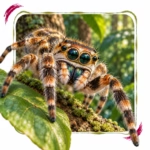
Scorpion Fact Highlight
From the full animal facts page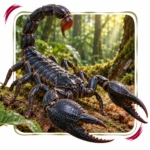
More Animal Comparisons
Pick another animal matchup and keep exploring. Compare appearances, habitats, diets, abilities, and surprising differences.



Make an Animal Story
Turn this spider vs scorpion comparison into a creepy-crawly desert adventure with our free Animal Story Generator.
Source notes: References used for this comparison. See more See less
Try Another Matchup
Explore this comparison →