
Spider vs Tarantula: Spider Group-to-Tarantula Subgroup Comparison
A tarantula is already a spider, so this is a broad-group comparison rather than two separate animal branches. The common house spider represents the familiar small web-building side: it catches prey in an irregular three-dimensional tangle web and usually measures only a few millimeters in body length. The Chilean rose tarantula represents a large ground-hunting tarantula with a leg span measured in centimeters, thick legs, downward-moving fangs, a burrow retreat, and defensive urticating hairs. Both have eight legs, two main body regions, spinnerets, venom, pedipalps, and an external skeleton that must be molted for growth. Neither should be picked up for identification.
About Spider
- Type Arachnid
- Diet Mostly insects and other small arthropods caught in sticky tangle-web strands, restrained with extra silk, bitten, externally digested, and consumed as liquid food
- Group Spider, represented here by the common house spider (Parasteatoda tepidariorum) so the broad comparison has measurable traits; spiders include more than 50,000 described species with many body plans
- Known for A small cobweb spider with two main body regions, eight slim walking legs, pedipalps beside the mouth, several tiny eyes, and a rounded patterned abdomen; adult females are usually about 5–6 millimeters in body length and males about 3.8–4.7 millimeters, excluding legs
- Special skill Irregular space-filling capture web, sticky silk, vibration sensing through legs, spinnerets that control different silks, venom-delivering chelicerae, flexible abdomen, and small body suited to narrow sheltered corners
About Tarantula
- Type Arachnid
- Diet Invertebrates such as crickets, beetles, and other arthropods, plus occasional small vertebrates; it hunts mainly from the ground at night and uses size, fangs, and venom to subdue prey
- Group Tarantula, represented here by the Chilean rose tarantula (Grammostola rosea), a terrestrial New World tarantula; the tarantula family Theraphosidae contains many other species
- Known for A robust, dark brown to black ground spider covered in rose-tinted sensory setae, with thick legs, two large downward-moving fangs, two pedipalps, and eight small eyes; females average about 12–13 centimeters in leg span and males about 9 centimeters
- Special skill Large downward-striking fangs, strong chelicerae, dense vibration-sensitive setae, irritating urticating abdominal hairs for defense, a silk-lined retreat, gripping foot pads, and a slow metabolism that can support long fasts
Spider vs Tarantula: Quick Answer
Every tarantula is a spider, but most spiders are not tarantulas. Compared with a common house spider, a Chilean rose tarantula is far larger, hairier-looking, heavier-bodied, and mainly hunts from the ground instead of using an aerial prey-catching web. The house spider builds an irregular tangle web in protected corners. The tarantula uses a silk-lined ground retreat, powerful downward-moving fangs, and irritating abdominal hairs for defense. Observe both without touching.
Where Do They Fit?
Follow the branches to see how Spider and Tarantula are classified and related.
Spider vs Tarantula: Quick Comparison
| Feature | Spider (Common House Spider Representative) | Tarantula (Chilean Rose Tarantula Representative) |
|---|---|---|
| Main meaning | The entire order Araneae, represented here by Parasteatoda tepidariorum | One spider family, Theraphosidae, represented here by Grammostola rosea |
| Typical scale | Female body about 5–6 mm long, with long slim legs | Female leg span about 12–13 cm, with a robust body and thick legs |
| Outer covering | Fine sensory hairs present but not usually shaggy-looking | Dense rose-tinted setae create a distinctly hairy appearance |
| Hunting style | Waits in a sticky three-dimensional tangle web | Ambushes prey mainly on the ground, especially after dark |
| Silk use | Builds an aerial capture web and hangs egg sacs in it | Lines a retreat, lays signal silk, and wraps or guards an egg sac |
| Fang movement | Small chelicerae oppose one another in the typical araneomorph pattern | Large fangs move mostly downward in the mygalomorph pattern |
| Defense | Hides, retreats, uses silk, and may bite tiny prey | Retreats, raises its front body, bites if pressed, or releases irritating hairs |
| Home | Protected building corners, fences, furniture, and stone gaps | Dry scrub ground, shallow burrows, crevices, and abandoned burrows |
| Young | Spiderlings emerge from a pear-shaped egg sac | Spiderlings emerge from a guarded round silk egg sac |
| Safe clue | Identify by web and proportions from a distance | Never handle; hairs can irritate skin and eyes, and fangs carry venom |
How Are Spiders and Tarantulas Alike?
- A tarantula is a spider, so both representatives belong to order Araneae and class Arachnida.
- Both have eight walking legs, two main body regions, pedipalps, chelicerae with venom-delivering fangs, spinnerets, and no antennae or wings.
- Both are predators that detect movement or vibration, immobilize prey, release digestive fluids, and draw in liquefied food.
- Both make silk, even though they use it differently, and females enclose eggs in protective silk sacs.
- Both grow by molting an external skeleton and are especially vulnerable until the new covering hardens.
How Are Spiders and Tarantulas Different?
- Spider is the huge parent group; tarantulas form one family of spiders, Theraphosidae.
- The common house-spider representative measures only a few millimeters in body length, while a female Chilean rose tarantula averages about 12–13 centimeters across the legs.
- The house spider has a delicate outline and long slim legs; the tarantula is robust, thick-legged, and densely covered in visible setae.
- The house spider relies on an irregular aerial tangle web to catch prey; the tarantula is mainly a terrestrial ambush hunter and uses silk around its retreat rather than as a large flying-insect net.
- Araneomorph house-spider fangs oppose one another, while the tarantula’s mygalomorph fangs move mostly downward.
- The Chilean rose tarantula can release irritating urticating hairs from its abdomen, a defense the common house spider does not possess.
Spider vs Tarantula Adaptation Showdown
Web-hunter-and-ground-hunter showdown: The tarantula wins size and typical individual strength because the selected Chilean rose tarantula is vastly larger and subdues relatively large prey with a robust body and powerful chelicerae. Speed is a tie because reliable like-for-like maxima are unavailable and movement changes with temperature and context. Stealth is a tie: the house spider hides in a tangle web and the tarantula waits near a ground retreat. Social skill is a tie because both are mainly solitary. Swimming is a tie because neither representative is aquatic. Tarantula wins weirdest adaptation for releasing microscopic urticating abdominal hairs that can irritate a predator. These categories compare adaptations, not combat.
Fun Spider vs Tarantula Facts
A Tarantula Fits Inside the Spider Family Tree
Tarantulas are not a separate kind of eight-legged animal beside spiders. They are members of order Araneae, within the family Theraphosidae. A common house spider belongs to a different family, Theridiidae. Saying “spider vs tarantula” is therefore like saying “bird vs owl”: the second name identifies one special branch inside the first.
One Builds a Prey Net and One Builds a Ground Alarm
The common house spider stretches sticky silk through a protected corner to create a messy-looking but functional three-dimensional prey trap. A Chilean rose tarantula does not spin that kind of aerial capture web. It lays silk around a burrow or resting area, where vibrations can announce approaching prey, predators, or a possible mate.
Tarantula Hair Is Not Mammal Fur
The shaggy covering on a tarantula consists of setae, specialized structures in the outer skeleton that can detect air currents, touch, and vibration. The Chilean rose tarantula also has urticating hairs on its abdomen. When threatened, it can rub these loose, creating an irritating cloud that should be kept away from skin and especially eyes.
Both Turn Prey Into Drinkable Food
Neither spider chews a meal the way a child chews bread. After prey is restrained and bitten, digestive fluids begin breaking tissues down outside the mouth. The spider then draws in the resulting liquid through a narrow opening that filters out large solid pieces. Venom helps capture prey, but medically important effects vary enormously among spider species.
Molting Means Climbing Out of an Old Suit
A spider’s hard outer skeleton cannot stretch forever. Before a molt, the animal forms a new covering underneath, splits the old one, and carefully pulls out its legs and body. A newly molted spider is soft and vulnerable until the new skeleton hardens. Tarantulas may lie on their backs during this normal process, which can look alarming.
Spider vs Tarantula Quiz
- Is a tarantula a type of spider? Answer: Yes. Tarantulas are spiders in family Theraphosidae.
- Which representative catches prey in an irregular aerial tangle web? Answer: The common house spider.
- What does a Chilean rose tarantula use urticating hairs for? Answer: Defense by irritating a possible predator.
- Why do both spiders molt? Answer: Their outer skeleton does not grow, so they must replace it with a larger one.
- Should a child pick up either animal to identify it? Answer: No. Observe without touching and ask an adult for help.
Spider vs Tarantula FAQ
What is the main difference between a spider and a tarantula?
Spider is the broad group containing all members of order Araneae. A tarantula is one type of spider in family Theraphosidae. Compared with the common house-spider representative, a Chilean rose tarantula is much larger, more robust, more visibly hairy, and mainly hunts on the ground.
Do all spiders make webs?
All known spiders make silk, but not all build aerial webs to catch prey. Common house spiders use tangle webs as traps. Tarantulas use silk to line retreats, detect vibrations, protect eggs, and support other tasks while hunting mainly without a capture web.
Are tarantulas more venomous than ordinary spiders?
“More venomous” is not a useful general rule. Both representatives use venom to subdue prey, but venom chemistry and medical importance differ among species. A Chilean rose tarantula can bite and its urticating hairs can irritate, so it should never be handled casually.
Why are tarantulas hairy?
The visible covering is made of setae rather than mammal fur. Many setae sense touch, air movement, or vibrations. New World tarantulas also have detachable urticating hairs used in defense.
What should a child do after finding a large spider?
Leave it alone, keep hands and pets away, and tell a responsible adult. Do not trap it bare-handed, poke it, spray it, or use appearance alone to decide whether it is harmless.
Animal Words to Know
- Araneae: The scientific order containing all true spiders, including tarantulas.
- Theraphosidae: The spider family containing tarantulas.
- Setae: Hair-like structures that can sense touch or vibration and sometimes aid defense.
- Urticating hairs: Tiny detachable barbed hairs that can irritate skin, eyes, or other tissues.
- Spinnerets: Movable silk-producing structures near the rear of a spider’s abdomen.
House Spider and Tarantula Activity
House Spider and Tarantula Activity
Draw a small common house spider beside an irregular tangle web and a much larger Chilean rose tarantula beside a ground retreat. Show wrapped prey and an egg sac on the house-spider side, and thick hairy legs and a silk-lined shelter on the tarantula side. Place both inside a large circle labeled spiders. Label eight legs, two body regions, fangs, spinnerets, web, burrow, and spiderling.
Meet Each Animal
Want the full fact file? Here are quick highlights from each animal’s own facts page.
Spider Fact Highlight
From the full animal facts page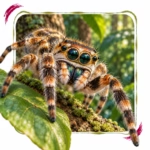
Tarantula Fact Highlight
From the full animal facts page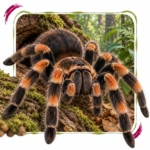
More Animal Comparisons
Pick another animal matchup and keep exploring. Compare appearances, habitats, diets, abilities, and surprising differences.






Make an Animal Story
Turn this spider vs tarantula comparison into a silk-web and desert-burrow mystery with our free Animal Story Generator.
Source notes: References used for this comparison. See more See less
Try Another Matchup
Explore this comparison →