
Springbok vs Thomson’s Gazelle: Antelope Species Comparison
Springboks look gazelle-like, but they are not members of a gazelle genus. This page compares the Springbok, Antidorcas marsupialis, with Thomson’s Gazelle, Eudorcas thomsonii. The Springbok is usually larger and lives in dry southern Africa. Both sexes have curved horns, and a hidden fold along the back opens into a white fan during pronking. Thomson’s Gazelle is a smaller East African plains animal with a bold black side stripe and no back fan.
About Springbok
- Type Living
- Diet Herbivore and mixed feeder; grazes grass and browses shrubs, flowers and moisture-rich plants
- Group Southern African antelope and the only living species in genus Antidorcas (Antidorcas marsupialis)
- Known for White face, dark eye stripes, reddish flank band, horns in both sexes and spectacular pronking with a white back fan
- Special skill Opens a skin fold along its back to raise a bright white fan while making stiff-legged pronking leaps
About Thomson’s Gazelle
- Type Living
- Diet Herbivore; mainly short grass, with seeds, twigs and leaves during dry conditions
- Group Small East African gazelle species in the cattle family Bovidae (Eudorcas thomsonii)
- Known for Small tan body, bold black side stripe, white belly and rump, ringed horns and fast zigzagging escape
- Special skill Stots in stiff-legged high jumps and can sprint around 70 kilometers per hour across open ground
Springbok vs Thomson’s Gazelle: Quick Answer
A Springbok is usually larger and more strongly built, with a reddish-brown flank band, horns in both sexes and a fold of white hair hidden along its back. During a high pronking leap, that fold opens like a fan. Thomson’s Gazelle is smaller, with a bold black horizontal side stripe and a white rump patch. Both jump stiff-legged, but only the Springbok raises the special white back fan.
Where Do They Fit?
Follow the branches to see how Springbok and Thomson’s Gazelle are classified and related.
Springbok vs Thomson’s Gazelle: Quick Comparison
| Feature | Springbok | Thomson’s Gazelle |
|---|---|---|
| Scientific name | Antidorcas marsupialis | Eudorcas thomsonii |
| Adult mass | About 33-46 kg | About 15-35 kg |
| Shoulder height | Around 80 cm | About 55-82 cm |
| Side marking | Broad reddish-brown to dark flank band | Bold black horizontal stripe |
| Face | Mostly white with dark stripes from eyes toward mouth | Tan and white with a dark stripe through the eye |
| Horns | Black curved horns in both sexes | Strong ringed horns on males; females may have small horns or none |
| Back display | Hidden white hair fan opens during pronking | No opening back fan |
| Habitat | Dry southern plains, shrubland and desert edges | East African short-grass plains and savanna |
| Food | Seasonal mix of grass, shrubs, flowers and succulents | Mostly short grass, with some browse and seeds |
| Alarm jump | Pronks with arched back and white fan raised | Stots with stiff legs and head held high |
How Are Springboks and Thomson’s Gazelles Alike?
- Both are slender African antelopes in the cattle family Bovidae.
- Both have tan-and-white coats with dark face and side markings.
- Both form herds and use many alert eyes and ears to detect danger.
- Both are herbivores that eat grass and can add other plant foods when seasons change.
- Both use fast running, sharp turns and stiff-legged jumps during escape or alarm.
How Are Springboks and Thomson’s Gazelles Different?
- The Springbok is normally heavier than Thomson’s Gazelle.
- Springboks live in southern Africa; Thomson’s Gazelles live mainly in Kenya and Tanzania.
- A Springbok carries a reddish-brown flank band, while the gazelle’s side stripe is black.
- Male and female Springboks have horns; female Thomson’s Gazelles may have small horns or none.
- The Springbok can open a white back fan during pronking, but Thomson’s Gazelle cannot.
Springbok vs Thomson’s Gazelle Adaptation Showdown
- Size – Springbok: Its normal adult mass range is higher, although the largest Thomson’s Gazelles overlap with small Springboks.
- Speed – Tie: Both are rapid plains runners, and published figures do not provide a fair matched test over the same distance.
- Strength – Springbok: Its heavier average body and horns in both sexes give it more total power; this is not a fight prediction.
- Stealth – Tie: Springbok colors match dry southern ground, while the gazelle’s tan back blends with East African grass.
- Social – Tie: Both form flexible herds that split, join and change with food, rain and breeding.
- Swimming – Tie: Neither is a water specialist; their main escape tools are running and jumping.
- Weirdest – Springbok: It can unzip a hidden fold of fur into a brilliant white back fan while bouncing high above the ground.
Fun Springbok vs Thomson’s Gazelle Facts
A Fan Hidden in the Back
A folded strip of skin runs along the Springbok’s back. When the animal pronks, long white hairs rise and turn the fold into a bright fan.
Not Quite a Gazelle
The Springbok is the only living species in Antidorcas. Thomson’s Gazelle belongs to Eudorcas, so the look-alikes sit in different genera.
Water from Food
Springboks can choose moisture-rich flowers, leaves and succulents when surface water is scarce. This helps them survive dry country.
The Great Treks
Huge Springbok movements once crossed southern Africa in herds that could contain hundreds of thousands or more. Modern treks are much smaller and rarer.
Two Kinds of High Jump
Springbok pronking arches the back and lifts the white fan. Thomson’s Gazelle stotting is also stiff-legged, but it has no fan to open.
Springbok vs Gazelle Quiz
Which animal has a hidden white back fan? A) Springbok B) Thomson’s Gazelle C) Both Answer: A) Springbok
Which animal usually weighs more? A) Springbok B) Thomson’s Gazelle C) They are identical Answer: A) Springbok
Where does Thomson’s Gazelle live? A) East Africa B) South America C) Australia Answer: A) East Africa
Which Springboks grow horns? A) Both sexes B) Males only C) Neither sex Answer: A) Both sexes
What are pronking and stotting? A) Stiff-legged jumps B) Swimming strokes C) Nest-building methods Answer: A) Stiff-legged jumps
Springbok vs Thomson’s Gazelle FAQ
Is a Springbok a gazelle?
It is a gazelle-like antelope but belongs to its own genus, Antidorcas, rather than a recognized gazelle genus.
Which gazelle is used on this page?
Thomson’s Gazelle is the benchmark. Gazelle is a broad name, so another species could give different results.
Why does a Springbok show white hair?
The bright fan appears during excitement or alarm and makes its pronking display especially easy to see.
Can Springboks live without a nearby water hole?
They can meet much of their water need from moisture-rich plants, although they drink when water is available.
Which animal is faster?
Both are extremely fast. Without a matched scientific test using the same distance and conditions, a tie is fairest.
Animal Words to Know
- Antelope: A varied group of hoofed mammals in the cattle family Bovidae.
- Genus: A scientific group of closely related species.
- Pronking: A Springbok’s repeated stiff-legged jumps, often with an arched back and raised white fan.
- Stotting: A high stiff-legged jump used by several hoofed animals during alarm or escape.
- Succulent: A plant with thick parts that store water.
Build a Jump-and-Markings Flip Card
Build a Jump-and-Markings Flip Card
Draw a larger Springbok on one flap with a reddish flank band, horns on a male and female, and a white back fan raised during pronking. Draw a smaller Thomson’s Gazelle on the second flap with a bold black side stripe and a stiff-legged stot. Hide the names, then use the markings and jump styles to identify each one.
Meet Each Animal
Want the full fact file? Here are quick highlights from each animal’s own facts page.
Springbok Fact Highlight
From the full animal facts page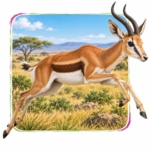
Thomson’s Gazelle Fact Highlight
From the full animal facts page
More Animal Comparisons
Pick another animal matchup and keep exploring. Compare appearances, habitats, diets, abilities, and surprising differences.
Make an Animal Story
Create an antelope story about a Springbok with a secret white flag meeting a speedy gazelle on the plains!
Source notes: References used for this comparison. See more See less
Try Another Matchup
Explore this comparison →