
Squirrel vs Flying Squirrel for Kids
An Eastern Gray Squirrel and Southern Flying Squirrel are true relatives in the squirrel family, but they use the forest on different schedules. The larger gray squirrel bounds and climbs through trees in daylight, using its bushy tail for balance and burying many nut caches. The tiny flying squirrel emerges at night, stretches a skin membrane between its wrists and ankles, and glides from tree to tree while steering with a flattened tail.
About Eastern Gray Squirrel
- Type Mammal
- Diet Omnivore; mainly nuts, seeds, buds, fruits, and fungi
- Group Tree squirrel; family Sciuridae
- Known for A bushy tail, agile leaps, daytime foraging, and buried nut caches
- Special skill Leaping between branches and scatter-hoarding nuts located by memory and smell
About Southern Flying Squirrel
- Type Mammal
- Diet Omnivore; nuts, seeds, insects, fungi, berries, eggs, and other foods
- Group Flying squirrel; family Sciuridae
- Known for Nighttime glides on a wrist-to-ankle skin membrane
- Special skill Steering and braking a glide with a patagium and flattened tail
Quick Answer
Quick answer: The Eastern Gray Squirrel is much larger, active mostly by day, and built for running, climbing, and jumping. The Southern Flying Squirrel is smaller, active at night, and does not truly fly; it glides on a skin membrane called a patagium. Both are tree squirrels that use cavities or leaf nests, eat nuts and fungi, cache food, raise kits, and help forests by moving seeds.
Eastern Gray Squirrel vs Southern Flying Squirrel: Quick Comparison
| Feature | Eastern Gray Squirrel | Southern Flying Squirrel |
|---|---|---|
| Scientific identity | Sciurus carolinensis | Glaucomys volans |
| Squirrel family | Sciuridae | Sciuridae |
| Published adult mass | About 338-750 g | About 38-90 g |
| Published adult length | About 38-53 cm | About 20-29 cm |
| Best-known habitat | Hardwood forest, parks, suburbs, and yards | Mature deciduous or mixed forest with tree cavities |
| Body clues | Medium body, ordinary limbs, very broad bushy tail | Small body, huge dark eyes, flattened tail, wrist-to-ankle membrane |
| Main travel style | Runs, climbs, and leaps between branches | Climbs and glides between trees |
| Active time | Mostly daytime | Strictly nighttime |
| Social pattern | Somewhat social; mothers nest alone with kits | Winter groups of 10-20 may huddle in one nest |
| Food storage | Scatter-hoards single nuts in many ground caches | Caches nuts in cracks, cavities, and nest sites |
How Are Gray and Flying Squirrels Alike?
- Both are rodents in family Sciuridae and are adapted for life in trees.
- Both eat nuts, seeds, fungi, buds, fruits, and at least some animal foods.
- Both store food for later and may help spread seeds through the forest.
- Both shelter or raise kits in tree cavities, leaf nests, or similar protected sites.
- Both have strong climbing feet, long tails used in movement, whiskers, and keen senses.
How Are Gray and Flying Squirrels Different?
- The Eastern Gray Squirrel is much larger and heavier than the Southern Flying Squirrel.
- The gray squirrel is active mostly by day, while the flying squirrel is active at night and has extra-large eyes.
- The gray squirrel runs and leaps, while the flying squirrel glides on a patagium stretched from wrist to ankle.
- The gray squirrel has a deep bushy tail, while the flying squirrel has a flatter tail used to steer and brake.
- Gray squirrels are only somewhat social, while many flying squirrels may huddle together in a shared winter nest.
Eastern Gray Squirrel vs Southern Flying Squirrel Showdown
Adaptation showdown: Eastern Gray Squirrel wins size because its published length and mass ranges are far greater. Speed is a Tie because a daylight jump and a nighttime glide are different movements and the sources do not provide a matched race. Eastern Gray Squirrel wins functional strength for moving a much larger body through forceful leaps and climbs; this is not a fight prediction. Southern Flying Squirrel wins stealth because it forages at night and can glide between trees. Southern Flying Squirrel wins social behavior because 10 to 20 may huddle in one winter nest. Eastern Gray Squirrel wins swimming because large historical groups have been documented swimming across the Connecticut River, while neither species is an aquatic specialist. Southern Flying Squirrel wins weirdest for turning a wrist-to-ankle skin membrane and flattened tail into a steerable parachute.
Fun Eastern Gray Squirrel vs Southern Flying Squirrel Facts
Flying Means Gliding
A Southern Flying Squirrel cannot flap wings or climb through the air. It leaps from a high point and stretches its wrist-to-ankle patagium into an air-catching surface that carries it downward toward another tree.
A Tail Steers the Parachute
During a glide, the flying squirrel changes tension in its membrane to adjust course and uses its flattened tail to steer. Just before landing, it flips the tail up and raises the front of its body.
Winter Nests Become Squirrel Blankets
Southern Flying Squirrels are very social in cold weather. As many as 20 may share one nest and huddle, reducing the amount of heat each tiny body must produce alone.
Nuts Are Hidden One by One
Eastern Gray Squirrels scatter-hoard food in many small caches. They recover buried nuts with memory and smell, and forgotten seeds may grow into new trees.
Gray Squirrels Can Cross Rivers
Eastern Gray Squirrels are not water specialists, but they can swim. Connecticut recorded a 1933 migration in which 1,000 or more gray squirrels swam across the Connecticut River.
Squirrel vs Flying Squirrel Quiz
- Which squirrel is much larger? Answer: The Eastern Gray Squirrel.
- Does a Southern Flying Squirrel truly fly? Answer: No. It glides on a skin membrane.
- Which squirrel is active mostly at night? Answer: The Southern Flying Squirrel.
- What is the gliding membrane called? Answer: The patagium.
- Why may flying squirrels share a winter nest? Answer: Huddling helps them conserve heat.
Eastern Gray Squirrel vs Southern Flying Squirrel FAQ
Is a flying squirrel really a squirrel?
Yes. Eastern Gray Squirrels and Southern Flying Squirrels both belong to family Sciuridae.
Can flying squirrels flap and fly like bats?
No. They glide downward between high points by stretching a skin membrane, and they must climb before launching again.
Which is bigger, a gray squirrel or flying squirrel?
The Eastern Gray Squirrel is much bigger. Published mass ranges are about 338 to 750 grams versus about 38 to 90 grams.
Why do flying squirrels have such large eyes?
They are nocturnal, so large eyes help them gather light and navigate at night.
Can gray squirrels swim?
Yes. They are not aquatic specialists, but gray squirrels can swim, and large river crossings have been recorded during migrations.
Animal Words to Know
- Patagium: The loose skin membrane a flying squirrel stretches for gliding.
- Glide: To travel through the air without flapping wings or using an engine.
- Nocturnal: Most active at night.
- Diurnal: Most active during the day.
- Scatter-hoard: To hide separate food items in many different places.
Map Two Treetop Travel Routes
Map Two Treetop Travel Routes
Draw one adult Eastern Gray Squirrel and one adult Southern Flying Squirrel at honest relative scale on neighboring hardwood trees. Trace a gray squirrel route with running, climbing, jumping, and a ground nut cache. Trace a flying squirrel route with a high launch, stretched patagium, curved glide, tail-up landing, and cavity nest. Add day and night symbols, then explain why this is a comparison of adaptations rather than a race or wildlife handling activity.
Meet Each Animal
Want the full fact file? Here are quick highlights from each animal’s own facts page.
Eastern Gray Squirrel Fact Highlight
From the full animal facts page
Southern Flying Squirrel Fact Highlight
From the full animal facts page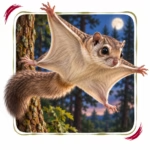
More Animal Comparisons
Pick another animal matchup and keep exploring. Compare appearances, habitats, diets, abilities, and surprising differences.


Make an Animal Story
Send a nut-hiding gray squirrel and a moonlight glider into a treetop mystery with our free Animal Story Generator.