
Sumatran Rhino vs Javan Rhino: Asian Rhino Comparison
Sumatran and Javan rhinos are the two rarest Asian rhino species, and both survive only in Indonesia. They are forest browsers, mud wallowers and mostly solitary animals. A Sumatran rhino is the smaller, hairier species and carries two horns. A Javan rhino is much heavier, nearly hairless and wrapped in deep skin folds, with one small horn in adult males and often no visible horn in females.
About Sumatran Rhino
- Type Living
- Diet Herbivore and browser
- Group Small hairy Asian rhinoceros (Dicerorhinus sumatrensis)
- Known for Reddish hair, fringed ears, two horns and many whistle-like calls
- Special skill Moves through dense rainforest with a small body, flexible upper lip and strong vocal communication
About Javan Rhino
- Type Living
- Diet Herbivore and browser
- Group Lesser one-horned rhinoceros (Rhinoceros sondaicus)
- Known for One small horn, armour-like skin folds and survival in one wild population
- Special skill Uses a grasping upper lip to pull browse and skin folds suited to moving through wet tropical cover
Sumatran Rhino vs Javan Rhino: Quick Answer
Sumatran rhinos are the smallest living rhinos, usually about 600-950 kilograms in the current conservation account. They have reddish-brown hair, fringed ears and two horns. Javan rhinos can weigh about 900-2,300 kilograms and have grey armour-like skin folds. Adult males carry one small horn; females often have a tiny knob or no horn. Javan Rhino wins size and strength. Sumatran Rhino wins forest stealth and the weirdest combination of hair, two horns and musical calls.
Where Do They Fit?
Follow the branches to see how Sumatran Rhino and Javan Rhino are classified and related.
Sumatran Rhino vs Javan Rhino: Quick Comparison
| Feature | Sumatran Rhino | Javan Rhino |
|---|---|---|
| Scientific name | Dicerorhinus sumatrensis | Rhinoceros sondaicus |
| Wild range today | Small fragmented populations in Indonesia | One population in Ujung Kulon National Park, western Java |
| Current estimate | About 34-47 animals in the 2025 international estimate | Approximately 50 animals in the 2025 international estimate |
| Adult mass | About 600-950 kg in the current IRF profile | About 900-2,300 kg |
| Hair and skin | Reddish-brown skin with variable long hair and fringed ears | Grey, nearly hairless skin with deep armour-like folds |
| Horns | Two; the front horn is larger and the rear horn is usually small | One small horn in males; females often have a knob or no horn |
| Habitat | Dense lowland and highland tropical forest, river valleys and swamps | Lowland rainforest, wet grassland, rivers and wallows near sea level |
| Diet | Browses leaves, twigs, bark, shoots and fruit from many plant species | Browses shoots, twigs, leaves and fallen fruit from hundreds of plant species |
| Social life | Mostly solitary, but communicates with whistles and other calls | Mostly solitary and communicates with scent marks, tracks and sounds |
| Cooling system | Uses mud wallows and water because rhinos do not cool by sweating well | Spends long periods wallowing to cool and protect its skin |
How Are Sumatran and Javan Rhinos Alike?
- Both are living Asian rhinos found only in Indonesia today.
- Both are critically endangered and survive in extremely small wild populations.
- Both are browsers that use a grasping upper lip to pull leaves, shoots and twigs.
- Both are mainly solitary, apart from breeding and mothers raising calves.
- Both depend on rainforest, fresh water, mineral licks and muddy wallows.
How Are Sumatran and Javan Rhinos Different?
- Sumatran rhinos are smaller; Javan rhinos can be more than twice as heavy.
- Sumatran rhinos have noticeable reddish hair; Javan rhinos are nearly hairless with armour-like folds.
- Sumatran rhinos have two horns; Javan males have one small horn and females often have none.
- Sumatran rhinos survive in several tiny, separated areas; all known Javan rhinos live in one national park.
- Sumatran rhinos are famous for varied whistles and whines, while Javan rhinos are less often heard or seen.
Sumatran Rhino vs Javan Rhino Adaptation Showdown
- Size – Javan Rhino: Its published mass reaches roughly 2,300 kilograms, while the current Sumatran profile reaches about 950 kilograms.
- Speed – Tie: Both can move rapidly through forest, but no reliable head-to-head speed test exists.
- Strength – Javan Rhino: Its much greater maximum mass gives it more whole-body power, not a prediction about a fight.
- Stealth – Sumatran Rhino: Its smaller body, reddish-brown hair and use of dense upland forest make it especially difficult to detect.
- Social – Tie: Both species are mainly solitary and form their longest social bond between a mother and her calf.
- Swimming – Tie: Both use rivers, pools and wallows, but the available accounts do not support a fair swimming champion.
- Weirdest – Sumatran Rhino: It is a hairy, two-horned tropical rhino that can whistle, whine and make call sequences sometimes compared with whale song.
Fun Sumatran Rhino vs Javan Rhino Facts
The Hairy Rhino Is the Smallest Rhino
Sumatran rhinos are the smallest living rhino species. Calves are especially furry, and adults keep variable reddish-brown hair on the body and ear fringes.
Javan Females May Have No Horn
Adult Javan males usually carry one small horn. Females often have only a tiny bump or no visible horn at all.
Mud Is Essential Skin Care
Both species wallow in mud and water. The coating helps cool the body, keeps skin moist and may reduce biting insects.
One Species Lives in One Park
Every known wild Javan rhino now lives in Ujung Kulon National Park. A disease, tsunami or habitat problem could therefore affect the whole species.
Sumatran Rhinos Are Surprisingly Vocal
They make whistles, whines and other calls that travel through thick forest. Sound helps animals communicate when sight is blocked by vegetation.
Sumatran Rhino vs Javan Rhino Quiz
Which rhino has two horns? A) Sumatran rhino B) Javan rhino C) Both always have two Answer: A) Sumatran rhino
Which rhino is larger? A) Sumatran rhino B) Javan rhino C) They are identical Answer: B) Javan rhino
Which rhino has noticeable reddish hair? A) Sumatran rhino B) Javan rhino C) Neither Answer: A) Sumatran rhino
Where do all known Javan rhinos live? A) Ujung Kulon National Park B) The African savanna C) The Arctic Answer: A) Ujung Kulon National Park
Why do both rhinos wallow in mud? A) To cool and protect their skin B) To grow horns C) To hibernate Answer: A) To cool and protect their skin
Sumatran Rhino vs Javan Rhino FAQ
Are Sumatran and Javan rhinos the same species?
No. They are separate species in different genera, with different body sizes, skin coverings and horn numbers.
Which is rarer?
Both are critically endangered. The latest cited estimates are about 34-47 Sumatran rhinos and approximately 50 Javan rhinos, and every individual matters.
Why is the Sumatran rhino hairy?
Hair is an ancient-looking feature of this species and helps hold mud on the skin. Young calves are furrier than adults.
Do female Javan rhinos have horns?
Most females have a very small knob or no visible horn, while adult males normally grow one small horn.
Can the two species meet in the wild?
No. Their surviving populations are separated: Javan rhinos live in western Java, while Sumatran rhinos remain in other protected Indonesian forests.
Animal Words to Know
- Browser: An animal that feeds mainly on leaves, shoots, twigs and other high-growing plants.
- Critically endangered: A conservation category showing an extremely high risk of extinction in the wild.
- Prehensile: Able to grasp or hold something, as with a rhino’s flexible upper lip.
- Solitary: Living mainly alone rather than in a permanent herd.
- Wallow: A muddy or watery hollow where an animal rolls, rests or cools.
Hairy Rhino and Armoured Rhino Activity
Hairy Rhino and Armoured Rhino Activity
Draw a smaller Sumatran rhino in dense forest and a much larger Javan rhino beside a lowland wallow. Give the Sumatran rhino reddish hair, fringed ears and two horns. Give the Javan rhino grey armour-like folds and one tiny male horn. Add five labels: hairy coat, two horns, skin folds, one horn and mud wallow.
Meet Each Animal
Want the full fact file? Here are quick highlights from each animal’s own facts page.
Sumatran Rhino Fact Highlight
From the full animal facts page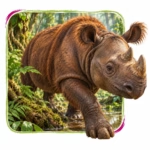
Javan Rhino Fact Highlight
From the full animal facts page
More Animal Comparisons
Pick another animal matchup and keep exploring. Compare appearances, habitats, diets, abilities, and surprising differences.





Make an Animal Story
Create a rainforest rescue story with a hairy Sumatran rhino and an armoured Javan rhino!
Source notes: References used for this comparison. See more See less
Try Another Matchup
Explore this comparison →