
Tawny Owl vs Barn Owl for Kids
Tawny Owls and Barn Owls can live in the same countryside, yet their faces and voices are easy to separate. The Tawny Owl is a compact typical owl with bark-colored feathers, dark eyes, and a rounded face. The Barn Owl belongs to a different owl family and has a pale heart-shaped facial disc, longer legs, and a harsh screech instead of a true hoot.
About Tawny Owl
- Type Bird
- Diet Carnivore; small mammals, birds, frogs, insects, worms, and other small prey
- Group Typical owl; family Strigidae
- Known for Dark eyes, bark-colored feathers, and the classic two-part hooting duet
- Special skill Asymmetrical ear openings help pinpoint faint sounds in dark woodland
About Barn Owl
- Type Bird
- Diet Carnivore; mainly voles, mice, shrews, and other small mammals
- Group Barn owl; family Tytonidae
- Known for A white heart-shaped facial disc, long legs, silent low flight, and a screeching call
- Special skill A heart-shaped facial disc and uneven ear openings funnel and compare sound with great accuracy
Quick Answer
Quick answer: Tawny Owls are woodland specialists with broad rounded wings, strong bark camouflage, and a famous hooting duet. Barn Owls patrol open grassland and farmland in low, silent flight. Their pale heart-shaped facial disc helps collect sound, and their call is usually a shriek, hiss, or snore. Their adult masses overlap, so neither is a simple size champion.
Tawny Owl vs Barn Owl: Quick Comparison
| Feature | Tawny Owl | Barn Owl |
|---|---|---|
| Scientific identity | Strix aluco | Tyto alba |
| Owl family | Strigidae, the typical owls | Tytonidae, the barn owls |
| Published size | About 38 cm; roughly 420 g for males and 520 g for females | About 32-40 cm and roughly 430-620 g |
| Face | Round facial disc with dark eyes | White heart-shaped facial disc with dark eyes |
| Plumage clue | Mottled reddish-brown or gray-brown like tree bark | Golden-buff and gray above with pale or white underparts |
| Best-known habitat | Mature woodland, parks, and large gardens | Open grassland, farmland, marsh edges, and buildings or cavities for nests |
| Voice | Male hoot and female ke-wick call can form a duet | Screeches, shrieks, hisses, and snores rather than a true hoot |
| Main food | Small mammals plus birds, frogs, insects, and worms | Mostly small mammals such as voles, mice, and shrews |
| Nest | Usually a tree hole; also old nests, buildings, or other cavities | Tree hollows, barns, lofts, churches, cliffs, and nest boxes |
| Hunting style | Nocturnal woodland flight and listening from perches | Low silent flight over open ground, often near dusk or at night |
How Are Tawny Owls and Barn Owls Alike?
- Both are birds of prey with hooked bills, sharp talons, large eyes, and soft-edged flight feathers.
- Both use sensitive hearing to locate small animals when light is low.
- Both eat many rodents and later cough up pellets containing indigestible fur and bones.
- Both often nest in cavities and have white eggs cared for by adults.
- Both usually hunt alone even when a mated pair shares a territory or nesting area.
How Are Tawny Owls and Barn Owls Different?
- Tawny Owls belong to the typical owl family Strigidae; Barn Owls belong to Tytonidae.
- The Tawny Owl has a rounded bark-colored face; the Barn Owl has a pale heart-shaped face.
- Tawny Owls favor mature woodland, while Barn Owls hunt mainly across open grassland and farmland.
- A Tawny Owl gives the familiar hooting duet, while a Barn Owl usually screeches, hisses, or snores.
- Tawny Owls have a compact shape and shorter legs; Barn Owls have a slimmer shape, longer legs, and proportionally long wings.
Tawny Owl vs Barn Owl Showdown
Adaptation showdown: Size is a Tie because their published lengths and masses overlap. Speed is a Tie because the sources give no fair matched flight-speed test. Strength is a Tie because both use talons and a hooked bill on prey suited to their habitat, without a matched measure. Barn Owl wins stealth because its soft flight feathers and low silent patrols help it approach prey over grass. Social behavior is a Tie because both are usually solitary hunters but can form lasting pairs. Swimming is a Tie because neither is a water specialist. Barn Owl wins weirdest for a heart-shaped sound-collecting face and ear openings placed at different heights.
Fun Tawny Owl vs Barn Owl Facts
The Famous Hoot Is a Duet
The storybook owl call is often built from two Tawny Owls. A male gives the long hooting part, while a female answers with a sharp ke-wick, producing the familiar two-part rhythm.
Barn Owls Do Not Truly Hoot
Barn Owls communicate with eerie shrieks, hisses, clicks, twitters, and snores. Their voice is one of the quickest clues that the pale owl overhead is not a Tawny Owl.
Two Uneven Ears
Both owls use ear openings that are not perfectly level. Tiny differences in when a sound reaches each ear help the brain work out the direction and height of rustling prey.
A Face That Collects Sound
The Barn Owl’s stiff facial feathers form a heart-shaped disc. The disc guides sound toward the ear openings, helping the owl locate small mammals hidden under grass.
Pellets Tell a Food Story
Owls swallow small prey in large pieces. Later they cough up a compact pellet of fur, feathers, teeth, and bones that scientists can examine to discover what the owl ate.
Tawny Owl vs Barn Owl Quiz
- Which owl has a heart-shaped facial disc? Answer: The Barn Owl.
- Which owl is strongly linked to mature woodland? Answer: The Tawny Owl.
- Does a Barn Owl usually give a classic hoot? Answer: No. It more often shrieks, hisses, or snores.
- Why are owl ear openings uneven? Answer: They help pinpoint the direction and height of sounds.
- What can scientists learn from an owl pellet? Answer: They can identify bones, teeth, fur, or feathers from prey.
Tawny Owl vs Barn Owl FAQ
Are Tawny Owls and Barn Owls the same family?
No. Tawny Owls are in Strigidae, while Barn Owls are in Tytonidae.
Which owl is bigger?
Their published adult measurements overlap, so size is a tie in this comparison.
Which one hoots?
The Tawny Owl gives a classic hoot; the Barn Owl is better known for screeches and hisses.
Can both owls fly silently?
Both have soft flight adaptations, and the Barn Owl is especially famous for low silent hunting over grass.
Can they live near people?
Yes. Tawny Owls can use parks and large gardens, while Barn Owls may nest in buildings and hunt nearby farmland.
Animal Words to Know
- Facial disc: A ring or shape of stiff feathers around an owl’s face that helps direct sound.
- Nocturnal: Most active at night.
- Pellet: A compact bundle of indigestible food parts coughed up by a bird.
- Territory: An area an animal occupies and may defend from others of its kind.
- Asymmetrical: Not placed or shaped exactly the same on both sides.
Map Two Owl Listening Zones
Map Two Owl Listening Zones
Draw exactly one adult Tawny Owl in a mature woodland and exactly one adult Barn Owl above neighboring rough grassland at honest relative scale. Add clue cards for round face, heart face, hoot, screech, tree bark, pale underside, woodland perch, and low grassland flight. Sort and explain the clues, then draw sound waves leading toward each owl’s uneven ears. Observe wild owls without people handling them.
Meet Each Animal
Want the full fact file? Here are quick highlights from each animal’s own facts page.
Tawny Owl Fact Highlight
From the full animal facts page
Barn Owl Fact Highlight
From the full animal facts page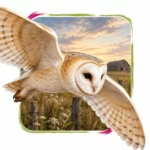
More Animal Comparisons
Pick another animal matchup and keep exploring. Compare appearances, habitats, diets, abilities, and surprising differences.





Make an Animal Story
Send a hooting Tawny Owl and a silent heart-faced Barn Owl through a moonlit mystery with our free Animal Story Generator.