
Thorny Devil vs Horned Lizard for Kids: Spines and Ants
The Thorny Devil and Texas Horned Lizard are small, wide-bodied ant hunters with camouflage, spikes, short tails, and patient movement. They look like cousins, but they belong to different lizard families on opposite sides of the Pacific. Similar desert problems led evolution toward similar armor, while each species also developed a defense the other lacks.
About Thorny Devil
- Type Spiny desert agamid lizard
- Diet Ant specialist
- Group Dragon lizard family, Agamidae
- Known for All-over spines, a false head, ant eating, and skin channels that carry water
- Special skill Collects dew or damp sand between its scales and moves the water to its mouth by capillary action
About Texas Horned Lizard
- Type Horned desert phrynosomatid lizard
- Diet Mostly ant specialist
- Group North American spiny lizard family, Phrynosomatidae
- Known for A flat round body, long head horns, ant eating, and defensive eye blood
- Special skill Can spray a small stream of blood from tissues near its eyes at some predators
Quick Answer
Quick answer: A Thorny Devil is an Australian agamid covered in small spines, with a false head behind its neck and microscopic skin channels that carry water to its mouth. A Texas Horned Lizard is a North American phrynosomatid with long bony head horns and the ability to squirt blood from near its eyes at certain predators. Both mainly eat ants, hide with camouflage, lay eggs, and spend much of life alone.
Thorny Devil vs Texas Horned Lizard: Quick Comparison
| Feature | Thorny Devil | Texas Horned Lizard |
|---|---|---|
| Scientific name | Moloch horridus | Phrynosoma cornutum |
| Lizard family | Agamidae, the Old World dragon lizards | Phrynosomatidae, North American spiny lizards |
| Adult size | Small and hand-length; females are larger than males | Small and palm-length; females are larger than males |
| Armor | Many conical scales and spines, including a false head | Long bony head horns plus pointed and fringed body scales |
| Native home | Arid and semi-arid Australia | South-central United States and northern Mexico |
| Main food | Almost entirely small ants | Mostly harvester ants, plus other small arthropods |
| Movement | Slow walk with a rocking, stop-and-start gait | Short runs followed by freezing or pressing flat |
| Water trick | Skin grooves draw water between scales toward the mouth | Drinks available water normally; lacks the same full-body channel network |
| Predator defense | Camouflage, spines, inflation, tucked head, and false head | Camouflage, horns, flattening, inflation, hissing, and sometimes eye blood |
| Young | Usually several eggs in a deep nesting burrow | Often 14 to 37 eggs buried in soil; hatchlings are independent |
How Thorny Devils and Horned Lizards Are Alike
- Both are small, broad, low lizards protected by camouflage and pointed scales.
- Both specialize in eating large numbers of ants with quick tongue movements.
- Both live in dry open country with loose ground for hiding or nesting.
- Both are mainly solitary, active by day, and warmed by outside heat.
- Both lay eggs and produce hatchlings that must feed and hide independently.
How Thorny Devils and Horned Lizards Are Different
- The Thorny Devil is an Australian agamid, while the Texas Horned Lizard belongs to a North American family.
- The Thorny Devil has water-carrying channels between scales, while the horned lizard lacks that same full-body system.
- The Texas Horned Lizard has long rigid skull horns, while most Thorny Devil points are specialized scales.
- A Texas Horned Lizard can squirt blood near its eyes at some predators, while a Thorny Devil cannot.
- The Thorny Devil has a spiny false head behind the neck, while the horned lizard relies on its real horned head.
Thorny Devil vs Horned Lizard Adaptation Showdown
Adaptation showdown: Size is a Tie because adult ranges overlap and females are larger in both species. Speed is a Tie because both are short-distance, stop-and-freeze lizards rather than pursuit runners. Strength is a Tie because matched force data are unavailable and their defenses emphasize armor instead of power. Stealth is a Tie because both use exceptional desert camouflage and freezing behavior. Social behavior is a Tie because each is usually solitary outside breeding. Swimming is a Tie because neither is an aquatic specialist. Texas Horned Lizard wins weirdest for a last-resort defense that can send blood from the tissues near its eyes toward a canine predator, although the Thorny Devil’s water-channel skin is almost as surprising.
Fun Thorny Devil vs Texas Horned Lizard Facts
Water Runs Between the Scales
Tiny connected grooves cover the Thorny Devil’s skin. Capillary action can pull dew or moisture from damp sand along those grooves toward the corners of its mouth.
A Decoy Head
When threatened, a Thorny Devil may tuck down its real head. A spiny knob behind the neck then resembles a second head and presents a difficult mouthful.
An Ant Conveyor
Thorny Devils may eat hundreds of tiny ants in a day, picking them up one after another with a quick sticky tongue while standing beside a trail.
Blood as a Chemical Warning
A Texas Horned Lizard can raise pressure in vessels around its eyes and release blood toward some canine predators. Chemicals in the blood can taste unpleasant to them.
Look-Alikes, Not Close Cousins
Australian Thorny Devils and North American horned lizards evolved similar flat bodies, spikes, camouflage, and ant diets independently.
Thorny Devil vs Horned Lizard Quiz
- Which lizard uses skin grooves to move water toward its mouth? Answer: The Thorny Devil.
- Which lizard may squirt blood near its eyes? Answer: The Texas Horned Lizard.
- What food dominates both diets? Answer: Ants.
- Where does the Thorny Devil live? Answer: In arid and semi-arid Australia.
- Why do these unrelated lizards look alike? Answer: Similar desert lives favored convergent adaptations such as camouflage, broad bodies, and spines.
Thorny Devil vs Texas Horned Lizard FAQ
Is a Thorny Devil a horned lizard?
No. They belong to different families and evolved on different continents.
Does a Thorny Devil drink through its skin?
Not exactly. Grooves between scales carry water to the mouth, where the lizard swallows it.
Does a Texas Horned Lizard always squirt blood?
No. It first relies on camouflage, freezing, flattening, inflation, horns, or escape. Eye blood is a specialized defense against some predators.
Can their spines be shot at an attacker?
No. The points remain attached and work as armor, camouflage, and a difficult shape to swallow.
Should a wild horned lizard be picked up?
No. Handling causes stress and many populations face habitat and food pressures. Watch from a respectful distance.
Animal Words to Know
- Capillary action: The movement of water through tiny spaces without a pump.
- Convergent evolution: The separate evolution of similar traits in organisms that are not close relatives.
- Harvester ant: An ant that gathers seeds and is an important food for many horned lizards.
- Camouflage: Colors, patterns, shapes, or behavior that make an animal harder to notice.
- Arid: Very dry and receiving little rainfall.
Map Two Desert Survival Kits
Map Two Desert Survival Kits
Draw exactly one adult Thorny Devil and exactly one adult Texas Horned Lizard at honest relative scale. Label the Thorny Devil’s many conical spines, false head, scale grooves, short tail, and ant-catching tongue. Label the horned lizard’s long skull horns, flat body, side fringe, short tail, and harvester ants. Use blue arrows to trace water toward the Thorny Devil’s mouth and a small caption, not blood, to describe the horned lizard defense. Never collect, handle, or disturb wild reptiles or ant nests.
Meet Each Animal
Want the full fact file? Here are quick highlights from each animal’s own facts page.
Thorny Devil Fact Highlight
From the full animal facts page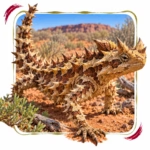
Texas Horned Lizard Fact Highlight
From the full animal facts page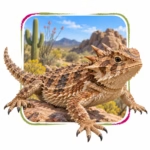
More Animal Comparisons
Pick another animal matchup and keep exploring. Compare appearances, habitats, diets, abilities, and surprising differences.





Make an Animal Story
Send two armored ant hunters across a desert adaptation mystery with our free Animal Story Generator.