
Goodfellow’s Tree-kangaroo vs Red Kangaroo: Marsupial Comparison
Goodfellow’s Tree-kangaroo and the Red Kangaroo belong to the same marsupial family, but they seem designed for opposite worlds. One is a compact New Guinea rainforest climber with strong arms and gripping claws. The other is the largest living marsupial, a long-legged Australian traveler built to bound across dry open country.
About Goodfellow’s Tree-kangaroo
- Type Tree-climbing marsupial
- Diet Mostly herbivore
- Group Kangaroo family, Macropodidae
- Known for Climbing high in New Guinea rainforests
- Special skill Grips branches with powerful forelimbs, curved claws, and broad padded feet
About Red Kangaroo
- Type Ground-dwelling marsupial
- Diet Herbivore
- Group Kangaroo family, Macropodidae
- Known for Being the largest living marsupial and a powerful hopper
- Special skill Uses elastic leg tendons to cover ground with long, energy-saving hops
Goodfellow’s Tree-kangaroo vs Red Kangaroo: Quick Answer
Goodfellow’s Tree-kangaroo is a roughly 7 kg rainforest climber that uses all four limbs and a balancing tail among branches. A male Red Kangaroo can reach about 92 kg and cross open ground in long, fast hops. Both are plant-eating marsupials with pouches, big hind feet, and joeys.
Where Do They Fit?
Follow the branches to see how Goodfellow’s Tree-kangaroo and Red Kangaroo are classified and related.
Goodfellow’s Tree-kangaroo vs Red Kangaroo: Quick Comparison
| Feature | Goodfellow’s Tree-kangaroo | Red Kangaroo |
|---|---|---|
| Scientific name | Dendrolagus goodfellowi | Osphranter rufus |
| Native home | Mountain forests of New Guinea | Dry and semi-dry mainland Australia |
| Body size | Body about 55 to 77 cm; average mass about 7.4 kg | Males up to about 1.4 m body length and 92 kg |
| Main habitat | Rainforest canopy and dense mountain forest | Open plains, grassland, shrubland, and savanna |
| Movement | Climbs and walks on branches, with controlled leaps | Bounds on huge hind legs and uses its tail when moving slowly |
| Limbs and feet | Strong forelimbs, curved claws, and broad padded feet | Small forelimbs, extremely long hind feet, and elastic leg tendons |
| Tail job | Balances the body on branches | Balances fast hops and braces the body during slow five-limbed movement |
| Main food | Leaves, fruit, flowers, grass, and other vegetation | Mostly grasses plus herbs, leaves, and shrubs |
| Social life | Usually solitary | Often lives in loose groups called mobs |
| Young | Usually one joey that continues growing in a pouch | Usually one joey; reproduction can pause during drought or pouch use |
How Tree-kangaroos and Kangaroos Are Alike
- Both are marsupials in the kangaroo family Macropodidae.
- Both have large hind feet, strong tails, and forward-opening pouches.
- Both eat mostly plants and can digest fibrous leaves or grasses.
- Both usually give birth to one extremely tiny joey at a time.
- Both use hopping or leaping movements, although they do so in different places.
How Tree-kangaroos and Kangaroos Are Different
- Goodfellow’s Tree-kangaroo lives in wet New Guinea forest, while the Red Kangaroo lives in dry mainland Australia.
- A large male Red Kangaroo can weigh more than twelve times as much as the average Goodfellow’s Tree-kangaroo.
- The tree-kangaroo has powerful arms and curved claws for climbing, while the Red Kangaroo has enormous hind legs for ground hopping.
- The tree-kangaroo is usually solitary, while Red Kangaroos often gather in mobs.
- The tree-kangaroo browses many leaves and fruits, while the Red Kangaroo is especially adapted to grazing grasses.
Tree-kangaroo vs Kangaroo Adaptation Showdown
Adaptation showdown: Red Kangaroo wins size because a large male can weigh about 92 kg, compared with an average of about 7.4 kg for Goodfellow’s Tree-kangaroo. Red Kangaroo wins speed because it can bound near 60 kilometres per hour and make leaps longer than 8 metres. Red Kangaroo wins strength because its far larger body and muscular hindquarters power long travel and forceful kicks. Goodfellow’s Tree-kangaroo wins stealth because its striped coat and careful movement blend into dim rainforest branches. Red Kangaroo wins social behavior because it often feeds and rests in mobs, while the tree-kangaroo is usually alone. Swimming is a Tie because neither species is a water specialist, even though kangaroo relatives can swim when necessary. Goodfellow’s Tree-kangaroo wins weirdest for turning the familiar kangaroo body plan into a four-limbed canopy climber.
Fun Goodfellow’s Tree-kangaroo vs Red Kangaroo Facts
The Largest Living Marsupial
The Red Kangaroo is the largest living marsupial. A big male can have a body about 1.4 metres long, a tail about 1 metre long, and a mass near 92 kilograms.
Springy Energy Savers
Red Kangaroo tendons store and return energy like springs with every landing and takeoff. Faster hopping can be surprisingly efficient across open country.
A Canopy Body Makeover
Goodfellow’s Tree-kangaroo has stronger forelimbs and shorter, broader hind feet than a ground kangaroo. Its curved claws and rough pads help grip bark and branches.
Long Leaps, Different Directions
A Red Kangaroo can leap more than 8 metres forward while traveling fast. A tree-kangaroo makes much shorter branch-to-branch leaps but can descend safely from great heights.
Rainforest Fermentation
Tree-kangaroos have a large forestomach where microbes help break down fibrous plant food. Red Kangaroos also use foregut fermentation to gain energy from tough vegetation.
Tree-kangaroo vs Kangaroo Quiz
- Which animal is the largest living marsupial? Answer: The Red Kangaroo.
- Which animal has stronger forelimbs and curved climbing claws? Answer: Goodfellow’s Tree-kangaroo.
- What is a group of Red Kangaroos called? Answer: A mob.
- Where does Goodfellow’s Tree-kangaroo live? Answer: In mountain rainforests of New Guinea.
- How do spring-like tendons help a Red Kangaroo? Answer: They store and return energy between hops.
Goodfellow’s Tree-kangaroo vs Red Kangaroo FAQ
Is a tree-kangaroo the same species as a Red Kangaroo?
No. They are different genera and species within the same kangaroo family.
Which animal is bigger?
The Red Kangaroo is dramatically larger, especially an adult male.
Can a Red Kangaroo climb trees?
No. Its long hind feet and body are specialized for hopping across the ground, not gripping branches.
Why does a tree-kangaroo have such a long tail?
The tail balances its body as it climbs and moves along branches. It cannot grip like a monkey’s prehensile tail.
Do both animals carry joeys in pouches?
Yes. A tiny newborn crawls to the mother’s pouch, attaches to a teat, and continues developing there.
Animal Words to Know
- Macropod: A member of the big-footed marsupial family that includes kangaroos, wallabies, and tree-kangaroos.
- Foregut fermentation: Digestion in which microbes break down plant food in stomach chambers before the small intestine.
- Tendon: A strong band that connects muscle to bone and can store elastic energy.
- Mob: A group of kangaroos or some other macropods.
- Arid: Very dry, with little rainfall.
Compare Two Kangaroo Blueprints
Compare Two Kangaroo Blueprints
Draw exactly one adult Goodfellow’s Tree-kangaroo and exactly one adult male Red Kangaroo at honest relative scale. Use one color to circle climbing features and another to circle hopping features. Label forelimbs, claws, hind legs, feet, pouch, and tail. Add a rainforest canopy path and an open-plain hopping path, but never approach, feed, or handle wild marsupials.
Meet Each Animal
Want the full fact file? Here are quick highlights from each animal’s own facts page.
Goodfellow’s Tree-kangaroo Fact Highlight
From the full animal facts page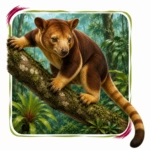
Red Kangaroo Fact Highlight
From the full animal facts page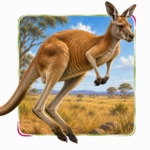
More Animal Comparisons
Pick another animal matchup and keep exploring. Compare appearances, habitats, diets, abilities, and surprising differences.



Make an Animal Story
Send a tree-climbing Kangaroo and a giant Red Kangaroo across two worlds with our free Animal Story Generator.
Source notes: References used for this comparison. See more See less
Try Another Matchup
Explore this comparison →