
Tree-kangaroo vs Wallaby for Kids: Climber and Hopper
Goodfellow’s Tree-kangaroo and the Red-necked Wallaby are relatives in the kangaroo family, and both carry joeys in pouches. Their bodies fit very different places. The tree-kangaroo uses strong arms, curved claws, and a balancing tail in the rainforest canopy. The wallaby uses long hind legs to hop across the ground near forest cover.
About Goodfellow’s Tree-kangaroo
- Type Tree-climbing marsupial
- Diet Mostly herbivore
- Group Kangaroo family, Macropodidae
- Known for Climbing high in New Guinea rainforests
- Special skill Grips branches with powerful forelimbs, curved claws, and broad padded feet
About Red-necked Wallaby
- Type Ground-dwelling marsupial
- Diet Herbivore
- Group Kangaroo family, Macropodidae
- Known for Rusty shoulders, strong hops, and swiveling ears
- Special skill Bounds efficiently on long hind legs and can swim when needed
Quick Answer
Quick answer: Goodfellow’s Tree-kangaroo is a smaller New Guinea rainforest climber with strong forelimbs, curved claws, and a long balancing tail. The Red-necked Wallaby is a larger Australian ground animal with long hind legs built for hopping. Both are plant-eating marsupials whose tiny newborn joeys continue growing inside a pouch.
Goodfellow’s Tree-kangaroo vs Red-necked Wallaby: Quick Comparison
| Feature | Goodfellow’s Tree-kangaroo | Red-necked Wallaby |
|---|---|---|
| Scientific name | Dendrolagus goodfellowi | Notamacropus rufogriseus |
| Home range | Mountain rainforests of New Guinea | Eastern and southeastern Australia, including Tasmania |
| Body size | Body about 55 to 77 cm; average mass about 7.4 kg | Body and head about 92.5 to 105 cm; often about 14 to 18 kg |
| Main habitat | Rainforest trees and dense mountain forest | Eucalypt forest, woodland, scrub, and open feeding areas |
| Movement | Climbs, walks along branches, and makes controlled leaps | Hops on long hind legs and moves on all fours at slow speed |
| Body tools | Powerful forelimbs, curved claws, padded feet, and a long balancing tail | Large hind feet, muscular legs, a strong tail, and independently swiveling ears |
| Main food | Leaves, flowers, fruit, grasses, and other plant material | Grasses, herbs, leaves, roots, and other vegetation |
| Active time | Mostly active at night and around dim forest hours | Most active from late afternoon through night and early morning |
| Social life | Usually solitary | Often solitary but may feed in groups of up to about 30 |
| Young | Usually one tiny joey that grows in a pouch | Usually one joey; a new embryo can pause its development |
How Tree-kangaroos and Wallabies Are Alike
- Both are marsupials in the kangaroo family Macropodidae.
- Both usually raise one joey at a time inside a forward-opening pouch.
- Both have large hind feet, strong tails, and fur-covered bodies.
- Both eat mostly plants and have digestive systems that help break down tough vegetation.
- Both are usually most active when the light is low rather than at bright midday.
How Tree-kangaroos and Wallabies Are Different
- Goodfellow’s Tree-kangaroo lives in New Guinea rainforest, while the Red-necked Wallaby is native to eastern Australia and Tasmania.
- The tree-kangaroo climbs with powerful arms and curved claws, while the wallaby travels mainly by ground hopping.
- A Red-necked Wallaby is generally longer and heavier than a Goodfellow’s Tree-kangaroo.
- The tree-kangaroo is usually alone in the canopy, while wallabies may gather in loose feeding groups.
- The tree-kangaroo has forelimbs and hind limbs closer in length, while the wallaby has greatly enlarged hind legs.
Tree-kangaroo vs Wallaby Adaptation Showdown
Adaptation showdown: Red-necked Wallaby wins size because adults are generally longer and about twice as heavy as Goodfellow’s Tree-kangaroos. Red-necked Wallaby wins speed because its long hind legs are specialized for efficient travel across open ground. Strength is a Tie because the wallaby powers big hops while the tree-kangaroo uses muscular arms and claws to haul itself through branches. Goodfellow’s Tree-kangaroo wins stealth because its striped brown coat and slow canopy movement help it disappear among shadowy leaves. Red-necked Wallaby wins social behavior because it may join feeding groups, while the tree-kangaroo is usually solitary. Red-necked Wallaby wins swimming because wallabies are documented swimmers, though they are not aquatic animals. Goodfellow’s Tree-kangaroo wins weirdest for being a kangaroo relative that can leap between trees and descend safely from remarkable heights.
Fun Goodfellow’s Tree-kangaroo vs Red-necked Wallaby Facts
A Kangaroo in the Canopy
Goodfellow’s Tree-kangaroo has shorter, broader hind feet and stronger forelimbs than a ground kangaroo. Curved claws and rough foot pads help it grip wet branches.
A Very Long Downward Leap
A tree-kangaroo can make impressive leaps through the canopy and may descend about 18 metres to the ground without injury. Flexible joints and a climbing body help manage the landing.
Ears That Turn
A Red-necked Wallaby can rotate its large ears in different directions. This helps it listen for danger while its eyes keep watch elsewhere.
Cooling With a Lick
On hot days, a wallaby licks its forearms. Evaporation from the wet skin helps move heat away from blood vessels near the surface.
A Pause Before the Next Joey
A female Red-necked Wallaby can delay an embryo’s development while an older joey still needs the pouch or conditions are difficult. This is called embryonic diapause.
Tree-kangaroo vs Wallaby Quiz
- Which animal spends much of its time in rainforest trees? Answer: Goodfellow’s Tree-kangaroo.
- Which animal has the longer, more powerful legs for ground hopping? Answer: The Red-necked Wallaby.
- What helps a tree-kangaroo grip branches? Answer: Strong forelimbs, curved claws, and broad padded feet.
- How can a wallaby cool itself on a hot day? Answer: It can lick its forearms so evaporation carries heat away.
- What is a baby of either animal called? Answer: A joey.
Goodfellow’s Tree-kangaroo vs Red-necked Wallaby FAQ
Is a tree-kangaroo really a kangaroo?
Yes. Tree-kangaroos, wallabies, and kangaroos all belong to the marsupial family Macropodidae.
Can a Red-necked Wallaby climb trees?
It is built mainly for life on the ground and does not climb through the canopy like a tree-kangaroo.
Which animal is bigger?
The Red-necked Wallaby is generally longer and heavier, although individual size varies.
Do both animals have pouches?
Yes. Females carry and nurse a tiny developing joey inside a pouch.
Can a tree-kangaroo use its tail like a hand?
No. Its long tail is important for balance, but it is not prehensile and cannot grip a branch like a hand.
Animal Words to Know
- Arboreal: Adapted for living or moving in trees.
- Marsupial: A mammal whose very small newborn usually continues developing while attached to a teat, often inside a pouch.
- Canopy: The leafy upper layer formed by the crowns of forest trees.
- Embryonic diapause: A temporary pause in the development of a very early embryo.
- Prehensile: Able to curl around and grip an object, as some tails can.
Build a Climber and Hopper Course
Build a Climber and Hopper Course
Draw exactly one adult Goodfellow’s Tree-kangaroo and exactly one adult Red-necked Wallaby at honest relative scale. Add a safe paper canopy route for the tree-kangaroo and a ground hopping route for the wallaby. Label the claws, forelimbs, hind legs, feet, ears, pouch, and tail that suit each route. Observe wild animals only from a respectful distance and never feed or handle them.
Meet Each Animal
Want the full fact file? Here are quick highlights from each animal’s own facts page.
Goodfellow’s Tree-kangaroo Fact Highlight
From the full animal facts page
Red-necked Wallaby Fact Highlight
From the full animal facts page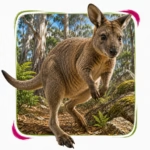
More Animal Comparisons
Pick another animal matchup and keep exploring. Compare appearances, habitats, diets, abilities, and surprising differences.




Make an Animal Story
Send a climbing Tree Kangaroo and a hopping Wallaby through a rainforest mystery with our free Animal Story Generator.