
Water Buffalo vs Bison: Wetland-Water-Buffalo-to-Prairie-Bison Bovid Comparison
Water buffalo and American bison are huge members of the cattle family, but they are different genera shaped by different worlds. Domestic water buffalo are Bubalus animals from Asian river and swamp lineages, famous for wide horns, splayed mud-going hooves, wallowing, milk, and farm work. American bison are wild Bison animals from North American grasslands, famous for shaggy forequarters, a massive low head, short horns, and a shoulder hump powered by long vertebrae and strong muscles. Their weights overlap, both sexes usually have permanent horns, and both are herd-living ruminant grazers. The everyday nickname “buffalo” for a bison does not turn it into a water buffalo.
About Water Buffalo
- Type Mammal
- Diet Herbivorous ruminant eating grasses, rice straw, crop residues, hay, silage, legumes, aquatic plants, reeds, sedges, and formulated feeds depending on husbandry; grazing and digestion vary between river and swamp types, breeds, production systems, seasons, and local forage
- Group Domestic water buffalo, Bubalus bubalis in family Bovidae; two major domesticated lineages are the river type with 50 chromosomes and the swamp type with 48, while the endangered wild water buffalo is generally treated separately as Bubalus arnee and is not silently combined with domestic breed measurements here
- Known for A large heavy domestic bovid whose size varies sharply by lineage, breed, sex, nutrition, and use; swamp buffalo commonly weigh about 325–450 kilograms, while river buffalo commonly weigh about 450–1,000 kilograms, with bulls usually larger than females, and both sexes normally carry permanent horns
- Special skill Large splayed hooves spread weight over mud and flooded soil; strong shoulders and a low steady gait support traction; a four-compartment stomach ferments coarse plants; sweeping permanent horns defend and display; sparse hair and dark skin shed little insulating bulk; and wallowing, shade, water immersion, or spraying help control heat in warm humid climates
About Bison
- Type Mammal
- Diet Herbivorous ruminant feeding mainly on grasses and sedges, with forbs, browse, and other plants added according to season and habitat; bison move while grazing and can sweep or push snow with the head to uncover winter forage
- Group American bison, Bison bison in family Bovidae, including plains and wood bison forms; this page uses bison to mean the North American species rather than the European bison Bison bonasus, and notes that the common North American nickname buffalo does not make it a true Bubalus water buffalo
- Known for North America’s largest living land mammal, with Yellowstone bulls weighing up to about 900 kilograms and cows about 450 kilograms; adults have a massive low head, tall shoulder hump, shaggy dark forequarters, slimmer hindquarters, and short curved permanent horns in both sexes
- Special skill Elongated upper-back vertebrae anchor powerful neck and shoulder muscles, producing the famous hump and helping swing the heavy head through snow; a massive skull and short horns support defense; thick skin, dense underfur, long guard hairs, and fat conserve heat; hard hooves travel grassland; and bison can run quickly, pivot, swim, and wallow
Water Buffalo vs Bison: Quick Answer
A water buffalo is a domesticated Asian-origin Bubalus bovid with long widely spreading or curled horns, a flatter back, sparse hair, broad splayed hooves, and a strong need for water, wallows, shade, or cooling in hot weather. An American bison is a wild North American Bison bovid with a huge low head, short curved horns, shaggy forequarters, slimmer hindquarters, and a tall muscle-supported shoulder hump. Their sizes overlap, but their bodies, habitats, human histories, and temperature adaptations are very different.
Where Do They Fit?
Follow the branches to see how Water Buffalo and Bison are classified and related.
Water Buffalo vs Bison: Quick Comparison
| Feature | Water Buffalo | American Bison |
|---|---|---|
| Scientific name | Bubalus bubalis for domestic water buffalo | Bison bison |
| Native origin | South and Southeast Asian domestication lineages | North America |
| Main forms | River type and swamp type, plus many breeds | Plains bison and wood bison forms |
| Typical build | Long low body, flatter back, sparse coat, large splayed feet, and long horns | Top-heavy body, low massive head, high shoulder hump, shaggy front, and short horns |
| Adult mass | Commonly about 325–1,000 kg across swamp and river types, with breed and sex variation | Yellowstone bulls up to about 900 kg and cows about 450 kg |
| Horns | Usually long and sweeping, curling, or semicircular; both sexes normally horned | Short, dark, upward-curving horns in both sexes |
| Main landscape | Managed farm, rice paddy, floodplain, wet pasture, river margin, and wallow | Prairie, grassland, meadow, sagebrush, open woodland, and snowy basin |
| Temperature strategy | Uses shade, wallowing, immersion, and wet mud to lose heat | Uses dense underfur, long guard hair, thick skin, and body fat to survive severe cold |
| Human relationship | Domesticated for milk, meat, transport, traction, and farm work | Primarily wild or conservation-managed, with additional private livestock herds |
| Famous earth bath | Wet mud or water wallow for cooling and skin protection | Dry dust wallow for insects, loose hair, scent, display, and social behavior |
How Are Water Buffalo and Bison Alike?
- Both are large even-toed hoofed mammals in family Bovidae and subfamily Bovinae, with cloven hooves, permanent keratin-covered horns, strong shoulders, broad muzzles, and calves that drink milk.
- Both are ruminant herbivores whose rumen microbes ferment fibrous grasses and other plants before food is rechewed as cud and processed through four stomach compartments.
- Both form social groups with strong cow-calf bonds, changing bull associations, scent communication, dominance behavior, breeding seasons or peaks, and vigilant herd responses.
- Both graze, travel to water, swim when needed, roll or wallow on the ground, host insects and birds, and can reshape vegetation, soil, trails, and wet places through feeding and movement.
- Both are immensely strong animals that require generous space; neither should be approached, fed, touched, surrounded, ridden without trained husbandry, or judged safe from a calm pose.
How Are Water Buffalo and Bison Different?
- Domestic water buffalo belong to genus Bubalus and descend from Asian domestication lineages; American bison belong to genus Bison and are native North American wildlife.
- Water buffalo have a relatively flatter back, long face, sparse coat, large splayed feet, and long outward, backward, or curled horns. Bison have a high shoulder hump, huge low head, shaggy front coat, narrow hindquarters, and short curved horns.
- River and swamp water buffalo are mainly managed for milk, meat, traction, transport, or mixed farm work. Bison mainly live in conservation, Tribal, public, and private herds and retain characteristic wild seasonal behavior.
- Water buffalo are warm-climate specialists that often depend on water, mud, shade, or spraying to cool. Bison have thick winter insulation and powerful neck muscles that swing the head through snow to reach grass and sedges.
- Water buffalo hooves spread over soft mud and flooded fields. Bison hooves are compact grassland travel tools that carry the body across prairie, hard ground, slopes, and snow.
- The word buffalo causes confusion: American bison are commonly called buffalo in North America, but true water buffalo are more distant Bubalus relatives and should not be given a bison hump in illustrations.
Water Buffalo vs Bison Adaptation Showdown
Wet-field bovid versus prairie snowplow showdown: Size is a tie because river water buffalo, swamp water buffalo, bison bulls, and females span broad overlapping masses; choosing one exceptional maximum would hide lineage and sex. Speed is a tie because bison can run about 55 kilometers per hour but reliable standardized water-buffalo trials do not support a fair direct race. Strength is also a tie: water buffalo excel at steady traction in wet ground and bison carry enormous wild power, yet no controlled whole-body test compares equivalent animals. Stealth is a tie because neither is a specialist stalker and each blends best in its own habitat. Bison wins social behavior for large self-organized wild herds that split, merge, migrate, and gather for the rut, while water-buffalo groups are often shaped by husbandry. Water buffalo wins swimming for anatomy, daily water use, splayed hooves, and heat-control behavior centered on wetlands, though bison also swim strongly. Bison wins strangest adaptation for turning elongated vertebrae and huge neck muscles into a living snow-clearing hump. These fields compare adaptations, not combat.
Fun Water Buffalo vs Bison Facts
A Bison Is Not a Water Buffalo
American bison are often called buffalo in Canada and the United States, but their scientific name is Bison bison. Domestic water buffalo are Bubalus bubalis, an Asian-origin lineage more closely tied to river, swamp, and farm environments. Both belong to the bovine branch of the cattle family, yet their genera, shapes, histories, and climate adaptations clearly separate them.
Water Buffalo Come in River and Swamp Types
Domestic water buffalo contain two major lineages. River buffalo generally have 50 chromosomes, are often larger, and include many dairy breeds with curled horns. Swamp buffalo generally have 48 chromosomes, are often stockier and lighter, and have long backswept or semicircular horns suited to traditional draft work. The groups can interbreed, and their hybrids commonly carry 49 chromosomes.
A Bison Hump Is a Muscle-Powered Snow Tool
The tall ridge over a bison’s shoulders is not a camel-like bag of fat. Long upper-back vertebrae provide attachment for massive neck and shoulder muscles. Those muscles hold and swing the enormous head, helping the animal push aside or sweep through snow to expose buried grasses and sedges while the shaggy front coat protects it from winter.
Both Wallow, but Their Baths Do Different Jobs
A water buffalo may sink into water or coat itself with wet mud to lose heat, shield the skin, and discourage insects. A bison often rolls in a dry dusty hollow, helping remove loose winter hair and biting insects while leaving scent; bulls also wallow during the rut. Either animal can use a wallow repeatedly and change the soil around it.
Their Horns Grow for Life but Their Shapes Tell a Story
Water-buffalo horns usually extend far sideways or backward before sweeping, curling, or forming a semicircle, with form differing between river and swamp types and among breeds. Bison horns are much shorter and curve outward and upward from the massive head. Unlike deer antlers, both animals’ horns have a living bony core beneath a permanent keratin sheath and are not shed each year.
Water Buffalo vs Bison Quiz
- Which animal has a tall shoulder hump? Answer: The American bison.
- What are the two major domestic water-buffalo types? Answer: River buffalo and swamp buffalo.
- Why does a water buffalo often wallow in wet mud or water? Answer: Mainly to cool its body and protect its skin.
- Is an American bison scientifically a water buffalo? Answer: No. It is Bison bison, while domestic water buffalo are Bubalus bubalis.
- Do their horns fall off every year like deer antlers? Answer: No. Their keratin-covered horns are permanent.
Water Buffalo vs Bison FAQ
Is a bison the same as a water buffalo?
No. American bison are Bison bison from North America. Domestic water buffalo are Bubalus bubalis from Asian domestication lineages. They share family Bovidae but differ in genus, body shape, horns, coat, habitat, and human history.
Which is bigger, a water buffalo or bison?
There is no honest universal winner. Swamp buffalo commonly weigh about 325–450 kilograms, river buffalo about 450–1,000 kilograms, Yellowstone bison cows about 450 kilograms, and large bulls up to about 900 kilograms. Breed, lineage, sex, age, nutrition, season, and source change the comparison, so their adult ranges overlap strongly.
Why are bison called buffalo?
Buffalo became a long-established North American common nickname for the American bison. It is widely understood, but bison is clearer scientifically because true buffalo include the water buffalo Bubalus and African buffalo Syncerus.
Can bison and water buffalo swim?
Yes. Bison are strong swimmers and can cross rivers. Water buffalo are especially comfortable using water and wet ground, with broad feet that help in mud and swimming and regular immersion or wallowing for cooling. Ability still varies with age, condition, current, bank shape, and distance.
Are water buffalo and bison safe to approach?
No. A bison is fast, agile wildlife and must be viewed from the official park distance. A domestic water buffalo is managed livestock, but domestication does not remove its size, horns, maternal defense, fear, or individual temperament. Never enter a field, pen, herd, or calf space without the owner and trained supervision.
Animal Words to Know
- Bovid: A member of family Bovidae, which includes cattle, bison, buffalo, antelopes, goats, and sheep.
- Ruminant: A herbivore whose microbes ferment plant fiber in a multi-compartment stomach.
- Wallow: A wet or dry hollow where a large animal rolls, rests, cools, removes insects, sheds hair, or leaves scent.
- Domestication: Long-term human-guided breeding and management that changes a population across generations.
- Keratin: The tough protein forming the outer sheath of a bovid horn, as well as hair and hooves.
Water Buffalo and Bison Habitat Activity
Water Buffalo and Bison Habitat Activity
Draw an Asian water buffalo and American bison at the same scale. Give the buffalo a flatter back, sparse dark coat, long sweeping horns, and broad splayed hooves beside wet pasture and a mud wallow. Give the bison a high shoulder hump, massive head, shaggy forequarters, short curved horns, and compact hooves on a prairie. Label bovid, hump, horns, coat, hooves, and habitat.
Meet Each Animal
Want the full fact file? Here are quick highlights from each animal’s own facts page.
Water Buffalo Fact Highlight
From the full animal facts page
Bison Fact Highlight
From the full animal facts page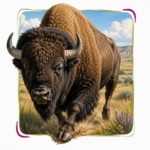
More Animal Comparisons
Pick another animal matchup and keep exploring. Compare appearances, habitats, diets, abilities, and surprising differences.





Make an Animal Story
Turn this water buffalo vs bison comparison into a wetland-farm and snowy-prairie journey with our free Animal Story Generator.
Source notes: References used for this comparison. See more See less
Try Another Matchup
Explore this comparison →