
Whale Shark vs Basking Shark: Giant Filter-Feeding Shark Comparison
Whale sharks and basking sharks are the two largest living fish, yet both survive by filtering tiny food from seawater. The whale shark is the bigger, warmer-water giant with a broad spotted body and unique skin pattern. The basking shark favors cooler seas and cruises with a cavernous mouth open while its enormous gill slits process plankton-rich water.
About Whale Shark
- Type Fish
- Diet Filter Feeder
- Group Carpet Shark
- Known for Largest living fish, white spots, broad head, gentle behavior, and filter feeding
- Special skill Filtering plankton, fish eggs, and tiny swimming animals while using suction and forward swimming
About Basking Shark
- Type Fish
- Diet Filter Feeder
- Group Mackerel Shark
- Known for Huge open mouth, enormous gill slits, cool-water cruising, and plankton feeding
- Special skill Swimming steadily with its mouth open so water passes across gill rakers that trap plankton
Whale Shark vs Basking Shark: Quick Answer
The whale shark is the largest living fish and usually inhabits warmer seas. It has white spots, a broad flattened head, and specialized filter pads. The basking shark is generally the second-largest living fish, favors cooler waters, and filters plankton with long gill rakers while swimming with its mouth open. Both are gentle filter-feeding sharks.
Where Do They Fit?
Follow the branches to see how Whale Shark and Basking Shark are classified and related.
Whale Shark vs Basking Shark: Quick Comparison
| Feature | Whale Shark | Basking Shark |
|---|---|---|
| Animal type | Fish | Fish |
| Animal group | Carpet shark | Mackerel shark |
| Known for | Largest living fish, white spots, and broad head | Huge mouth, giant gill slits, and cool-water cruising |
| Main habitat | Tropical and warm-temperate oceans | Temperate and cool oceans |
| Typical color | Dark gray or blue-gray with pale spots and stripes | Gray-brown, dark gray, or nearly black above |
| Head shape | Broad, wide, and flattened | More pointed or conical snout |
| Feeding tool | Filter pads near the gills | Long comb-like gill rakers |
| Baby name | Pup | Pup |
| Social style | Usually solitary but forms feeding aggregations | Usually solitary or in groups around food |
| Special skill | Suction and ram filter feeding | Continuous open-mouth ram feeding |
How Are Whale Sharks and Basking Sharks Alike?
- Both whale sharks and basking sharks are enormous cartilaginous fish.
- Both are filter feeders that eat plankton and other tiny organisms.
- Both have gills, powerful tails, and skin covered with dermal denticles.
- Both give birth to live pups rather than laying eggs outside the body.
- Both may form seasonal feeding aggregations where ocean food is concentrated.
How Are Whale Sharks and Basking Sharks Different?
- Whale sharks are generally larger, while basking sharks rank as the second-largest living fish.
- Whale sharks favor tropical and warm-temperate seas, while basking sharks prefer cooler temperate waters.
- Whale sharks have pale spots and stripes, while basking sharks are more evenly gray or brown.
- Whale sharks use filter pads and can create suction, while basking sharks rely mainly on ram feeding with gill rakers.
- Whale sharks have broad flattened heads, while basking sharks have more pointed snouts and extremely large gill openings.
Whale Shark vs Basking Shark Showdown
Giant-shark showdown: The whale shark wins for size and total body strength because it is the largest living fish. Speed, social life, and swimming are ties because both are mostly slow-moving ocean travelers that may gather around rich food patches. The basking shark takes stealth with its plain gray coloring and quiet cruising. The whale shark wins our weirdest-fact prize because every individual carries a unique pattern of pale spots that researchers can use like a fingerprint.
Fun Whale Shark vs Basking Shark Facts
Largest Fish vs Second-Largest Fish
Whale sharks are the largest living fish, with exceptional individuals reaching well over 10 meters. Basking sharks are generally the second-largest living fish and can also grow to lengths comparable with a large bus.
Spotted Giant vs Gray Giant
Whale sharks have dark bodies covered with pale spots and stripes. Basking sharks are usually gray-brown or dark gray, helping them blend into cool open water.
Filter Pads vs Gill Rakers
A whale shark traps food with specialized filter pads near its gills and can use suction to pull water and prey into its mouth. A basking shark swims forward with its mouth open and strains plankton through long comb-like gill rakers.
Warm Seas vs Cool Seas
Whale sharks are most strongly associated with tropical and warm-temperate waters. Basking sharks often visit cooler productive seas where currents and ocean fronts concentrate plankton.
Whale Sharks Have Spot Fingerprints
The pattern of spots behind a whale shark’s gills is unique to that individual. Researchers photograph these markings and use pattern-matching software to recognize sharks seen again.
Whale Shark vs Basking Shark Quiz
- Which shark is the largest living fish? Answer: Whale shark.
- Which shark usually lives in cooler seas? Answer: Basking shark.
- What tiny drifting food do both sharks eat? Answer: Plankton.
- Which shark has pale spot patterns? Answer: Whale shark.
- What filtering structures does a basking shark use? Answer: Gill rakers.
Whale Shark vs Basking Shark FAQ
What is the main difference between a whale shark and a basking shark?
A whale shark is usually larger, spotted, broad-headed, and associated with warmer seas. A basking shark is grayer, more pointed-snouted, common in cooler seas, and filters food using long gill rakers.
Which is bigger, a whale shark or a basking shark?
The whale shark is generally larger and is the biggest living fish. The basking shark is usually considered the second-largest.
Do whale sharks and basking sharks have teeth?
Yes, but their teeth are tiny and are not used to tear large prey. Both mainly filter small food from seawater.
Are whale sharks and basking sharks dangerous to people?
Neither species hunts people. They are enormous wild animals, so swimmers and boats should keep a respectful distance and avoid touching, feeding, chasing, or blocking them.
Why does a basking shark swim with its mouth open?
Swimming with its mouth open allows plankton-rich water to flow across gill rakers, which trap food before the water exits through the gill slits.
Animal Words to Know
- Filter feeder: An animal that strains tiny food particles or organisms from water.
- Plankton: Small organisms that drift or swim weakly in water.
- Gill raker: A comb-like structure that helps trap food near a fish’s gills.
- Dermal denticle: A tiny tooth-like scale covering shark skin.
- Aggregation: A temporary gathering of many animals in one place.
Whale Shark and Basking Shark Filter-Feeder Activity
Whale Shark and Basking Shark Filter-Feeder Activity
Draw a whale shark and basking shark at realistic relative scale with a diver for reference. Give the whale shark a broad flat head, pale spots, and a close-up of its filter pads. Give the basking shark a pointed snout, enormous open mouth, large gill slits, and a close-up of its gill rakers. Label plankton, filter pad, gill raker, spots, and gills.
Meet Each Animal
Want the full fact file? Here are quick highlights from each animal’s own facts page.
Whale Shark Fact Highlight
From the full animal facts page
Basking Shark Fact Highlight
From the full animal facts page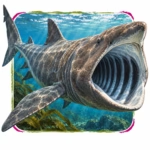
More Animal Comparisons
Pick another animal matchup and keep exploring. Compare appearances, habitats, diets, abilities, and surprising differences.






Make an Animal Story
Turn this whale shark vs basking shark comparison into a gentle giant-ocean adventure with our free Animal Story Generator.
Source notes: References used for this comparison. See more See less
Try Another Matchup
Explore this comparison →