
White Rhino vs Black Rhino: Living African Rhino Species Comparison
White and black rhinos are two different African species, but their names do not describe their skin: both are gray, and mud can tint either animal brown, red, or nearly black. The fastest field clue is the mouth. A white rhino has a broad square lip that crops grass like a mower, so its huge head hangs low and a powerful neck hump supports it. A black rhino has a narrow hooked upper lip that plucks leaves and twigs, so its smaller head is usually carried higher. White rhinos are generally much heavier and more social; black rhinos are generally smaller, more solitary, and more associated with woody cover. Individuals and habitats vary, so the lips, head posture, body size, and feeding behavior should be read together.
About White Rhino
- Type Mammal
- Diet Specialist grazer using a broad square upper lip to crop mostly short grasses close to the ground; this low feeding posture is supported by a huge head, strong neck, and prominent shoulder hump
- Group White rhinoceros or square-lipped rhinoceros (Ceratotherium simum), represented mainly by the southern white rhino; the northern white rhino survives as only two nonbreeding females
- Known for The largest living rhino species; adult males commonly weigh about 1,800–2,500 kilograms and females about 1,800–2,000 kilograms, standing roughly 1.5–1.8 meters at the shoulder, with a massive head and neck hump
- Special skill Wide square grazing lip, enormous grass-supporting head and neck muscles, pronounced shoulder hump, two continuously growing keratin horns, three-toed cushioned feet, acute smell and hearing, gray skin, wallowing behavior, and semi-social tolerance
About Black Rhino
- Type Mammal
- Diet Browser using a pointed, flexible, prehensile upper lip to grasp leaves, shoots, twigs, shrubs, small trees, legumes, and some herbs or grass, often leaving neatly clipped angled ends on woody plants
- Group Black rhinoceros or hook-lipped rhinoceros (Diceros bicornis), a distinct African species with surviving eastern, south-central, and southwestern subspecies
- Known for Smaller and lighter than the white rhino; adult males may weigh up to about 1,350 kilograms and females up to about 900 kilograms, standing around 1.6 meters at the shoulder, although measurements vary by subspecies and individual
- Special skill Hooked prehensile upper lip, smaller high-carried head, flexible browsing reach, compact powerful body, quick directional changes, two keratin horns, three-toed padded feet, keen smell and hearing, gray skin, nocturnal activity, and scrub camouflage
White Rhino vs Black Rhino: Quick Answer
White and black rhinos are both gray. A white rhino is usually much larger, with a broad square mouth, huge low-hanging head, strong shoulder hump, and grass-grazing lifestyle. A black rhino is smaller, with a pointed hook-like upper lip, higher-carried head, less pronounced hump, and leaf-browsing lifestyle. Both have two keratin horns, three toes on each foot, poor close-detail vision, and excellent smell and hearing.
Where Do They Fit?
Follow the branches to see how White Rhino and Black Rhino are classified and related.
White Rhino vs Black Rhino: Quick Comparison
| Feature | White Rhino | Black Rhino |
|---|---|---|
| Scientific name | Ceratotherium simum | Diceros bicornis |
| Skin color | Gray, often stained by local mud or dust | Gray, often stained by local mud or dust |
| Typical adult weight | About 1,800–2,500 kg; males usually heaviest | Females up to about 900 kg and males up to about 1,350 kg |
| Upper lip | Broad, flat, and square for cropping grass | Pointed, hooked, and prehensile for grasping browse |
| Main diet | Grazer eating mostly short grasses | Browser eating leaves, shoots, twigs, and shrubs |
| Head posture | Usually low to the ground, with a huge head and neck hump | Usually higher, with a smaller head and less pronounced hump |
| Social tendency | Semi-social; females and young may form a crash | Usually solitary or mother-and-calf, with social exceptions |
| Habitat emphasis | Open grassland and savanna grazing areas | Scrub, bushland, woodland, semi-desert, and mixed habitats |
| Horns and feet | Two keratin horns; three toes on each foot | Two keratin horns; three toes on each foot |
| IUCN status | Near Threatened at species level; northern subspecies functionally extinct | Critically Endangered |
How Are White and Black Rhinos Alike?
- Both are African rhinoceroses in family Rhinocerotidae and order Perissodactyla, the odd-toed hoofed-mammal group.
- Both have gray skin rather than the colors in their names, and mud or dust from a wallow may temporarily change how dark or reddish they look.
- Both are herbivores with two horns made from tightly packed keratin fibers, not bone or ivory, and the front horn is usually longer.
- Both walk on three toes per foot, rely more on keen smell and hearing than sharp eyesight, and use dung, urine, scrapes, and scent trails to exchange information.
- Both normally produce one calf after a long pregnancy, keep the calf close for years, and face severe pressure from poaching, habitat loss, fragmentation, and small isolated populations.
How Are White and Black Rhinos Different?
- The white rhino is the larger, heavier species, often exceeding two metric tons; the black rhino is more compact and usually far lighter.
- The white rhino has a broad square lip for grazing; the black rhino has a pointed prehensile upper lip for plucking leaves, shoots, and twigs.
- A white rhino normally carries its huge head close to the ground and has a pronounced neck-shoulder hump; a black rhino carries a smaller head higher and has less of a hump.
- White rhinos favor open grassland and short grazing lawns, while black rhinos use a wider range of woody scrub, bushland, woodland, semi-desert, and mixed habitats.
- White rhino females and young may form stable pairs or small crashes; black rhinos are usually more solitary, although they can tolerate neighbors and gather at resources.
- The white rhino species is currently Near Threatened, while the black rhino is Critically Endangered; the northern white subspecies is a separate, exceptionally dire case with only two nonbreeding females.
White Rhino vs Black Rhino Adaptation Showdown
Grazer-and-browser adaptation showdown: White rhino wins size and absolute strength because it is the largest rhino, with a huge head and neck built for hours of low grazing. Black rhino wins speed only as a cautious representative shorthand: published estimates and its compact body suggest quicker acceleration and tighter turns, but wildlife speed records are imprecise. Black rhino wins stealth for browsing through dense scrub and doing much activity in cooler darkness. White rhino wins social life because females and young more often form stable pairs or crashes. Swimming is a tie because both wallow and can cross shallow water but neither is an aquatic specialist. White rhino wins weirdest adaptation for a broad living lawn-mower mouth. These are adaptation categories, not a fight prediction.
Fun White Rhino vs Black Rhino Facts
Neither Rhino Is Named for Its Real Color
White and black rhinos both have gray skin. The animal’s visible shade often matches the mud or dust coating it after a wallow. A popular story says “white” came from an English misunderstanding of an Afrikaans or Dutch word for wide, referring to the square lip, but the historical evidence is uncertain. The safest lesson is simple: use mouth shape, not color, for identification.
One Mouth Mows and the Other Mouth Picks
A white rhino presses its broad, flat lips across short grass and crops a wide strip close to the soil. A black rhino curls its pointed upper lip around leaves or twigs and pulls them toward the cheek teeth. These feeding tools shape the whole silhouette: the grazer needs a heavier low head, while the browser reaches forward and upward.
Rhino Horn Is Not a Giant Bone
A rhino horn grows from the skin and is built from compacted keratin, the structural protein also found in hair and nails. It rests over roughened nasal bone but is not a hollow tooth or a bone attached like an antler. Horn can continue growing and may regrow after a break if the growth base remains healthy, although serious injuries can damage that base.
A Midden Works Like a Scent Message Board
Rhinos repeatedly visit shared dung piles called middens. Smells in dung and urine can reveal identity, sex, reproductive condition, and territorial presence. A territorial male may scrape or kick dung and spray urine to spread his scent. The rhino reads the station mainly with its nose, turning an ordinary-looking pile into a neighborhood information center.
Black Rhinos Are Not Always Lonely
Black rhinos are often described as strictly solitary, but field observations show a more flexible life. A mother stays with her calf, neighboring animals may tolerate one another, and several rhinos can gather at waterholes, mineral licks, or rich feeding areas. White rhinos are still generally more social, yet neither species follows one unbreakable group rule.
White Rhino vs Black Rhino Quiz
- Are white rhinos white and black rhinos black? Answer: No. Both species have gray skin.
- Which rhino has a broad square lip for grazing? Answer: The white rhino.
- What does a black rhino use its hooked upper lip to grasp? Answer: Leaves, shoots, twigs, and other browse.
- Which species is usually larger and carries its head lower? Answer: The white rhino.
- What is a shared rhino dung pile called? Answer: A midden.
White Rhino vs Black Rhino FAQ
What is the easiest way to tell a white rhino from a black rhino?
Look at the mouth and feeding posture. A white rhino has a broad square lip and usually grazes with its huge head low. A black rhino has a pointed hooked upper lip and usually browses with its smaller head held higher.
Why are they called white and black rhinos?
The names do not describe skin color. The exact history of “white rhino” is disputed. The often-repeated story linking it to a word meaning wide may be plausible but is not securely documented, so square-lipped and hook-lipped are clearer descriptive names.
Which rhino is bigger?
The white rhino is much bigger on average and is the largest living rhino. Adult white rhinos commonly weigh around 1,800–2,500 kilograms, while the black-rhino figures used here reach about 900 kilograms for females and 1,350 for males.
Do both rhinos have two horns?
Normally yes. Both African species have a larger front horn and a smaller rear horn, but horn length and shape vary with sex, age, population, wear, injury, and conservation management.
Which rhino is rarer?
The black rhino is Critically Endangered, with about 6,788 animals estimated in the wild at the end of 2024. The white rhino species is Near Threatened with about 15,752 in situ, but nearly all are southern white rhinos; only two northern white females remain.
Animal Words to Know
- Grazer: An herbivore that feeds mainly on grasses and other low plants.
- Browser: An herbivore that feeds mainly on leaves, shoots, twigs, and shrubs.
- Prehensile: Able to grasp or hold something, as in a black rhino’s flexible upper lip.
- Keratin: A strong structural protein that forms rhino horn as well as hair and nails.
- Midden: A repeatedly used dung pile that carries scent information between animals.
White Rhino and Black Rhino Feeding Activity
White Rhino and Black Rhino Feeding Activity
Draw a southern white rhino and black rhino on the same ground line. Make the white rhino larger, with a low head and broad square lip grazing short grass. Give the black rhino a higher head and hooked upper lip reaching for leaves. Keep both gray, with two horns and three toes on each foot, because their names do not describe their color. Label grazer, browser, lip, horn, keratin, calf, and habitat.
Meet Each Animal
Want the full fact file? Here are quick highlights from each animal’s own facts page.
White Rhino Fact Highlight
From the full animal facts page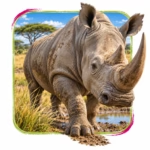
Black Rhino Fact Highlight
From the full animal facts page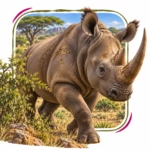
More Animal Comparisons
Pick another animal matchup and keep exploring. Compare appearances, habitats, diets, abilities, and surprising differences.




Make an Animal Story
Turn this white vs black rhino comparison into a grass-mower and leaf-picker savanna mystery with our free Animal Story Generator.
Source notes: References used for this comparison. See more See less
Try Another Matchup
Explore this comparison →