
White-tailed Deer vs Mule Deer for Kids
White-tailed Deer and Mule Deer are close North American cousins that can meet in parts of the West. A White-tailed Deer, Odocoileus virginianus, is easiest to spot by its broad tail, which flashes white when raised. A Mule Deer, Odocoileus hemionus, has much larger ears, a narrow tail with a black tip and a bouncy escape gait called stotting. Buck antlers also differ: white-tail tines usually rise from one main beam, while mule-deer antlers fork again and again.
About White-tailed Deer
- Type Living
- Diet Herbivore and ruminant; browses leaves, twigs, buds, fruits and acorns and also grazes grasses and crops
- Group Widespread American deer in family Cervidae (Odocoileus virginianus)
- Known for A broad tail with a bright white underside, antlers built around one sweeping main beam and great success near forests and farms
- Special skill Raises its broad tail like a white flag while fleeing, sending a bright danger signal through thick cover
About Mule Deer
- Type Living
- Diet Herbivore and ruminant; mainly browses nutritious leaves and twigs and also eats forbs, grasses and seasonal flowers
- Group Western North American deer in family Cervidae (Odocoileus hemionus)
- Known for Enormous mule-like ears, a narrow black-tipped tail, repeatedly forked antlers and a springy four-footed escape bound
- Special skill Stotts through brush and rocks with all four feet leaving the ground, and some herds make exceptionally long migrations
Quick Answer
Look first at the ears, tail and antlers—not body size, because the species overlap greatly in weight. A White-tailed Deer has smaller-looking ears and a broad tail that becomes a white flag when raised. A Mule Deer has giant ears, a short rope-like tail with a black tip and evenly forked antlers. When startled, it often springs away with all four hooves off the ground.
White-tailed Deer vs Mule Deer: Quick Comparison
| Feature | White-tailed Deer | Mule Deer |
|---|---|---|
| Scientific name | Odocoileus virginianus | Odocoileus hemionus |
| Main range | Most of the United States and southern Canada, continuing far into Latin America | Western North America from Canada and Alaska south into Mexico |
| Typical habitat | Forest edge, river woodland, wetland, farmland and brush with dense cover | Sagebrush, desert, mountain, canyon, grassland and open western forest |
| Ears | Moderate ears that look smaller beside the head | Very large mule-like ears that turn toward faint sounds |
| Tail | Broad and brown above with a large white underside; raised while fleeing | Short and narrow, usually white with a dark or black tip; often held down while fleeing |
| Buck antlers | Tines usually rise from a single forward-curving main beam | Main beams split into forks, and the forks may divide again |
| Escape gait | Fast runs and long bounds, often with the white tail flag showing | Stiff-legged stotting in which all four hooves can leave the ground together |
| Seasonal movement | Some populations shift locally, but many stay within modest home ranges | Many western herds migrate between low winter range and high summer range |
| Body size | Extremely variable; adults can overlap Mule Deer in length and weight | Often stockier in shared western habitats, but size overlaps White-tailed Deer |
| Conservation | Widespread overall, although disease, collisions and habitat change affect local herds | Widespread overall, but migration barriers, drought, disease and habitat change affect many herds |
How Are White-tailed and Mule Deer Alike?
- Both are hoofed plant-eaters in the same genus, Odocoileus.
- Both bucks grow and shed a new set of antlers in a yearly cycle.
- Both chew cud after quickly gathering leaves, twigs, grasses and other plants.
- Both give birth to spotted fawns that stay hidden and quiet when very young.
- Both use sharp hearing, smell and eyesight to notice wolves, coyotes, cougars and people.
How Are White-tailed and Mule Deer Different?
- White-tailed Deer have broad flagging tails; Mule Deer have short narrow tails with dark tips.
- Mule Deer ears are much larger in proportion to the head.
- White-tail antlers usually have upright tines on one beam, while mule-deer antlers branch into forks.
- White-tailed Deer usually run and bound; Mule Deer often stott with all four hooves airborne.
- White-tailed Deer range far into the tropics, while Mule Deer are animals of western North America.
White-tailed Deer vs Mule Deer Showdown
- Size – Tie: Mule Deer often look stockier where the species meet, but both vary so much that their weight ranges overlap.
- Speed – Tie: Both can escape quickly, yet published figures do not give a fair same-course race between the two species.
- Strength – Tie: Large bucks of either species carry powerful necks, shoulders and legs, and individual size matters more than the name.
- Stealth – Tie: Brown seasonal coats, stillness and careful use of cover help both deer disappear into their home habitat.
- Social – Tie: Each forms doe-and-fawn families and loose buck groups, with group size changing by season and habitat.
- Swimming – Tie: Both are capable swimmers, but neither is a water specialist and there is no fair matched record.
- Weirdest – Mule Deer: Its giant swiveling ears and pogo-like stotting gait make this western deer especially unusual.
Fun White-tailed Deer vs Mule Deer Facts
A Living White Flag
A frightened White-tailed Deer lifts its broad tail so the bright underside flashes as it runs.
Two Antler Blueprints
White-tail points grow from one main beam, while a Mule Deer’s antlers repeatedly divide into forks.
Four Hooves in the Air
A stotting Mule Deer springs upward and forward with all four feet leaving the ground together.
A 242-Mile Traveler
A GPS-collared Wyoming Mule Deer completed a roughly 242-mile one-way migration and about 480 miles round trip.
Spots That Fade
Fawns of both species begin life with pale spots that break up their outline among sunlit plants.
White-tailed Deer vs Mule Deer Quiz
Which deer raises a broad white tail flag? A) White-tailed Deer B) Mule Deer C) Both have the same tail Answer: A) White-tailed Deer
Which deer has the largest ears? A) White-tailed Deer B) Mule Deer C) Neither has ears Answer: B) Mule Deer
Which buck usually has repeatedly forked antlers? A) White-tailed Deer B) Mule Deer C) Both always do Answer: B) Mule Deer
What is stotting? A) Chewing cud B) A four-footed springing bound C) Growing antlers Answer: B) A four-footed springing bound
What are young deer called? A) Fawns B) Goslings C) Chrysalises Answer: A) Fawns
White-tailed Deer vs Mule Deer FAQ
Are White-tailed and Mule Deer the Same Species?
No. They are two species in the same genus. They may live near one another where their ranges overlap, but their ears, tails, antlers and usual escape gaits differ.
Which Deer Is Bigger?
There is no simple winner. Mule Deer often look stockier in the western places where both occur, but body sizes vary by sex, age, region and subspecies and overlap widely.
How Can You Tell the Females Apart?
Ignore antlers and check the head and rear. A Mule Deer doe has huge ears and a short black-tipped tail; a White-tailed doe has smaller-looking ears and a broad flagging tail.
Why Does a Mule Deer Bounce?
Stotting helps it move across rough rocks and shrubs, see over cover and make quick changes of direction while escaping.
Do Both Deer Migrate?
Some populations of both move seasonally, but long routes between mountain summer range and lower winter range are especially important for many Mule Deer herds.
Animal Words to Know
- Antler: A branching bone structure grown and shed by a deer, usually by an adult male.
- Browser: An animal that mainly eats leaves, shoots and twigs rather than only grass.
- Ruminant: A plant-eater with a special stomach that brings food back up to chew as cud.
- Stotting: A springing escape gait in which all four hooves leave the ground together.
- Tine: One pointed branch of an antler.
Build a Deer ID Field Card
Build a Deer ID Field Card
Fold a sheet into two columns. Draw one deer head, tail, antler and track clue for each species. Mark the White-tailed Deer with moderate ears, one main antler beam and a broad raised white tail. Mark the Mule Deer with giant ears, forked antlers, a narrow black-tipped tail and four airborne hooves. Cover the animal names and test a partner using only the clues.
Meet Each Animal
Want the full fact file? Here are quick highlights from each animal’s own facts page.
White-tailed Deer Fact Highlight
From the full animal facts page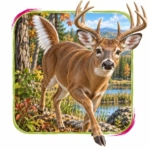
Mule Deer Fact Highlight
From the full animal facts page
More Animal Comparisons
Pick another animal matchup and keep exploring. Compare appearances, habitats, diets, abilities, and surprising differences.





Make an Animal Story
Create a woodland adventure about a tail-flashing deer and a giant-eared mountain deer!