
Yak vs Cow: Domestic Bovine Comparison
Yaks and domestic cattle are extremely close bovine relatives that people raise for food, materials, work, and transport. The domestic yak is specialized for cold high-altitude Asia, with a deep chest, dense underwool, long hanging hair, and sure feet. Domestic cattle include thousands of breeds adapted to farms and rangelands around the world. In everyday speech “cow” often means any domestic cattle animal, although scientifically a cow is an adult female.
About Yak
- Type Mammal
- Diet Herbivore
- Group Bovine
- Known for Long shaggy coat, sweeping horns, high-altitude survival, sure-footed travel, grunting calls, and helping mountain communities
- Special skill Breathing and working in thin high-altitude air, conserving heat with dense underwool and long outer hair, and crossing steep rocky ground
About Cow
- Type Mammal
- Diet Herbivore
- Group Domestic Cattle
- Known for Milk and meat production, many specialized breeds, familiar mooing calls, herd behavior, grazing, and life alongside people
- Special skill Digesting tough vegetation through rumination and thriving in a wide variety of climates through diverse breeds and human care
Yak vs Cow: Quick Answer
A domestic yak usually has long shaggy hair hanging beneath its body, a bushy tail, and wide horns, and it is superbly adapted to cold mountains and thin air. Domestic cattle vary enormously by breed but commonly have shorter coats, slimmer tails ending in tufts, and less extreme high-altitude adaptations. Both are herd-living ruminants with cloven hooves and babies called calves.
Where Do They Fit?
Follow the branches to see how Yak and Cow are classified and related.
Yak vs Cow: Quick Comparison
| Feature | Domestic Yak | Domestic Cattle |
|---|---|---|
| Animal type | Mammal | Mammal |
| Scientific name | Bos grunniens | Usually Bos taurus, including many breeds and lineages |
| Family | Bovidae | Bovidae |
| Body shape | Compact, deep-chested, and sturdy | Extremely variable from small, lean breeds to massive beef and dairy breeds |
| Coat | Dense underwool with very long outer hair over the sides, belly, and legs | Usually shorter, smoother hair, though some breeds are long-haired |
| Tail | Long and fully bushy, somewhat horse-like | Usually slender with a tuft of hair at the tip |
| Horns | Often long and widely sweeping, but some are naturally hornless | Shape varies greatly; breeds may be horned or naturally hornless |
| Main habitat | Cold high plateaus and alpine grasslands | Managed farms and rangelands across many climates |
| Main sound | Often described as grunting | Lowing or mooing |
| Baby name | Calf | Calf |
| Special ability | Living and working in cold, oxygen-poor mountain air | Enormous breed diversity for different climates and human needs |
How Are Yaks and Cows Alike?
- Both domestic yaks and cattle are hoofed mammals in the family Bovidae and genus Bos.
- Both are ruminant herbivores with cloven hooves, horns in many breeds, herds, and calves.
- Both have been domesticated and may provide milk, meat, hides, fiber, work, and other resources.
- Both communicate through sound, scent, posture, and physical contact.
- Yaks and cattle are close enough genetically to produce hybrids when people breed them.
How Are Yaks and Cows Different?
- Yaks originated in highland Asia, while domestic cattle descend from aurochs and now live worldwide.
- Yaks usually have long skirt-like body hair and a fully bushy tail, while most cattle have shorter hair and a slender tail with a tuft.
- Yaks are strongly adapted to cold, high elevations and thin air, while cattle breeds occupy a much wider range of climates.
- Yaks commonly grunt, while cattle are famous for lowing or mooing.
- Yak milk is generally richer in fat and solids than typical cow’s milk, although nutrition varies with breed, diet, season, and management.
Yak vs Cow Showdown
Domestic bovine showdown: Size and speed are ties because cattle breeds vary from very small to enormous and reliable like-for-like speed data are limited. The yak wins the strength category for working endurance in cold, thin mountain air, while stealth, social behavior, and swimming remain ties because neither is a specialist in those traits. The yak takes the weirdest-fact prize for its grunting call and its remarkable ability to live and work at elevations where ordinary lowland cattle may struggle. This is an adaptation comparison, not a claim that every yak is stronger than every cow.
Fun Yak vs Cow Facts
A Mountain Bovine and a Worldwide Bovine
Domestic yaks developed alongside people on and around the Tibetan Plateau, where cold, altitude, and short growing seasons shape daily life. Domestic cattle now occupy nearly every region where people keep livestock, with breeds selected for tropical heat, dry rangelands, cold pastures, dairy production, beef, or pulling loads.
A Shaggy Skirt and a Tufted Tail
Yak underwool traps heat close to the skin while extremely long outer hairs hang from the flanks, belly, and legs. Most cattle have shorter coats and narrow tails with hair concentrated in a switch at the end, although shaggy Highland cattle are a famous exception.
Yaks Grunt and Cattle Moo
The domestic yak’s scientific name, Bos grunniens, can be translated as “grunting ox.” Yaks make grunts and other calls, while domestic cattle are especially known for their drawn-out lowing or mooing sounds.
Their Milk Is Different
Yak milk commonly contains more fat, protein, and total solids than ordinary cow’s milk, helping people make rich butter, cheese, yogurt, and other high-energy foods. Exact composition changes with animal, breed, feed, elevation, season, and stage of lactation.
Yaks and Cattle Can Have Hybrid Calves
Because domestic yaks and cattle are close relatives within Bos, people have crossed them for centuries. Hybrids are known by several regional names, including dzo for a male and dzomo for a female in Tibetan usage; females are generally fertile, while first-generation males are usually sterile.
Yak vs Cow Quiz
- Which animal usually has a long hair skirt and fully bushy tail? Answer: The yak.
- What sound are domestic cattle famous for making? Answer: Mooing or lowing.
- What are baby yaks and cattle called? Answer: Calves.
- What kind of digestive animals are both yaks and cattle? Answer: Ruminants.
- Which animal is especially adapted to cold, thin high-altitude air? Answer: The yak.
Yak vs Cow FAQ
What is the main difference between a yak and a cow?
A domestic yak is a cold-adapted highland bovine with long hanging hair, dense underwool, a bushy tail, and strong high-altitude physiology. Domestic cattle include many breeds and usually have shorter coats and tuft-ended tails.
Is a yak a type of cow?
A yak is not domestic cattle, but it is a very close cattle relative in the genus Bos. An adult female yak can correctly be called a cow, while an adult male is called a bull.
Can yaks and cattle breed?
Yes. People have bred yak-cattle hybrids for centuries. Female hybrids are usually fertile, while first-generation male hybrids are generally sterile.
Do yaks moo?
Yaks make several sounds but are especially known for grunting rather than producing the familiar long moo of domestic cattle. Their scientific name Bos grunniens refers to grunting.
Which is bigger, a yak or a cow?
There is no universal winner. Domestic cattle breeds range from very small to extremely large, and yak size also varies by breed, sex, age, nutrition, and region.
Animal Words to Know
- Domestic: Bred and managed by people across many generations.
- Bovine: A member of the cattle subfamily Bovinae.
- Ruminant: A hoofed plant eater that rechews partly digested food called cud.
- Underwool: Fine insulating hair beneath longer protective outer hair.
- Hybrid: An offspring whose parents come from two different species or distinct forms.
Yak and Cow Habitat Activity
Yak and Cow Habitat Activity
Draw a domestic yak on a cold high plateau and a dairy cow in a green lowland pasture. Give the yak a deep chest, long hair, dense undercoat, bushy tail, and broad horns. Give the cow a shorter coat, broad muzzle, large ears, and tufted tail. Label bovine, calf, coat, high altitude, pasture, and ruminant.
Meet Each Animal
Want the full fact file? Here are quick highlights from each animal’s own facts page.
Yak Fact Highlight
From the full animal facts page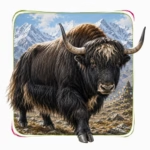
Cow Fact Highlight
From the full animal facts page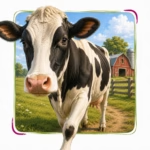
More Animal Comparisons
Pick another animal matchup and keep exploring. Compare appearances, habitats, diets, abilities, and surprising differences.





Make an Animal Story
Turn this yak vs cow comparison into a high-mountain-and-farm adventure with our free Animal Story Generator.
Source notes: References used for this comparison. See more See less
Try Another Matchup
Explore this comparison →