
Zebra vs Donkey: Equid Comparison
Zebras and donkeys are close relatives in the equid family, with single-toed hooves, long faces, manes, and babies called foals. Zebras are wild African equids covered in unique black-and-white stripes. Donkeys were domesticated from African wild asses and are famous for long ears, loud brays, endurance, and sure-footed travel.
About Zebra
- Type Mammal
- Diet Herbivore
- Group Equid
- Known for Black-and-white stripes, herd vigilance, strong kicks, and wild African life
- Special skill Recognizing herd mates by stripe patterns and defending itself with powerful kicks
About Donkey
- Type Mammal
- Diet Herbivore
- Group Equid
- Known for Long ears, loud brays, sure-footed travel, endurance, and domestication
- Special skill Traveling safely over rough ground and coping with hot, dry environments
Zebra vs Donkey: Quick Answer
Zebras are wild African equids with bold stripes, upright manes, and strong herd defenses. Donkeys are domesticated equids with long ears, shorter manes, loud brays, and excellent sure-footedness. Both are herbivorous mammals, and both have babies called foals.
Where Do They Fit?
Follow the branches to see how Zebra and Donkey are classified and related.
Zebra vs Donkey: Quick Comparison
| Feature | Zebra | Donkey |
|---|---|---|
| Animal type | Mammal | Mammal |
| Animal group | Equid | Equid |
| Known for | Stripes, wild herds, vigilance, and strong kicks | Long ears, brays, endurance, and sure-footed travel |
| Main habitat | African savannas, grasslands, woodlands, and mountains | Farms, dry grasslands, scrublands, deserts, and rocky trails |
| Where found | Africa | Worldwide through domestication |
| Diet | Herbivore | Herbivore |
| Baby name | Foal | Foal |
| Coat | Unique black-and-white stripes | Usually gray, brown, black, white, or spotted |
| Ears and mane | Medium ears and a short upright mane | Very long ears and a short upright mane |
| Special skill | Wild herd vigilance and predator defense | Sure-footed travel and heat tolerance |
How Are Zebras and Donkeys Alike?
- Both zebras and donkeys are mammals in the equid family.
- Both have one main hoof on each foot, long faces, manes, tails, and strong legs.
- Both are herbivores that mainly eat grasses and other plant material.
- Both are social animals that communicate with sounds, scents, facial expressions, and body movements.
- Both give birth to babies called foals that can stand and walk soon after birth.
How Are Zebras and Donkeys Different?
- Zebras are wild African animals, while donkeys have been domesticated and spread around the world.
- Zebras have bold black-and-white stripes, while donkeys usually have gray, brown, black, white, or spotted coats.
- Donkeys have especially long ears, while zebra ears are shorter.
- Zebras commonly live in wild herds or loose associations, while domestic donkeys live with people or in managed groups.
- Zebras are generally faster, while donkeys are especially sure-footed and efficient in dry, rocky country.
Zebra vs Donkey Showdown
Equid showdown: The zebra wins for average size, speed, camouflage, and our weirdest-fact pick because every zebra has a unique stripe pattern. Strength, social life, and swimming are ties because both are sturdy, social equids that can defend themselves and cross water when needed. The donkey earns a special trailblazer badge for endurance and sure-footed movement over rough ground.
Fun Zebra vs Donkey Facts
Wild Equid vs Domesticated Equid
Zebras remain wild animals adapted to African ecosystems. Donkeys were domesticated from African wild asses thousands of years ago and have worked with people as pack, riding, and farm animals.
Stripes vs Plain or Spotted Coats
Every zebra carries a unique pattern of black-and-white stripes. Donkeys usually have gray, brown, black, white, or spotted coats, and many show a dark stripe along the back and across the shoulders.
Medium Ears vs Extra-Long Ears
A zebra has alert ears that swivel toward sounds. A donkey’s ears are much longer and help collect faint noises while also releasing body heat in warm, dry environments.
Bark-Like Calls vs Loud Brays
Zebras communicate with barks, whinnies, snorts, squeals, and body signals. Donkeys are famous for the far-carrying bray, a two-part call that can help separated animals stay in contact.
Different Survival Specialties
Zebras rely on herd vigilance, speed, stripes, bites, and kicks to survive among African predators. Donkeys are careful, strong, and sure-footed, conserving energy and testing uncertain ground before moving.
Zebra vs Donkey Quiz
- Which animal has black-and-white stripes? Answer: Zebra.
- Which animal usually has the longer ears? Answer: Donkey.
- What are baby zebras and donkeys called? Answer: Foals.
- Which animal is famous for a loud bray? Answer: Donkey.
- Do zebras and donkeys belong to the same animal family? Answer: Yes, the equid family.
Zebra vs Donkey FAQ
What is the main difference between a zebra and a donkey?
A zebra is a wild African equid with stripes. A donkey is a domesticated equid with long ears, a loud bray, and strong adaptations for dry, rocky environments.
Is a zebra a type of donkey?
No. Zebras and donkeys are different species within the genus Equus, but they are close relatives.
Which is faster, a zebra or a donkey?
Zebras generally reach higher running speeds. Donkeys are better known for endurance, balance, and careful travel over rough ground.
Why do donkeys have such long ears?
Their long ears help detect distant sounds and release heat, useful adaptations inherited from ancestors that lived in hot, open environments.
Can zebras and donkeys have babies together?
They can sometimes produce hybrids called zonkeys or zedonks, but these hybrids are usually infertile because the parents have different chromosome arrangements.
Animal Words to Know
- Equid: A member of the horse family, including horses, zebras, and donkeys.
- Domesticated: Changed over many generations through living and breeding under human care.
- Foal: A young zebra, donkey, horse, or related equid.
- Bray: The loud, far-carrying call of a donkey.
- Hybrid: An offspring produced by parents from two different species or closely related groups.
Zebra and Donkey Equid Activity
Zebra and Donkey Equid Activity
Draw a zebra on African grassland beside a herd and a domestic donkey on a rocky farm trail. Give the zebra stripes and an upright mane. Give the donkey very long ears, a short mane, and a tufted tail; a shoulder cross may be added as a common but not universal marking. Label wild, domesticated, hoof, mane, ears, and foal.
Meet Each Animal
Want the full fact file? Here are quick highlights from each animal’s own facts page.
Zebra Fact Highlight
From the full animal facts page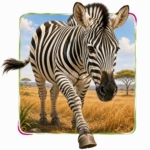
Donkey Fact Highlight
From the full animal facts page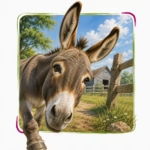
More Animal Comparisons
Pick another animal matchup and keep exploring. Compare appearances, habitats, diets, abilities, and surprising differences.






Make an Animal Story
Turn this zebra vs donkey comparison into a galloping animal story with our free Animal Story Generator.
Source notes: References used for this comparison. See more See less
Try Another Matchup
Explore this comparison →