
Crab Facts for Kids
Crab is a common name used mainly for true crabs in the infraorder Brachyura, a huge group of decapod crustaceans with broad bodies and short abdomens folded beneath the shell. True crabs inhabit every ocean and have also colonized rivers, lakes, caves, mangroves, beaches, forests, and other land habitats. They range from tiny pea crabs to Japanese spider crabs with enormous leg spans. Hermit crabs, king crabs, porcelain crabs, and several other crab-shaped animals belong to different branches.
Quick Crab Facts
- Animal Type: Invertebrate
- Group: True crabs in the infraorder Brachyura, plus other crab-shaped crustaceans in everyday language
- Known For: Hard carapaces, ten limbs, pincers, sideways movement, molting, stalked eyes, and folded abdomens
- Habitat: Oceans, coral reefs, estuaries, beaches, mangroves, freshwater, caves, and land
- Diet: Algae, plants, detritus, plankton, mollusks, worms, fish, carrion, and other foods depending on species
What You’ll Learn
Learn 10 amazing crab facts for kids about claws, shells, sideways walking, molting, and marine habitats, with a quiz, glossary, and activity
These simple facts are written for kids, parents, teachers, and curious young minds.
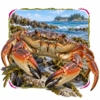
10 Fun Crab Facts for Kids
1. True Crabs Are Brachyurans
Most animals zoologists call true crabs belong to Brachyura. Hermit, king, porcelain, and coconut crabs are anomurans, while horseshoe crabs belong to an entirely different arthropod branch.
Kid Decode: The crab-shaped crowd contains true crabs, false crabs, and one horseshoe impostor from another ancient clan.
2. Five Pairs of Limbs Make Ten
Crabs are decapods with five limb pairs. The first pair usually forms claws called chelae, while the remaining four pairs mainly walk, swim, dig, climb, or hold onto surfaces.
Kid Decode: The body plan begins with ten limbs and then turns each pair into specialized equipment.
3. The Abdomen Folds Under the Body
In true crabs, the short segmented abdomen bends forward beneath the broad cephalothorax. This tucked shape produces the compact body people recognize as crab-like.
Kid Decode: The tail did not disappear; it folded underneath like a hinged trapdoor.
4. Sideways Is Fast but Not Mandatory
Many crabs move sideways efficiently because their leg joints bend best in that direction. Some also walk forward or backward, and spider crabs with long legs may move forward readily.
Kid Decode: Sideways is the favorite lane for many crabs, not an unbreakable traffic law.
5. Gills Sit in Protected Chambers
Aquatic crabs extract oxygen from water passing over gills beneath the carapace. Land crabs keep these surfaces moist and often possess enlarged, modified gill chambers for breathing humid air.
Kid Decode: The breathing feathers stay hidden inside a damp room beneath the shell.
6. Growth Requires Molting
A hard exoskeleton cannot stretch continuously. Before ecdysis, the crab forms a new covering underneath, splits the old shell, pulls its limbs free, absorbs water to expand, and later hardens the new armor.
Kid Decode: The crab escapes through its own shell and spends a while wearing soft new armor.
7. Lost Legs Can Regrow
Many crabs deliberately release a trapped or damaged limb at a special break point. A small replacement forms and becomes larger across later molts, sometimes requiring several molts to approach normal size.
Kid Decode: The emergency exit sacrifices one leg, while future shell changes slowly build another.
8. Eyes Often Stand on Movable Stalks
Compound eyes on stalks provide a broad view and can move or fold into protective sockets. Vision differs greatly among species, from fast beach runners to deep-sea crabs living in darkness.
Kid Decode: Two movable lookout towers scan above the armored body.
9. Females Carry Eggs Under the Abdomen
After mating, many female crabs attach thousands or even millions of fertilized eggs to feathery appendages beneath the folded abdomen. She ventilates and cleans the mass until the young hatch.
Kid Decode: The folded tail becomes a protected nursery holding a bright sponge-like cloud of eggs.
10. Larvae Look Nothing Like Adult Crabs
Many marine crabs hatch as tiny swimming zoea larvae with spines and long appendages. They molt through several stages, become a more crab-like megalopa, and finally settle as juvenile crabs.
Kid Decode: The sideways adult begins as a drifting spiky creature that barely resembles a crab.
The Weirdest Crab Fact
The crab-like body has evolved independently several times in different crustacean branches, a repeated evolutionary pattern called carcinization.
Try This Crab Activity
Crab Anatomy-and-Molt Drawing Activity
Draw a true crab from above and below. Label the carapace, folded abdomen, two claws, four pairs of walking legs, stalked eyes, antennae, mouthparts, and gill chambers. Add a sideways walking trail, an empty molt shell, a soft new crab, a regenerating leg, a female carrying eggs, and larval zoea and megalopa stages.
Quick Crab Quiz
- What are true crabs called scientifically? Answer: Brachyurans.
- How many limb pairs does a decapod have? Answer: Five pairs, or ten limbs.
- Why must a crab molt? Answer: Its hard exoskeleton cannot expand continuously.
- Can a crab regrow a lost leg? Answer: Many species can regenerate it over later molts.
- What is repeated evolution of a crab-like body called? Answer: Carcinization.
Mini Glossary
- Crustacean: An arthropod group containing crabs, lobsters, shrimp, barnacles, and relatives.
- Carapace: The hard upper shell covering much of a crab’s body.
- Decapod: A crustacean with five pairs of limbs.
- Ecdysis: The shedding of an old exoskeleton during molting.
- Carcinization: The independent evolution of a broad crab-like body in different crustacean lineages.
 Red Kangaroo Facts for Kids
 Serow Facts for Kids
 Cassowary Facts for Kids
 Homotherium Facts for Kids
More Animal Facts for Kids
Visit the full animal facts library or explore a focused animal group.
More Extinct Animal Facts for Kids
Discover dinosaurs, Ice Age giants, prehistoric sea creatures, recently extinct species, and other animals from the past.
Fact check note: Fact checked with Smithsonian and NOAA crustacean resources, the Marine Conservation Society’s crab overview, peer-reviewed decapod research on exoskeletons, molting, limb regeneration, gills, larvae, and carcinization, and current taxonomic references for Brachyura and Anomura.

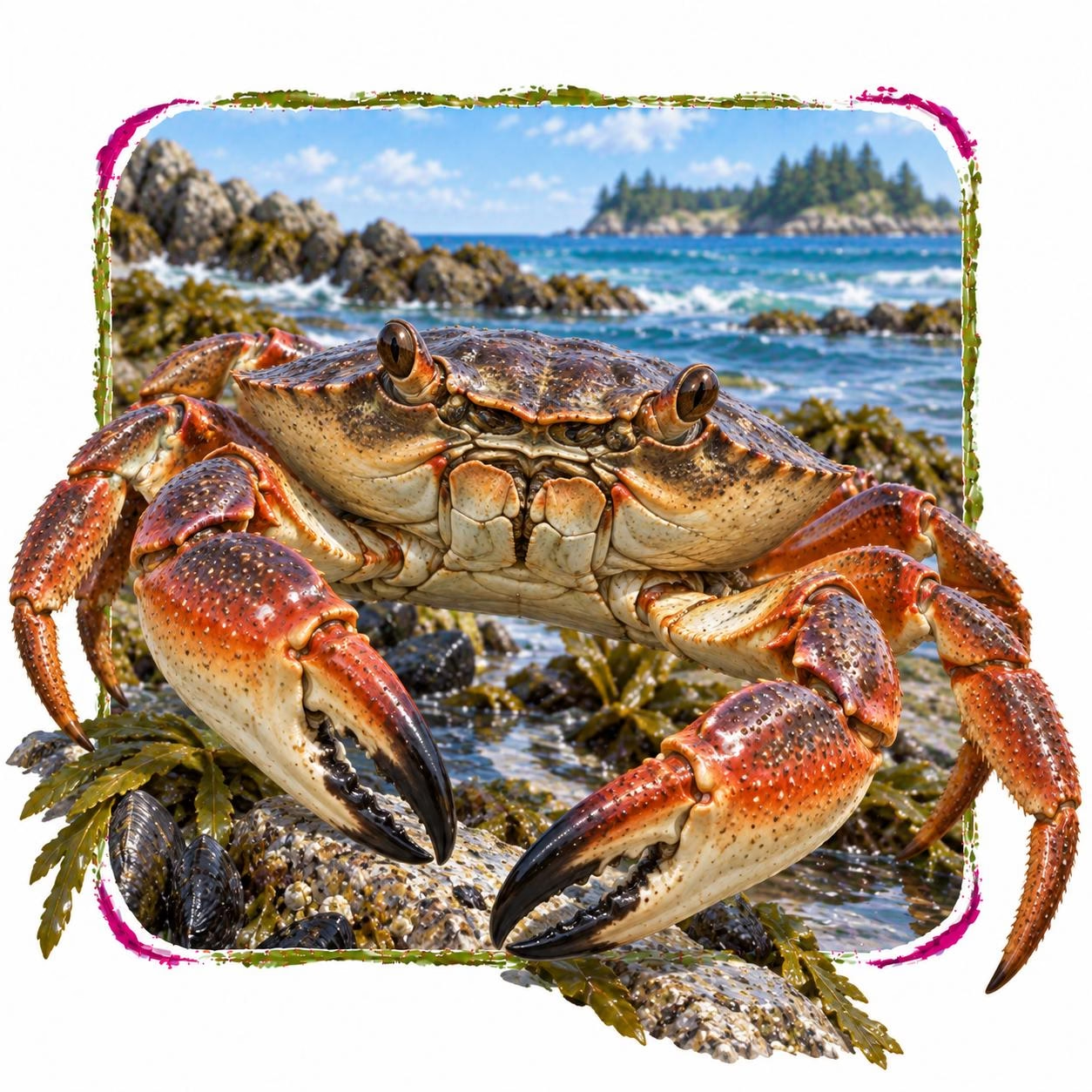
Crab in its natural Coral reefs, rocky shores, sandy and muddy seafloors, open ocean, deep sea, estuaries, mangroves, beaches, rivers, lakes, caves, forests, and other land habitats worldwide habitat