
Eastern Mole Facts for Kids
The Eastern Mole, Scalopus aquaticus, is a burrowing mammal found from parts of southern Canada through much of the eastern and central United States into northern Mexico. Despite the scientific name aquaticus, it is primarily a land-dwelling mole rather than an aquatic species. Its cylindrical body, velvety fur, nearly hidden eyes and ears, pointed snout, and enormous outward-facing forefeet are specialized for life underground. Eastern Moles build shallow feeding tunnels and deeper permanent passages, pushing excess soil to the surface as molehills. They hunt mainly earthworms, insects, larvae, and other soil animals. Their eyesight is extremely limited, but research has shown that they can compare smells entering the two nostrils and use this stereo sniffing to steer toward food. The species is currently listed as Least Concern.
Quick Eastern Mole Facts
- Animal Type: Mammal and mole
- Scientific Name: Scalopus aquaticus
- Known For: Giant shovel-like forefeet, underground tunnels, velvety fur, tiny hidden eyes, stereo smell, earthworm hunting, molehills, and year-round digging
- Habitat: Lawns, gardens, pastures, meadows, open woodland, fields, river terraces, sandy soils, loams, and other ground that can be excavated
- Diet: Mainly earthworms, insects, larvae, centipedes, and other soil invertebrates, with occasional other foods
What You’ll Learn
Discover 10 fun Eastern Mole facts for kids with accurate underground-mammal science, quick facts, a quiz, glossary, drawing activity, and North American wildlife links.
Simple facts make them fun for children, parents, teachers, and young nature explorers.

10 Fun Eastern Mole Facts for Kids
1. The Name Aquaticus Is Misleading
The scientific name Scalopus aquaticus sounds watery, but the Eastern Mole is mainly terrestrial and fossorial. It spends most of its life underground in soil rather than swimming through ponds or living like the semi-aquatic star-nosed mole.
Kid Decode: The Latin name suggests water, but this mole’s real world is made of dirt.
2. The Front Feet Are Living Shovels
Huge broad forefeet turn outward and carry strong claws. Powerful shoulders sweep soil sideways and backward while the compact cylindrical body follows through the tunnel.
Kid Decode: Each front paw is a five-clawed excavator attached to a muscular shoulder.
3. Velvety Fur Works in Both Directions
Eastern Mole fur is short, dense, and unusually flexible rather than lying firmly backward. This lets the animal move forward or reverse through tight tunnels without its coat snagging against the soil.
Kid Decode: The fur behaves like a reversible underground jacket.
4. Tiny Eyes Are Not the Main Navigation Tool
The eyes are tiny and hidden beneath fur and skin, and there are no obvious external ear flaps. The mole depends far more on smell, touch, vibration, and other close-range senses than on detailed vision.
Kid Decode: Underground, a sharp nose beats a sharp pair of eyes.
5. They Can Smell in Stereo
Experiments with Eastern Moles showed that they compare odor strength between the left and right nostrils. Blocking one nostril made animals veer toward the open side, demonstrating that bilateral smell helps them steer toward an odor source.
Kid Decode: Two nostrils give the mole a chemical left-and-right compass.
6. Shallow and Deep Tunnels Do Different Jobs
Shallow surface runs are often temporary feeding routes where the mole searches for prey. Deeper tunnels are more permanent and can contain nest chambers and protected travel routes used during dry, hot, or frozen conditions.
Kid Decode: The tunnel map has fast-food lanes near the surface and safer highways underneath.
7. Earthworms Are Major Prey
Eastern Moles mainly eat earthworms and insects, along with larvae, centipedes, and other soil invertebrates. They locate prey underground using smell and touch and may consume large amounts because digging requires substantial energy.
Kid Decode: The mole’s grocery store is stocked inside the soil itself.
8. Molehills Are Excavation Waste
When deeper tunnels are dug, loose soil is pushed upward and deposited at the surface as mounds. These molehills reveal underground construction even when the animal itself remains completely hidden.
Kid Decode: A dirt mound is the spoil pile from a construction project you cannot see.
9. Mothers Build Underground Nests
Females build protected nests in deeper tunnels and usually raise one litter during the breeding season. The young are born naked and helpless and remain underground until they are developed enough to begin independent life.
Kid Decode: The mole nursery is a hidden room beneath the lawn.
10. Moles Change the Soil Around Them
Tunneling mixes soil and creates pathways that can affect drainage and soil aeration, while molehills may disturb lawns and gardens. Eastern Moles are globally Least Concern and are widespread across a large part of North America.
Kid Decode: The same digging that annoys a gardener also rearranges the underground world.
The Weirdest Eastern Mole Fact
Eastern Moles can use the tiny difference in odor reaching each nostril to steer toward an earthworm, giving them a form of stereo smell much like two ears help locate a sound.
Try This Eastern Mole Activity
Eastern Mole Underground-City Activity
Draw a soil cutaway beneath a meadow or lawn. Add a velvety gray-brown Eastern Mole with a cylindrical body, pointed pink nose, tiny hidden eyes, no external ear flaps, short tail, and huge outward-facing shovel forefeet with five claws. Show shallow feeding runs, deeper permanent tunnels, a nest chamber, earthworms and insect larvae, molehills at the surface, and a stereo-smell diagram showing odor entering both nostrils. Add a label explaining that aquaticus is a misleading scientific name because the species is mainly terrestrial.
Quick Eastern Mole Quiz
- What is the Eastern Mole’s scientific name? Answer: Scalopus aquaticus.
- Is it mainly an aquatic animal? Answer: No, it is primarily terrestrial and underground.
- What body parts act like shovels? Answer: Its large outward-facing forefeet.
- What does stereo smell help it do? Answer: Locate the direction of an odor source such as prey.
- What is its current IUCN category? Answer: Least Concern.
Mini Glossary
- Fossorial: Adapted for digging and spending much of life underground.
- Olfaction: The sense of smell.
- Stereo Smell: Comparing odor information between the two nostrils to help locate a source.
- Molehill: A mound of soil pushed to the surface during tunnel excavation.
- Runway: A tunnel or repeated travel route used by an underground animal.
 Black-Capped Chickadee Facts for Kids
 Magpie Facts for Kids
 Leopard Gecko Facts for Kids
 Anhanguera Facts for Kids
More Animal Facts for Kids
Visit the full animal facts library or explore a focused animal group.
More Extinct Animal Facts for Kids
Discover dinosaurs, Ice Age giants, prehistoric sea creatures, recently extinct species, and other animals from the past.
Fact check note: Fact checked with the American Society of Mammalogists Mammal Diversity Database current account for Scalopus aquaticus, which lists the Eastern Mole as Least Concern and records its range from northern Mexico through much of the eastern and central United States into Canada; Animal Diversity Web for shallow and deep tunnel systems, underground nests, limited eyesight, hidden ears, prey, year-round fossorial behavior and reproduction; and Kenneth Catania’s 2013 Nature Communications study and Vanderbilt University summary demonstrating stereo and serial sniffing in Eastern Moles.

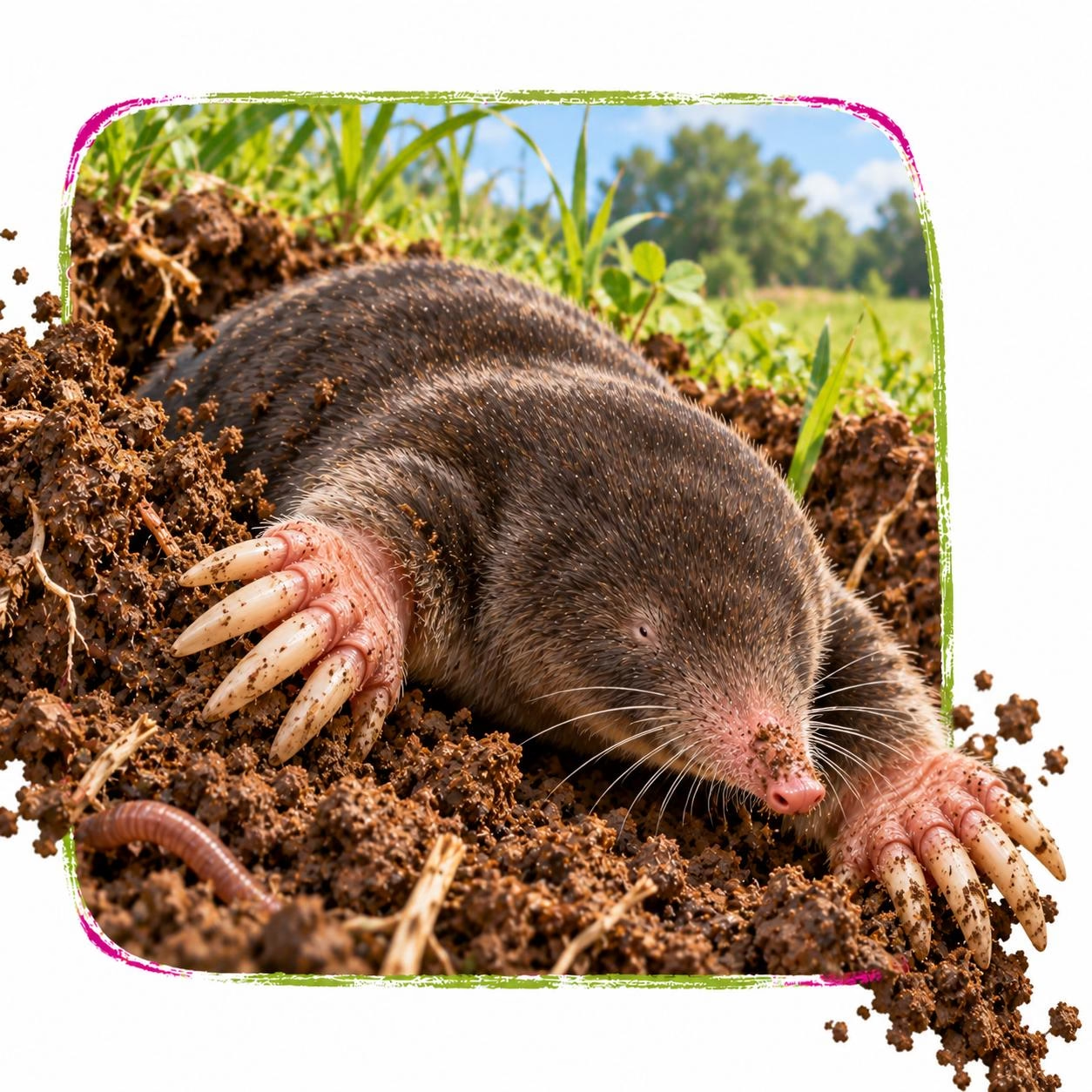
Eastern Mole in its natural Lawns, gardens, meadows, pastures, fields, open woodland, river terraces, sandy soils, loams, and other excavatable ground across eastern and central North America habitat