
Greater Kudu Facts for Kids
The Greater Kudu, Tragelaphus strepsiceros, is one of Africa’s tallest antelopes and a member of the spiral-horned antelope group. It lives mainly in eastern and southern Africa, where woodland, scrub, thickets, rocky hills, and river-edge vegetation provide food and cover. Adults have large rounded ears and pale vertical body stripes that help break up their outline among branches and shadows. Males are much heavier than females and grow spectacular corkscrew horns, while females are normally hornless. Greater Kudus browse leaves, shoots, herbs, fruits, flowers, and vines, rest in cover during the hottest hours, and often form loose social groups rather than tightly organised herds. The species is currently listed as Least Concern, although hunting, habitat change, fencing, disease, and local isolation can still affect populations.
Quick Greater Kudu Facts
- Animal Type: Mammal and antelope
- Scientific Name: Tragelaphus strepsiceros
- Known For: Long spiral horns in males, large ears, pale body stripes, woodland camouflage, browsing, loose social groups, and powerful jumping
- Habitat: Woodland, bushland, scrub, wooded savanna, rocky hills, riverine thickets, and other areas with dense cover
- Diet: Leaves, shoots, herbs, fruits, vines, flowers, and some fresh grass
What You’ll Learn
Discover 10 fun Greater Kudu facts for kids with accurate antelope science, quick facts, a quiz, glossary, drawing activity, and African wildlife links.
Easy explanations make them ideal for children, families, teachers, and young animal explorers.
10 Fun Greater Kudu Facts for Kids
1. It Is One of Africa’s Tallest Antelopes
Greater Kudus stand roughly 1 to 1.5 metres at the shoulder, with adult males much heavier than females. Large males can exceed 250 kilograms, while size varies among regions, age classes, and populations.
Kid Decode: A full-grown male can look over a shrub with the ease of a living watchtower.
2. Male Horns Grow Into Giant Spirals
Adult males carry long corkscrew horns that commonly twist through about two and a half turns. The horns grow throughout life and can reach around 1.2 metres along the curve or more in exceptional individuals; females are normally hornless.
Kid Decode: The horn grows forward, outward, and upward until it becomes a giant natural corkscrew.
3. White Stripes Break Up the Body Shape
Most Greater Kudus have several narrow pale vertical stripes across a gray-brown to reddish-brown body. Combined with patches of sunlight and shadow, the markings help make a large antelope surprisingly difficult to see inside scrub and woodland.
Kid Decode: A huge antelope can vanish when its stripes line up with branches and broken light.
4. Those Huge Ears Are Excellent Sensors
Large mobile ears can swivel toward sounds independently, helping a kudu detect predators and other animals while much of its body remains hidden in vegetation. Smell and vision also contribute to predator detection.
Kid Decode: The ears work like two furry radar dishes scanning different directions.
5. Greater Kudus Are Browsers
Leaves, shoots, vines, herbs, flowers, fruits, and other woody vegetation form most of the diet, with some tender grass eaten when available. Kudus can obtain considerable moisture from plants and may cope for periods without visiting open water.
Kid Decode: Instead of mowing a lawn, a kudu samples the leafy shelves of the bush.
6. Females and Males Often Live Differently
Females and young commonly form small loose groups that may temporarily join into larger gatherings. Adult males are often solitary or form small bachelor groups outside the breeding season, and the sexes spend much of the year apart.
Kid Decode: The woodland can hold family groups in one patch and quiet bachelor giants in another.
7. Newborn Calves Hide Before Joining the Group
A female usually gives birth to one calf after a pregnancy of roughly eight to nine months. For its first days or weeks, the calf stays concealed in vegetation while the mother returns to nurse it before it begins travelling more regularly with her.
Kid Decode: The baby’s first survival trick is becoming a silent striped bundle beneath the bushes.
8. Males Wrestle Horn to Horn
During competition, similar-sized males may push and twist against one another with their horns. Serious fights are uncommon, but the enormous spirals can sometimes become locked, creating a dangerous problem for both animals.
Kid Decode: Two corkscrews make impressive weapons until the corkscrews refuse to come apart.
9. They Can Clear Surprising Obstacles
Greater Kudus are strong jumpers and can clear high fences or obstacles when startled. Their long legs and flexible bodies help them bound through broken woodland and rocky terrain rather than depending on long-distance open-grassland speed alone.
Kid Decode: A towering antelope can suddenly fold itself into one enormous spring.
10. Least Concern Does Not Mean Threat-Free
The Greater Kudu is globally listed as Least Concern and remains widespread in many protected and managed landscapes. However, hunting pressure, habitat conversion, fencing, livestock disease, drought, and fragmented local populations can create serious regional problems.
Kid Decode: A safe-looking global label can still hide trouble in one valley or woodland.
The Weirdest Greater Kudu Fact
The spectacular spiral horns can occasionally lock together when two males fight, leaving the animals unable to separate without outside help or eventually causing both to die.
Try This Greater Kudu Activity
Greater Kudu Woodland-Camouflage Activity
Draw a Greater Kudu family scene in African woodland. Add one tall gray-brown male with long two-and-a-half-turn spiral horns, a throat beard, huge rounded ears, white facial markings, and pale vertical body stripes; include normally hornless females and one hidden calf. Add leafy browse, fruit, vines, a river-edge thicket, dappled camouflage, a small bachelor group, a safe horn-wrestling scene, predators such as lions or leopards at a distance, and a fence-jumping silhouette showing the kudu’s powerful legs.
Quick Greater Kudu Quiz
- What is the Greater Kudu’s scientific name? Answer: Tragelaphus strepsiceros.
- Which sex normally grows the giant spiral horns? Answer: Males.
- What kind of feeder is a Greater Kudu? Answer: A browser that eats leaves, shoots, fruits, vines, flowers, and other vegetation.
- Why do newborn calves spend time hidden in vegetation? Answer: Concealment helps protect them from predators.
- What is the Greater Kudu’s current global IUCN category? Answer: Least Concern.
Mini Glossary
- Bovid: A member of the hoofed mammal family containing cattle, goats, sheep, and antelopes.
- Browser: An animal that feeds mainly on leaves, shoots, twigs, flowers, and other parts of shrubs and trees.
- Bachelor Group: A social group made mainly of males that are not travelling with females and young.
- Camouflage: Colours and patterns that help an animal blend into its surroundings.
- Ruminant: A hoofed herbivore that ferments plant food in a specialised stomach and rechews cud.
 Roseate Spoonbill Facts for Kids
 Mute Swan Facts for Kids
 Cardinal Facts for Kids
 Aucasaurus Facts for Kids
More Animal Facts for Kids
Visit the full animal facts library or explore a focused animal group.
More Extinct Animal Facts for Kids
Discover dinosaurs, Ice Age giants, prehistoric sea creatures, recently extinct species, and other animals from the past.
Fact check note: Fact checked with the American Society of Mammalogists Mammal Diversity Database version 2.4 account for Tragelaphus strepsiceros, which retains Greater Kudu as one species and lists it as Least Concern; Animal Diversity Web’s Greater Kudu account for size, stripes, spiral horns, browsing diet, social grouping, reproduction, calf concealment, and habitat; and current African antelope references on woodland camouflage, jumping, male horn contests, predators, and regional conservation pressures.

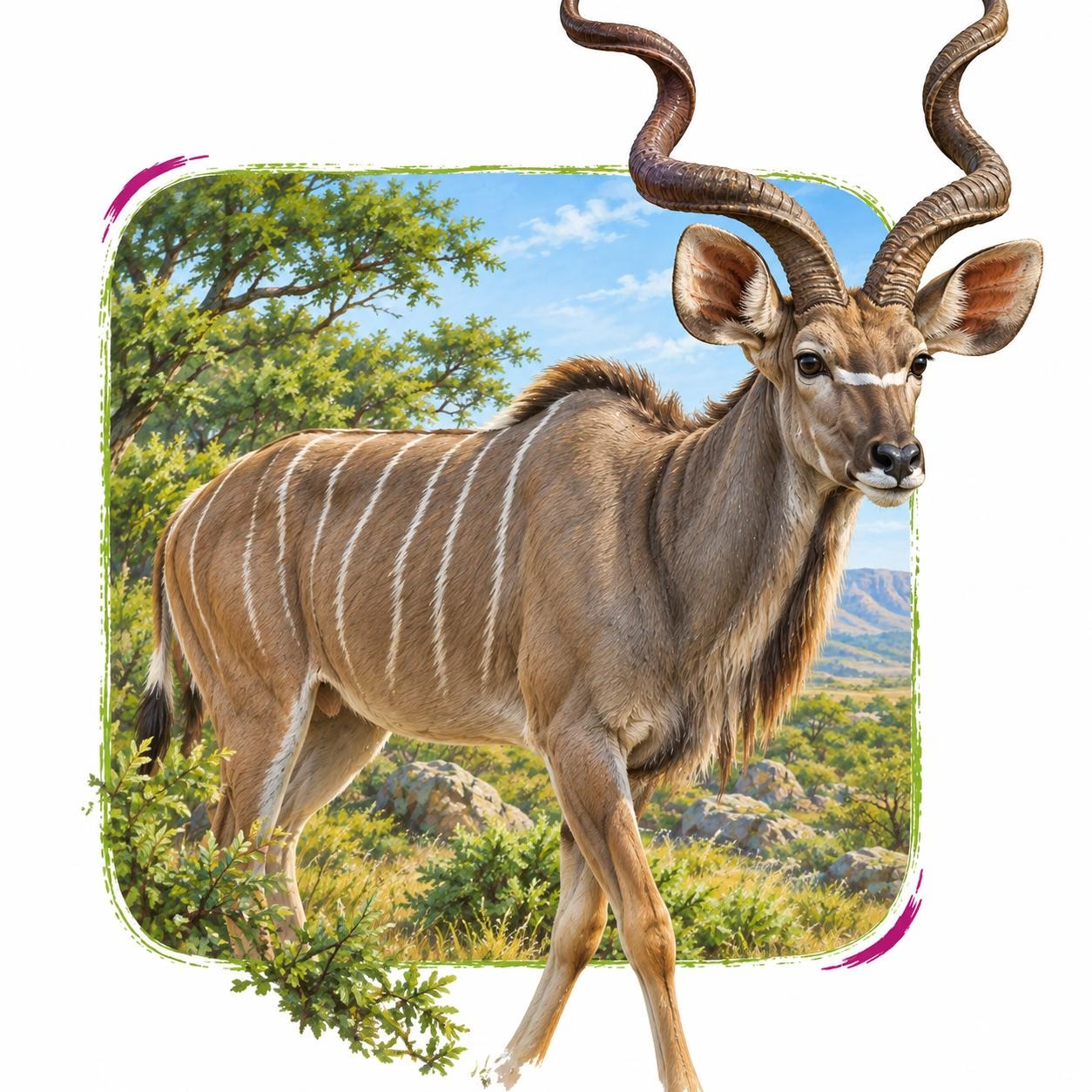
Greater Kudu in its natural Woodlands, wooded savannas, bushland, scrub, dense thickets, rocky hills, riverine vegetation, and other African habitats with browse and cover habitat