
House Mouse Facts for Kids
The House Mouse, Mus musculus, is a small rodent that has travelled with people across nearly the entire world. Its ancestral wild populations came from Eurasia, but human settlements, stored food, ships, farms, and trade carried house mice to every continent except Antarctica and to countless islands. Not every house mouse actually lives inside a house: some populations live in fields, grasslands, farms, rocky places, and other outdoor habitats, while others depend closely on buildings. House mice have pointed snouts, large rounded ears, long whiskers, long nearly hairless tails, and continuously growing incisors that must be worn down by gnawing. They are adaptable omnivores, communicate heavily through scent and sound, including ultrasound, build hidden nests, reproduce rapidly when food and shelter are abundant, and are currently listed as Least Concern.
Quick House Mouse Facts
- Animal Type: Mammal and rodent
- Scientific Name: Mus musculus
- Known For: Continuously growing incisors, long whiskers, scent communication, ultrasonic calls, hidden nests, rapid reproduction, human association, and extraordinary global spread
- Habitat: Houses, barns, warehouses, farms, fields, grasslands, rocky places, walls, burrows, islands, and many other habitats near or away from people depending on population
- Diet: Seeds, grains, fruit, plant material, insects, scraps, and other available foods
What You’ll Learn
Discover 10 fun House Mouse facts for kids with species-wide science, quick facts, a quiz, glossary, drawing activity, and rodent links.
These kid-friendly facts are made for children, parents, teachers, and little animal fact-finders.

10 Fun House Mouse Facts for Kids
1. House Mice Now Live Almost Worldwide
House mice spread far beyond their ancestral Eurasian range by travelling with humans and stored goods. Today Mus musculus occurs on continents and islands around the world except Antarctica, sometimes inside buildings and sometimes as outdoor wild or feral populations.
Kid Decode: The tiny passenger used human ships and settlements to turn the world into one enormous range map.
2. The Front Teeth Never Stop Growing
Like other rodents, house mice have a pair of upper and lower incisors that grow throughout life. Gnawing and tooth-to-tooth wear keep the sharp enamel-edged teeth from becoming dangerously long.
Kid Decode: The mouse owns four built-in chisels that need constant sharpening and shortening.
3. Whiskers Map the World Up Close
Long facial whiskers are sensitive touch organs that detect surfaces, gaps, air movement, and nearby objects. This tactile information is especially useful when a mouse moves through dark tunnels, wall spaces, vegetation, or cluttered rooms.
Kid Decode: A mouse can partly feel a dark hallway before its nose reaches the wall.
4. Smell Carries a Huge Amount of Information
House mice communicate using urine, gland secretions, and other scent cues. Chemical signals can carry information about identity, sex, reproductive condition, social relationships, and territory.
Kid Decode: To a mouse nose, one tiny scent mark can read like a whole profile card.
5. Some Mouse Conversations Are Too High for Us
House mice produce ultrasonic vocalizations above the range of normal human hearing. Pups call when separated from the nest, and adults of both sexes can produce ultrasound during courtship and other social interactions.
Kid Decode: A room that seems silent to you may contain an entire mouse conversation.
6. They Build Soft Hidden Nests
House mice gather shredded plant material, paper, cloth, insulation, and other soft items to build nests in protected spaces. Wild mice may also use rock cracks or burrow systems containing nest and food-storage chambers.
Kid Decode: A scrap of paper can become insulation in a mouse-sized bedroom.
7. They Are Flexible Omnivores
Seeds and grains are important foods, but house mice can also eat fruit, shoots, insects, carrion, and many human foods when available. The exact diet changes dramatically between wild habitats, farms, warehouses, and homes.
Kid Decode: The menu depends less on a recipe and more on what the mouse can find tonight.
8. Mouse Pups Start Life Helpless
After a pregnancy of roughly three weeks, females give birth to small litters of naked, blind young. The pups grow fur, open their eyes after about two weeks, and are usually weaned at around three weeks, with timing varying among conditions and populations.
Kid Decode: The fast little adult begins as a pink baby that cannot even see.
9. Populations Can Grow Very Quickly
When warmth, shelter, and food are abundant, house mice can breed repeatedly and young mature in only a few weeks. This high reproductive potential allows populations to rebound rapidly but does not mean every wild female produces the maximum possible number of litters.
Kid Decode: Good food and safe shelter can turn a few mice into many mice surprisingly fast.
10. House Mice Feed Many Predators
Owls, hawks, snakes, foxes, weasels, cats, mongooses, and many other predators eat house mice. On islands where mice were introduced, however, the mice themselves can also become ecological pests by eating seeds, invertebrates, eggs, or other native resources.
Kid Decode: The same mouse can be a vital snack in one food web and an invasive troublemaker in another.
The Weirdest House Mouse Fact
Male and female house mice can exchange courtship sounds at ultrasonic frequencies humans cannot hear, and studies show that the patterns can change with the identity and relatedness of the potential mate.
Try This House Mouse Activity
House Mouse Hidden-World Activity
Draw a cutaway showing a House Mouse moving between an outdoor field, barn, wall space, and pantry. Add a brown-gray mouse with pointed snout, rounded ears, long whiskers, long nearly hairless tail, continuously growing orange incisors, seed and insect foods, scent trails, ultrasonic sound waves, a burrow or wall nest lined with shredded material, a mother with blind pink pups, and predators such as an owl, snake, or weasel outside. Add a world map showing human-assisted spread to every continent except Antarctica.
Quick House Mouse Quiz
- What is the House Mouse’s scientific name? Answer: Mus musculus.
- Why must mice gnaw? Answer: Their incisors grow continuously and need to be worn down.
- What do whiskers help a mouse detect? Answer: Nearby surfaces, gaps, air movement, and objects.
- Can humans hear all mouse communication? Answer: No, many mouse calls are ultrasonic.
- What is the House Mouse’s current global IUCN category? Answer: Least Concern.
Mini Glossary
- Rodent: A mammal with continuously growing front incisors adapted for gnawing.
- Incisor: A front cutting tooth.
- Commensal: Living closely with another species and benefiting from its environment or resources, as house mice often do around people.
- Pheromone: A chemical signal carrying information between members of the same species.
- Ultrasound: Sound with a frequency above the normal range of human hearing.
 Western Diamondback Rattlesnake Facts for Kids
 Frog Facts for Kids
 Caribou Facts for Kids
 Rhomaleosaurus Facts for Kids
More Animal Facts for Kids
Visit the full animal facts library or explore a focused animal group.
More Extinct Animal Facts for Kids
Discover dinosaurs, Ice Age giants, prehistoric sea creatures, recently extinct species, and other animals from the past.
Fact check note: Fact checked with the American Society of Mammalogists Mammal Diversity Database version 2.5 account for Mus musculus, which documents its worldwide human-assisted distribution and current Least Concern status; Animal Diversity Web’s House Mouse account for body size, commensal and wild habitats, nests, omnivorous diet, reproduction, predators, whisker sensing, scent communication, and ultrasonic calls; and peer-reviewed house-mouse studies including Nicolakis and colleagues 2020 and Peng and colleagues 2026 on complex ultrasonic courtship communication.

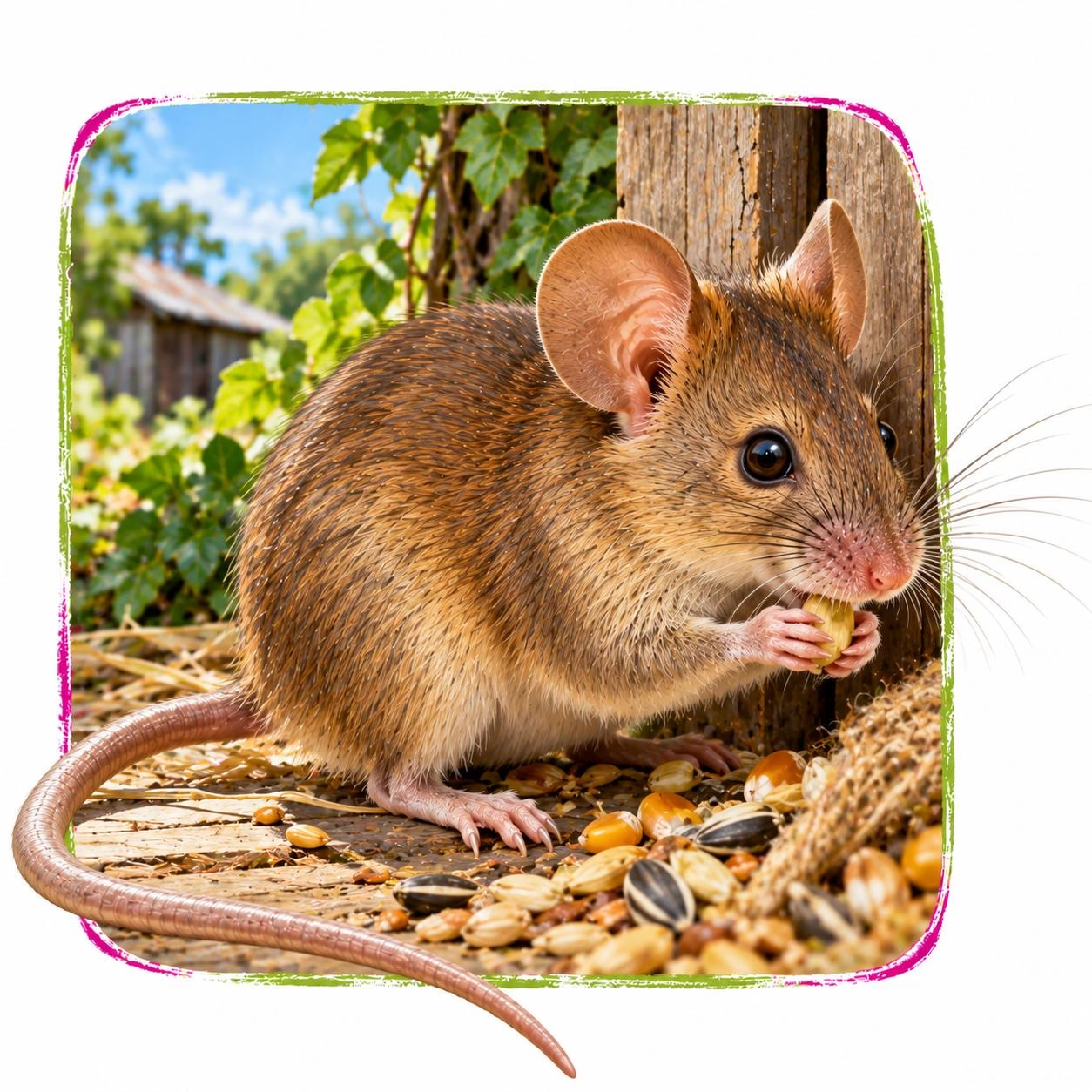
House Mouse in its natural Houses, barns, warehouses, farms, fields, grasslands, rocky places, walls, burrows, islands, and many other natural or human-modified habitats depending on population habitat