
Indian Peafowl Facts for Kids
The Indian Peafowl, Pavo cristatus, is a large pheasant native to the Indian subcontinent and famous for one of the most spectacular courtship displays in the bird world. The species name covers both sexes: an adult male is a peacock, an adult female is a peahen, and the young are peachicks. A mature peacock has a brilliant blue head, neck, and breast plus an enormous iridescent train covered in eyespots. That showy train is not actually the true tail; it is made from greatly elongated upper-tail covert feathers supported by much shorter tail feathers underneath. Peahens are mostly brown, gray, cream, and green and lack the giant train. Indian Peafowl forage on the ground for seeds, shoots, insects, and other small foods, fly into trees to roost, nest on the ground, and remain globally Least Concern. It is also the national bird of India.
Quick Indian Peafowl Facts
- Animal Type: Bird
- Scientific Name: Pavo cristatus
- Known For: Brilliant blue males, giant eyespot train, fan-shaped crest, courtship displays, loud calls, strong legs, ground foraging, and high tree roosts
- Habitat: Deciduous woodland, scrub, forest edge, farmland, village edges, grassland clearings, riverine areas, parks, and other habitats with cover, food, water, and roost trees
- Diet: Seeds, grains, shoots, berries, fruit, flowers, insects, worms, and occasional small reptiles or amphibians
What You’ll Learn
Discover 10 fun Indian Peafowl facts for kids with accurate bird science, quick facts, a quiz, glossary, drawing activity, and Indian wildlife links.
These simple explanations are perfect for kids, families, teachers, and
10 Fun Indian Peafowl Facts for Kids
1. Peacock Means Male, Not the Whole Species
Indian Peafowl is the name of the species. An adult male is called a peacock, an adult female a peahen, and a young bird a peachick. Calling every individual a peacock leaves the females and chicks out of the picture.
Kid Decode: Peafowl is the family label; peacock is only one half of the adult cast.
2. The Famous Tail Is Not Really the Tail
The peacock’s spectacular train is built from around two hundred greatly elongated upper-tail covert feathers. The true tail is much shorter and lies underneath, helping support and control the giant fan during display.
Kid Decode: The world’s most famous bird tail is technically wearing a feather cape over the real tail.
3. Eyespots Fill the Train
The long train feathers end in shimmering ocelli, or eyespots, made from microscopic feather structures that reflect different wavelengths of light. The colours are structural and iridescent, changing with viewing angle rather than coming only from ordinary pigments.
Kid Decode: Each eye-shaped feather patch behaves like a tiny colour-changing light machine.
4. A Display Is More Than a Pretty Fan
A courting peacock raises and spreads the train, turns toward females, shakes wings, and performs train-rattling movements. Females assess several visual and behavioural cues rather than responding to one simple feature such as train length alone.
Kid Decode: The fan is only the stage; the full performance includes movement, sound, angle, and timing.
5. Peafowl Can Fly
Despite the male’s enormous train, Indian Peafowl are capable fliers. They usually spend much of the day walking and running on the ground, then make strong short flights into trees or other elevated sites for safety and roosting.
Kid Decode: The giant feather fan does not cancel the bird’s flight ticket.
6. They Sleep High Above the Ground
Indian Peafowl commonly roost high in trees at night, where sleeping above ground reduces danger from many terrestrial predators. Birds often move toward regular roosting areas around dusk.
Kid Decode: After a day on foot, the whole bird climbs into the night sky to sleep.
7. The Menu Is Strongly Omnivorous
Peafowl scratch and peck for seeds, grain, plant shoots, fruit, insects, worms, and other small animals. Small reptiles and amphibians may also be eaten, but snakes are only one possible prey type and should not define the entire diet.
Kid Decode: Breakfast might be seeds, lunch beetles, and dinner whatever small snack appears next.
8. Peahens Build Ground Nests
A peahen makes a shallow nest on the ground, usually hidden beneath vegetation or other cover. She lays several eggs and performs the incubation herself, while the male does not help brood the clutch.
Kid Decode: The grandest feathers belong to the male, but the nursery is a quiet bowl hidden at ground level.
9. Peachicks Hatch Ready to Move
Peachicks are precocial: they hatch covered in down with open eyes and can move soon after hatching. They follow the peahen, learn what to eat, and can make short flights when still quite young.
Kid Decode: The chick skips the helpless-nestling stage and begins its walking lessons almost immediately.
10. It Is India’s National Bird
The Indian Peafowl is the national bird of India and is native across much of the Indian subcontinent. It has also been introduced widely around the world. The species is globally listed as Least Concern, although local birds still depend on safe habitat, roost trees, food, water, and protection from persecution.
Kid Decode: One spectacular ground bird carries both a scientific name and a national-symbol job.
The Weirdest Indian Peafowl Fact
The enormous fan that makes a peacock instantly recognisable is not its true tail at all: it is a train of greatly elongated upper-tail coverts, while the real tail feathers sit underneath and help hold the display up.
Try This Indian Peafowl Activity
Indian Peafowl Display Activity
Draw an Indian Peafowl scene at a woodland clearing in India. Add one bright blue peacock spreading a huge eyespot train, label the long feathers as upper-tail coverts, show the shorter true tail underneath, and add a brown-and-green peahen plus several peachicks. Include the fan-shaped crest, train-rattling motion lines, ground foraging for seeds and insects, a ground nest hidden under vegetation, a short flight into a tall roost tree at dusk, and a small national-bird-of-India symbol.
Quick Indian Peafowl Quiz
- What is the Indian Peafowl’s scientific name? Answer: Pavo cristatus.
- What is an adult male called? Answer: A peacock.
- Is the giant eyespot train the bird’s true tail? Answer: No, it is made of elongated upper-tail covert feathers.
- Where do Indian Peafowl commonly sleep? Answer: High in trees or other elevated roosts.
- What is its current global conservation category? Answer: Least Concern.
Mini Glossary
- Train: The peacock’s extremely long upper-tail covert feathers used in display.
- Ocellus: An eye-shaped marking, such as the colourful spots on a peacock’s train.
- Iridescence: Colours that change with viewing angle because of microscopic structures reflecting light.
- Precocial: Hatching relatively developed and able to move soon afterward.
- Roost: A place where a bird rests or sleeps, often at night.
 Goldfish Facts for Kids
 American Crocodile Facts for Kids
 Coral Facts for Kids
 Western Black Rhinoceros Facts for Kids
More Animal Facts for Kids
Visit the full animal facts library or explore a focused animal group.
More Extinct Animal Facts for Kids
Discover dinosaurs, Ice Age giants, prehistoric sea creatures, recently extinct species, and other animals from the past.
Fact check note: Fact checked with Cornell Lab of Ornithology All About Birds and Birds of the World resources for Pavo cristatus identification, the distinction between the train and true tail, courtship, roosting and ecology; BirdLife DataZone and BTO for current global Least Concern status; Animal Diversity Web for sexual dimorphism, reproduction, precocial chicks, diet, roosting and display behaviour; and the Government of India’s National Portal and Ministry of Environment sources confirming the Indian Peafowl as India’s national bird.

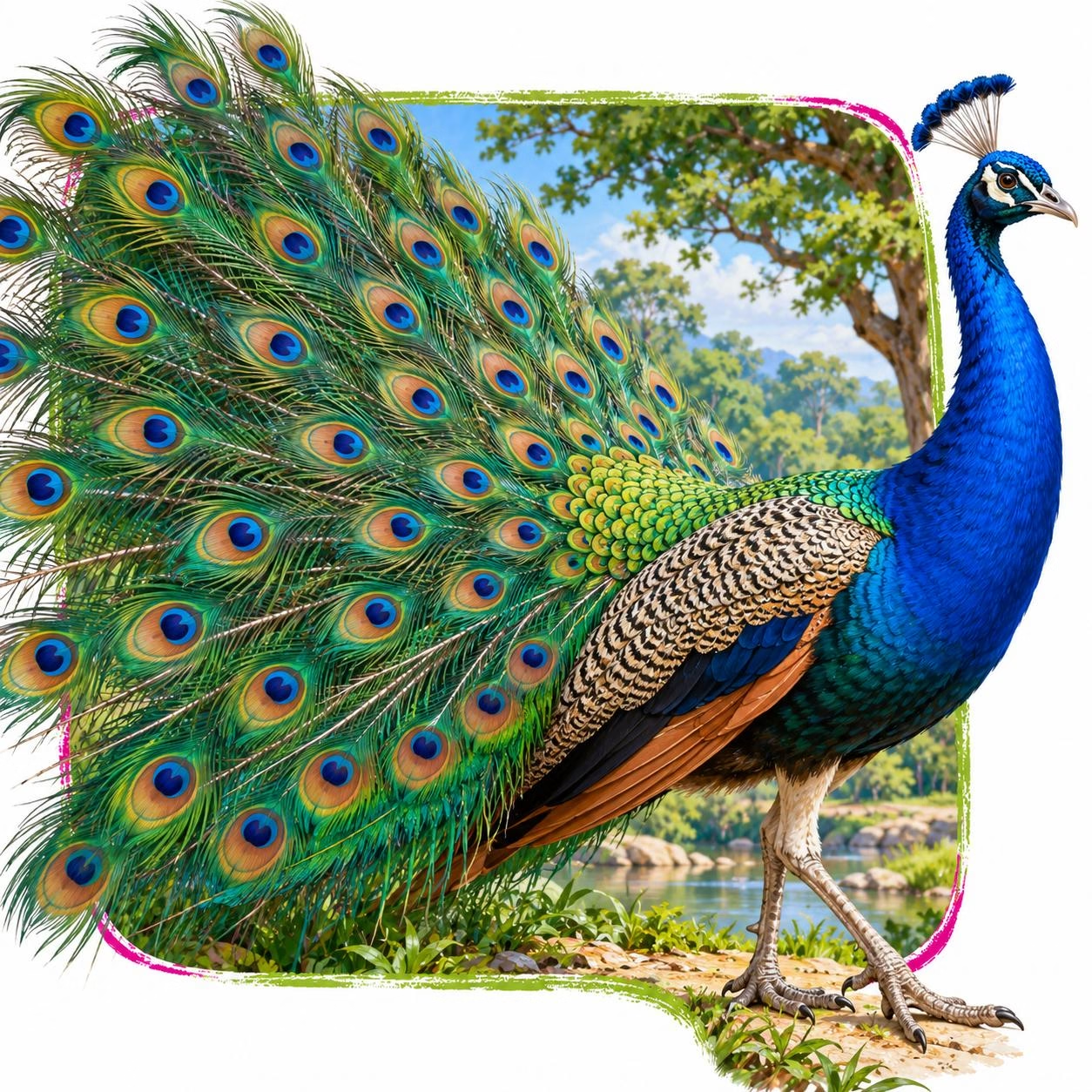
Indian Peafowl in its natural Deciduous woodland, scrub, forest edge, farmland, village margins, grassland clearings, riverine areas, parks, and other habitats with ground feeding areas, water, cover, and tall roost trees habitat