
Indian Rock Python Facts for Kids
The Indian Rock Python, Python molurus, is a very large nonvenomous snake native to the Indian subcontinent and Sri Lanka. It is a separate species from the darker Burmese Python, Python bivittatus, which older books sometimes treated as its subspecies. Indian Rock Pythons have pale tan, gray, yellowish, or brown bodies covered with dark irregular blotches, heat-sensitive pits along the lips, powerful muscles, and flexible jaws. They live in forest, scrub, grassland, rocky foothills, marshes, river valleys, and other habitats with reliable water and shelter.
Quick Indian Rock Python Facts
- Animal Type: Reptile
- Group: Large constricting snake in the genus Python and family Pythonidae
- Known For: Giant size, blotched camouflage, heat-sensitive lip pits, nonvenomous constriction, expandable feeding anatomy, swimming, egg brooding, and muscular heat production
- Habitat: Forest, scrub, grassland, rocky foothills, marshes, mangroves, river valleys, farmland edges, and other places near water
- Diet: Rodents, hares, fruit bats, birds, lizards, monitor lizards, civets, deer fawns, wild pigs, and other vertebrates that fit the individual snake
What You’ll Learn
Discover 10 giant indian rock python facts for kids about patterned scales, powerful coils, swimming, hunting, and South Asian habitats, plus a quiz, glossary, and activity
These facts are explained simply for kids, parents, teachers, and curious little fact-finders.

10 Fun Indian Rock Python Facts for Kids
1. It Is Separate From the Burmese Python
Older classifications treated the Burmese Python as a subspecies of Python molurus. Modern taxonomy recognizes Python molurus and Python bivittatus as separate species with overlapping but distinct features and ranges.
Kid Decode: One old scientific name split into two giant snakes with separate passports.
2. Blotches Break Up the Body Outline
Irregular brown saddle-like markings blend with leaf litter, bark, rock, reeds, and shadow. Color varies geographically, so some individuals look pale and dry-country colored while others are darker.
Kid Decode: The enormous body vanishes into a patchwork quilt of mud, leaves, stone, and sun.
3. Heat-Sensitive Pits Detect Warm Prey
Small hollows along the lips sense infrared radiation from warm animals. Combined with smell and vision, these pits help the python aim accurately in dim light.
Kid Decode: The snake’s lips carry a silent map of nearby warmth.
4. Constriction Interrupts Blood Flow
After biting, the python wraps coils around prey and tightens whenever the animal exhales or moves. Research on constrictors shows that pressure can rapidly disrupt circulation and vital organ function.
Kid Decode: The coils act like a whole-body pressure trap rather than a bone-crushing machine.
5. The Jaw Does Not Dislocate
Flexible skull joints, movable quadrate bones, and two lower-jaw halves joined by elastic tissue let the mouth spread around prey. Recurved teeth hold food while alternating jaw movements pull it inward.
Kid Decode: The skull becomes a walking feeding machine without popping out of its sockets.
6. One Meal Can Last a Long Time
Large prey provides enough energy for days or weeks, and the snake’s digestive organs become much more active after feeding. Pythons usually rest while processing a substantial meal.
Kid Decode: A giant dinner turns the following calendar into one long digestion break.
7. It Moves Straight Ahead With Rib Muscles
During rectilinear locomotion, belly scales grip the ground while muscles pull the skeleton forward inside the skin. This quiet movement suits a heavy-bodied ambush hunter.
Kid Decode: The snake advances like a living conveyor belt with no side-to-side wiggle required.
8. Water Is an Important Part of Its Habitat
Indian Rock Pythons are strong swimmers and often live near rivers, marshes, lakes, mangroves, and wetlands. They may remain partly submerged while cooling, travelling, or hiding.
Kid Decode: The huge forest snake can become a silent river ribbon.
9. A Mother Coils Around Her Eggs
Females lay leathery eggs in protected shelters and wrap their bodies around the clutch. They defend the eggs and can warm them through repeated muscular contractions called shivering thermogenesis.
Kid Decode: The mother becomes a muscular living incubator wrapped around a pile of eggs.
10. Decline Comes From Several Human Pressures
Habitat loss, wetland change, roads, fires, deliberate killing, capture, and past exploitation for skins contribute to population decline. Protecting large connected habitats and reducing fear-based killing are important.
Kid Decode: A snake built to overpower prey can still lose against disappearing wetlands and busy roads.
The Weirdest Indian Rock Python Fact
A brooding female can repeatedly contract her muscles to warm her eggs above the surrounding temperature, creating heat without leaving the nest to bask.
Try This Indian Rock Python Activity
Indian Rock Python Adaptation Activity
Draw an Indian Rock Python beside a Burmese Python comparison. Add pale tan or gray blotched camouflage, a blurred arrow-shaped head marking, heat-sensitive lip pits, forked tongue and Jacobson’s organ, flexible jaw joints, backward-curving teeth, muscular coils around appropriately sized prey, straight-line movement, climbing and swimming, a hollow-tree or burrow shelter, a female coiled around a large egg clutch, shivering thermogenesis, hatchlings, and conservation panels for habitat loss, road deaths, persecution, illegal trade, and safe professional rescue.
Quick Indian Rock Python Quiz
- What is the Indian Rock Python’s scientific name? Answer: Python molurus.
- Is it venomous? Answer: No.
- How does it subdue prey? Answer: It coils around prey and constricts it.
- What helps it detect warm animals? Answer: Heat-sensitive pits along the lips.
- What is its IUCN category? Answer: Near Threatened.
Mini Glossary
- Pythonid: A snake in the python family, Pythonidae.
- Constrictor: A snake that subdues prey by wrapping it in muscular coils.
- Labial Pit: A heat-sensitive hollow along a snake’s lip.
- Oviparous: Reproducing by laying eggs.
- Thermogenesis: Production of heat within an animal’s body.
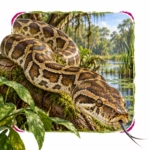
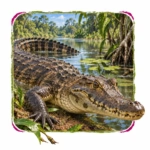 Caiman Facts for Kids
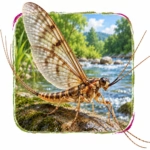 Mayfly Facts for Kids
 Beluga Whale Facts for Kids
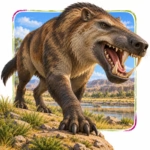 Andrewsarchus Facts for Kids
More Animal Facts for Kids
Visit the full animal facts library or explore a focused animal group.
More Extinct Animal Facts for Kids
Discover dinosaurs, Ice Age giants, prehistoric sea creatures, recently extinct species, and other animals from the past.
Fact check note: Fact checked with the Reptile Database and IUCN Red List taxonomy and Near Threatened assessment for Python molurus, field research on Indian Rock Python habitat use and home ranges, and herpetological studies of diet, heat-sensitive lip pits, constriction, rectilinear locomotion, swimming, oviparity, maternal brooding, shivering thermogenesis, hatchlings, and conservation threats.

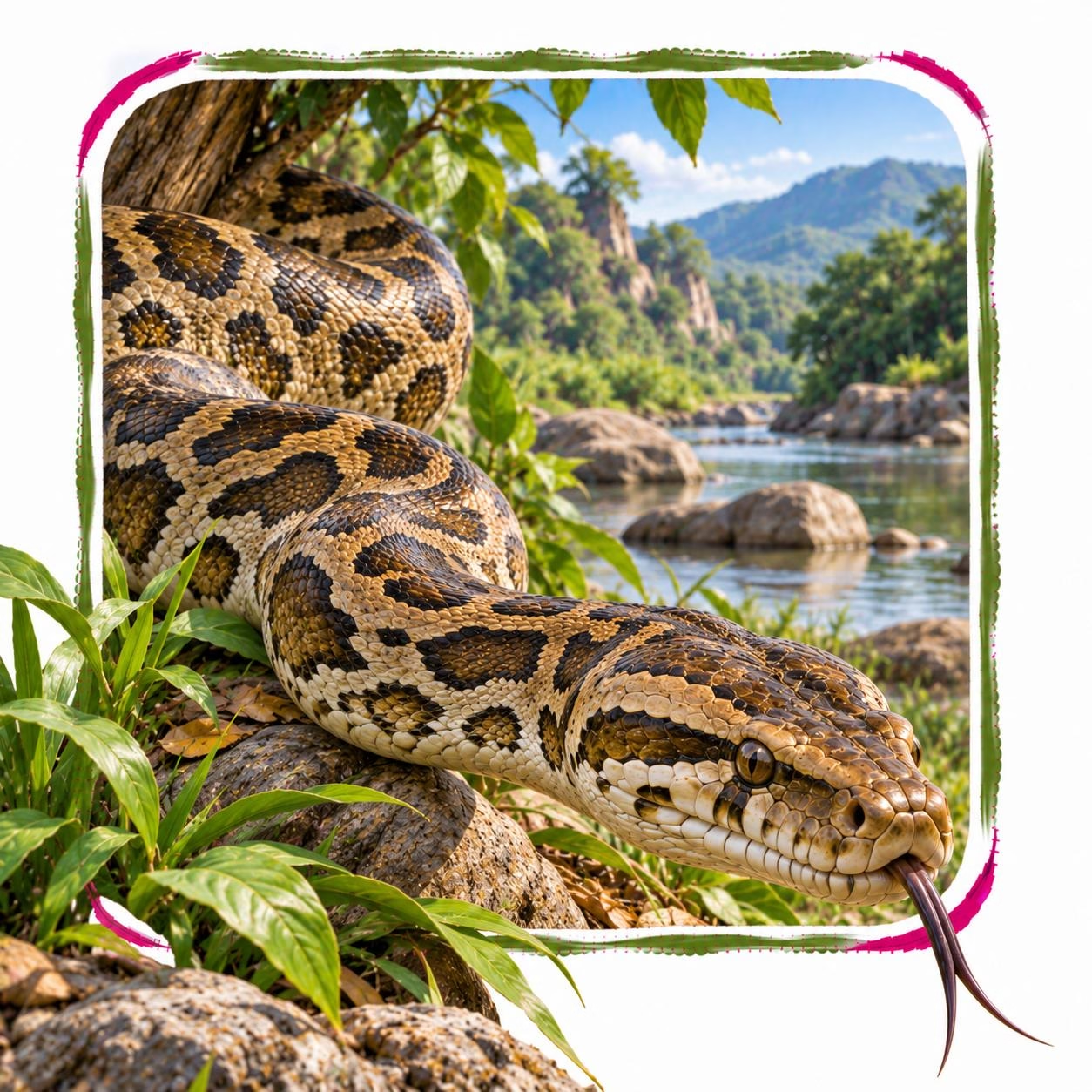
Indian Rock Python in its natural Forests, scrublands, grasslands, rocky foothills, marshes, mangroves, river valleys, farmland edges, and sheltered areas near reliable water across the Indian subcontinent and Sri Lanka habitat