
Scorpion Facts for Kids
Scorpions are predatory arachnids recognized by their grasping pincers and segmented tails tipped with venomous stingers. More than 2,500 species live in deserts, forests, grasslands, caves, mountains, and human-altered habitats across every continent except Antarctica. Most avoid people and hunt at night by detecting tiny vibrations, but all wild scorpions should be left untouched.
Quick Scorpion Facts
- Scientific Group: Order Scorpiones in class Arachnida
- Animal Type: Arachnid, arthropod, and invertebrate
- Diversity: More than 2,500 described living species, with new species still being identified
- Size: Roughly 9 millimetres to more than 20 centimetres depending on species
- Known For: Eight walking legs, two pincer-bearing pedipalps, a segmented tail, and a venomous stinger
- Range: Every continent except Antarctica
- Habitat: Deserts, forests, savannas, grasslands, caves, mountains, rocky places, burrows, and gardens
- Diet: Insects, spiders, centipedes, and other small animals
- Young: Live-born scorplings carried on their mother’s back
- Conservation: Status varies by species; many have not been assessed, while restricted species can be threatened by habitat loss or collection
What You’ll Learn
Discover 10 amazing scorpion facts for kids about pincers, stingers, eight legs, ultraviolet glow, and ancient arachnid relatives, plus a quiz, glossary, activity, and safe observation tips
These facts are explained simply for kids, parents, teachers, and curious little fact-finders.
10 Fun Scorpion Facts for Kids
1. Scorpions Are Arachnids
A scorpion has four pairs of walking legs and no wings or antennae. It is related to spiders, mites, ticks, and other arachnids rather than to six-legged insects.
Kid Decode: Count eight walking legs before calling a scorpion an insect.
2. Their Pincers Are Modified Limbs
The large grasping arms are pedipalps, a pair of appendages near the mouth rather than extra walking legs. Each ends in a claw called a chela that holds prey and helps with defense, courtship, and sensing.
Kid Decode: A scorpion carries two clawed pedipalps plus eight walking legs.
3. The Tail Ends in a Venom Bulb
The narrow five-segmented metasoma bends forward over the body. At its end, the telson contains paired venom glands and a curved stinger that injects venom into prey or a serious threat.
Kid Decode: The stinger is attached to a venom-filled final piece called the telson.
4. Only a Minority Are Medically Dangerous
All true scorpions produce venom, but most species cause limited local effects in people. A small minority can cause severe illness, especially in children, so no unknown scorpion should be touched and every sting needs prompt adult attention and local medical advice.
Kid Decode: “Most are less dangerous” never means “safe to pick up.”
5. Vibrations Guide Night Hunts
Many scorpions leave shelter after dark and use sensitive hairs and slit organs on their legs, pedipalps, and body to detect vibrations. They can judge the direction and distance of moving prey without relying on sharp eyesight.
Kid Decode: Footsteps from an insect can travel through sand like a dinner announcement.
6. Pectines Comb the Ground
A pair of feathery, comb-shaped sensory organs lies underneath the abdomen. These pectines touch the surface and detect texture and chemical clues, helping with navigation, hunting, and finding mates.
Kid Decode: A scorpion carries two sensory combs on its belly.
7. Ultraviolet Light Makes Them Glow
Compounds in the hardened outer cuticle fluoresce blue-green when ultraviolet light shines on them. Scientists use UV lamps to locate scorpions, but the biological purpose of the glow remains debated.
Kid Decode: Under ultraviolet light, a brown scorpion can shine electric turquoise.
8. Mothers Carry Live Babies
Unlike many other arachnids, scorpions give birth to live young. The soft pale scorplings climb onto their mother’s back and remain there without feeding until their first molt hardens a new protective exoskeleton.
Kid Decode: A mother scorpion becomes a walking nursery covered with tiny babies.
9. Courtship Includes a Pincer Dance
A male and female grasp pedipalps and move together in a promenade. The male searches for a suitable surface, deposits a sperm packet called a spermatophore, and guides the female over it.
Kid Decode: A scorpion mating dance is part waltz and part search for the perfect floor.
10. Their Family Is Extremely Ancient
Scorpion relatives appear in fossils more than 400 million years old, long before dinosaurs. Modern scorpions have changed in many ways, but the recognizable pincer-and-tail body plan has very deep evolutionary roots.
Kid Decode: Scorpion-shaped hunters were already ancient when the first dinosaurs appeared.
The Weirdest Scorpion Fact
A scorpion that looks brown or black in normal light can fluoresce bright blue-green under ultraviolet light. The hardened cuticle produces the glow, but scientists still debate whether it helps the animal detect exposure, find shelter, communicate, or serves another function.
Try This Scorpion Activity
Design a Scorpion Sensor Map
Draw a large scorpion without touching a real one. Label eight walking legs, two pincer-bearing pedipalps, sensory hairs, paired pectines, segmented metasoma, telson, and stinger. Add arrows showing ground vibrations from a beetle and a blue-green UV glow. Finish with three safety rules: look without touching, shake out outdoor shoes with adult help, and tell an adult immediately after a sting.
Quick Scorpion Quiz
- Is a scorpion an insect? Answer: No, it is an arachnid.
- How many walking legs does it have? Answer: Eight.
- What are the pincer-bearing limbs called? Answer: Pedipalps.
- What are pectines? Answer: Comb-shaped sensory organs under the abdomen.
- Where do newborn scorplings ride? Answer: On their mother’s back.
Mini Glossary
- Arachnid: An eight-legged arthropod in the group containing spiders and scorpions.
- Pedipalp: One of the paired appendages beside an arachnid’s mouth; in scorpions it bears a pincer.
- Telson: The final tail structure containing venom glands and the stinger.
- Pectine: A comb-shaped sensory organ underneath a scorpion.
- Fluorescence: Visible light emitted after a material absorbs light of another wavelength.
 Octopus Facts for Kids
 Sea Lion Facts for Kids
 Donkey Facts for Kids
 Bali Tiger Facts for Kids
More Animal Facts for Kids
Visit the full animal facts library or explore a focused animal group.
More Extinct Animal Facts for Kids
Discover dinosaurs, Ice Age giants, prehistoric sea creatures, recently extinct species, and other animals from the past.
Fact check note: Fact checked against the Australian Museum’s current scorpion overview, identification guide, and species profiles; Smithsonian National Museum of Natural History ultraviolet-fluorescence material; World Health Organization guidance on invertebrate stings; authoritative arachnid taxonomy references; and peer-reviewed studies of scorpion sensory biology, pectines, fluorescence, venom, reproduction, courtship, and fossils. Classification, species diversity, size range, anatomy, distribution, habitats, diet, venom risk, vibration sensing, book lungs, live birth, maternal care, molting, fluorescence, mating, safety, and evolutionary age were cross-checked.
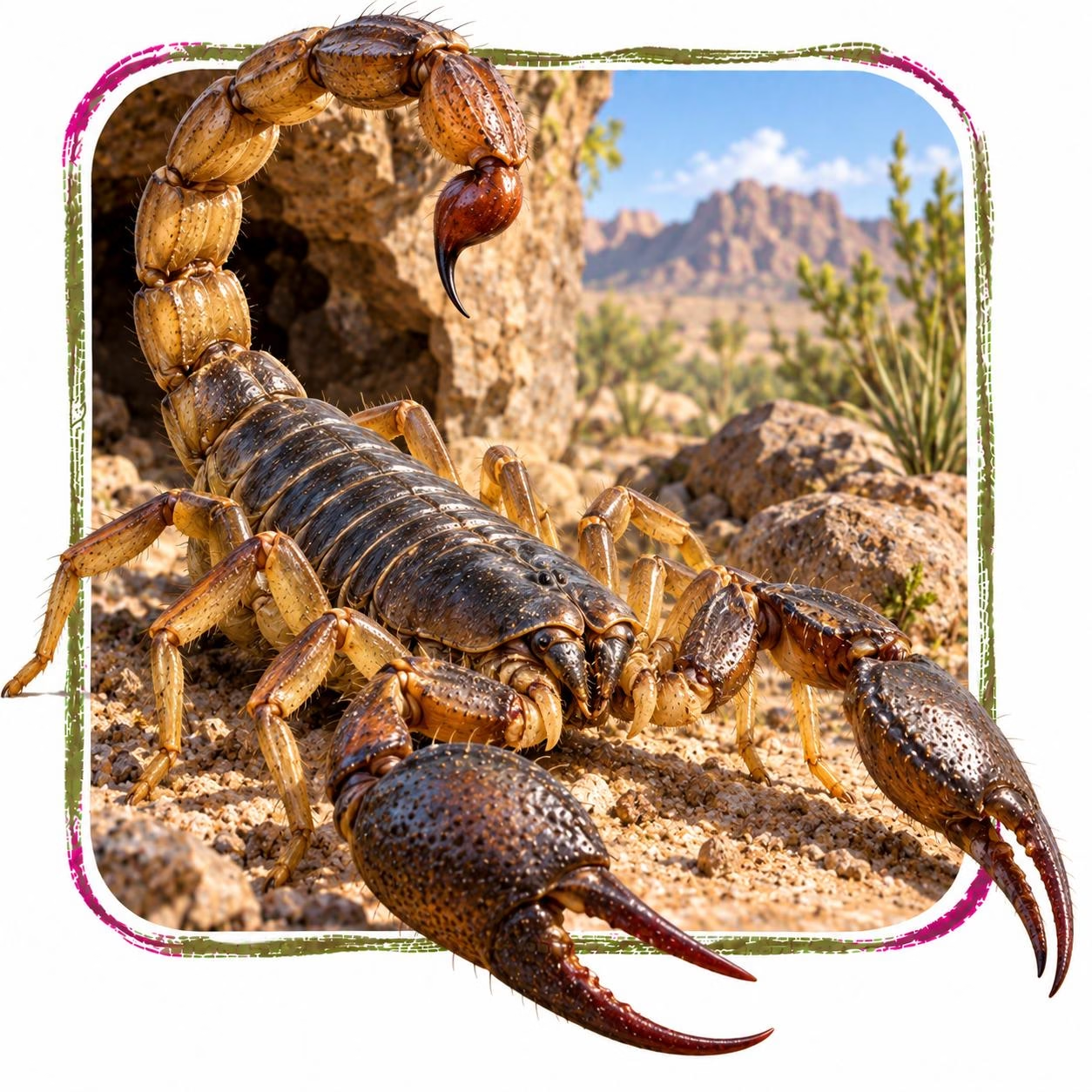
Scorpion in its natural Deserts, forests, savannas, grasslands, caves, rocky slopes, mountains, burrows, leaf litter, gardens, and buildings in warm regions habitat