
Southern Brown Bandicoot Facts for Kids
The Southern Brown Bandicoot, Isoodon obesulus, is a small stocky Australian marsupial with coarse brown-gray fur, a creamy belly, small rounded ears, a pointed snout, short front legs, stronger hind legs, and a short tapered tail. It lives in dense scrub, heath, forest understorey, grass and wetland-edge vegetation where low cover protects it from predators. Southern Brown Bandicoots rest in concealed ground nests during the day and emerge mainly at dusk and night to dig for insects, earthworms, roots, fungi, seeds, and other foods. Their pouch opens backward, helping keep soil away from tiny joeys while the mother digs. Pregnancy is extraordinarily short, about 12 to 16 days. Current Mammal Diversity Database taxonomy lists Isoodon obesulus as Least Concern at species level, but important regional populations are much more threatened; the eastern subspecies is federally Endangered in Australia.
Quick Southern Brown Bandicoot Facts
- Animal Type: Mammal and marsupial
- Scientific Name: Isoodon obesulus
- Known For: Pointed snout, backward-opening pouch, cone-shaped feeding holes, fast reproduction, underground fungi eating, solitary life, and major soil-turning activity
- Habitat: Dense heath, scrub, tussock grass, forest understorey, wetland edges, sandy soils, and other habitats with thick low cover
- Diet: Insects, grubs, earthworms, spiders, underground fungi, roots, tubers, seeds, fruit, and other plant material
What You’ll Learn
Discover 10 Southern Brown Bandicoot facts for kids with current marsupial taxonomy, quick facts, a quiz, glossary, drawing activity, and Australian wildlife links for curious young animal explorers.
Simple explanations make them fun for children, families, teachers, and young marsupial fans.
10 Fun Southern Brown Bandicoot Facts for Kids
1. It Is a Marsupial, Not a Giant Rat
Despite its pointed nose and ground-foraging lifestyle, the Southern Brown Bandicoot is a marsupial in the order Peramelemorphia, not a rodent. Its strong hind legs, unusual feet, pouch, and extremely short pregnancy reveal a very different evolutionary history.
Kid Decode: The rat-like silhouette hides a family tree much closer to other Australian marsupials.
2. The Pouch Opens Backward
The mother’s pouch faces toward the rear rather than toward the head. Because she spends so much time raking and digging soil with her front feet, the backward opening helps reduce the amount of dirt that reaches the developing joeys.
Kid Decode: The nursery door points away from the flying dirt.
3. Cone-Shaped Holes Reveal Its Nightly Work
Southern Brown Bandicoots dig narrow conical holes while searching for insects, larvae, earthworms, fungi, roots, and tubers. These small pits and nearby soil heaps are often easier to find than the shy animal itself.
Kid Decode: A bandicoot can sign its name across a garden using dozens of tiny dirt cones.
4. Digging Helps Engineer the Soil
By turning over large amounts of earth, bandicoots mix soil, litter, and nutrients, improve water penetration, and help spread underground fungi and their spores. Research in Victoria estimated that one Southern Brown Bandicoot can move several tonnes of soil in a year.
Kid Decode: A one-kilogram marsupial can become a miniature ecosystem earthmover.
5. Pregnancy Can Last Less Than Two Weeks
Southern Brown Bandicoots have one of the shortest mammal pregnancies, commonly around 12 to 16 days. Their young are born extremely undeveloped and continue growing attached to teats inside the pouch.
Kid Decode: The pregnancy may finish in under two weeks, but the real growing continues inside the pouch.
6. Several Joeys Can Share the Pouch
Females can produce litters of several tiny young and have eight teats, although not every teat is used at once. The joeys remain in the pouch for roughly two months before becoming independent soon afterward.
Kid Decode: The backward pouch is a fast-moving nursery with room for a small handful of joeys.
7. They Prefer to Live Alone
Southern Brown Bandicoots are mostly solitary. Males and females use individual home ranges and usually come together only for mating, with males often roaming over larger areas than females.
Kid Decode: This little digger runs a one-bandicoot night shift most of the time.
8. Dense Cover Is a Survival Tool
Low shrubs, tussocks, heath and thick ground vegetation provide shelter from cats, foxes, raptors, and other predators. During daylight, bandicoots hide in shallow ground nests lined and covered with grass and leaves.
Kid Decode: For a bandicoot, a messy tangle of shrubs can be better protection than an open lawn.
9. Its Taxonomy Has Become Narrower
Current Mammal Diversity Database treatment recognizes Isoodon obesulus as a species but notes that Isoodon peninsulae and Isoodon fusciventer were previously included. This means older books may map a broader Southern Brown Bandicoot complex than current taxonomy.
Kid Decode: Some old range maps contain neighbors that scientists now count as different species.
10. Global and Local Conservation Labels Tell Different Stories
Current MDD lists Isoodon obesulus as Least Concern at species level, but conservation risk is not uniform. The eastern subspecies, Isoodon obesulus obesulus, is federally Endangered in Australia, and state populations can be threatened by habitat loss, foxes, cats, roads, and unsuitable fire regimes.
Kid Decode: One species can be globally secure while a particular regional population is in serious trouble.
The Weirdest Southern Brown Bandicoot Fact
A female can finish pregnancy in roughly 12 to 16 days, one of the shortest gestations known in mammals, and then continue raising her tiny undeveloped young inside a backward-opening pouch.
Try This Southern Brown Bandicoot Activity
Southern Brown Bandicoot Soil-Engineer Activity
Draw a dense Australian heath and scrub scene at dusk. Add a Southern Brown Bandicoot with a stocky brown-gray body, cream belly, small round ears, pointed snout, short tapered tail, short digging forelegs, and longer hind legs. Show cone-shaped feeding holes, insects, earthworms, roots and underground fungi, a grass-and-leaf day nest, a backward-opening pouch with tiny non-graphic joeys, and a soil cutaway showing how digging mixes litter, nutrients and fungal spores. Add fox, cat, road and fire-regime threat icons at the edge of the scene.
Quick Southern Brown Bandicoot Quiz
- What is the Southern Brown Bandicoot’s scientific name? Answer: Isoodon obesulus.
- Which direction does the pouch open? Answer: Backward.
- What shape are its typical feeding holes? Answer: Narrow and cone-shaped.
- How long can pregnancy last? Answer: Roughly 12 to 16 days.
- What is the current species-level IUCN category in MDD? Answer: Least Concern, although some regional subspecies are threatened.
Mini Glossary
- Bandicoot: An Australian and New Guinean marsupial from the order Peramelemorphia.
- Marsupial: A mammal whose very undeveloped young usually continue growing attached to teats, often inside a pouch.
- Joey: A young marsupial.
- Mycophagy: Eating fungi.
- Soil Turnover: Digging and mixing soil layers, litter, and nutrients.
 Deer Facts for Kids
 Bilby Facts for Kids
 Sea Hare Facts for Kids
 Syrian Wild Ass Facts for Kids
More Animal Facts for Kids
Visit the full animal facts library or explore a focused animal group.
More Extinct Animal Facts for Kids
Discover dinosaurs, Ice Age giants, prehistoric sea creatures, recently extinct species, and other animals from the past.
Fact check note: Fact checked with the American Society of Mammalogists Mammal Diversity Database version 2.5 account for Isoodon obesulus, which lists the species as Least Concern, restricts it to Australia, and notes that I. peninsulae and I. fusciventer were previously included; the Australian Museum’s 2026-updated Southern Brown Bandicoot account for nocturnal solitary behavior, dense low-cover habitat, insect-earthworm-plant diet, reduced distribution, fox and cat predation, and fire-related threats; Royal Botanic Gardens Victoria for the backward-opening pouch, 12-to-15-day gestation, conical digging holes, underground fungi diet, and soil-turnover role; and current Australian and NSW government material showing that the eastern subspecies Isoodon obesulus obesulus is nationally and regionally Endangered even though the species-level MDD category is Least Concern.

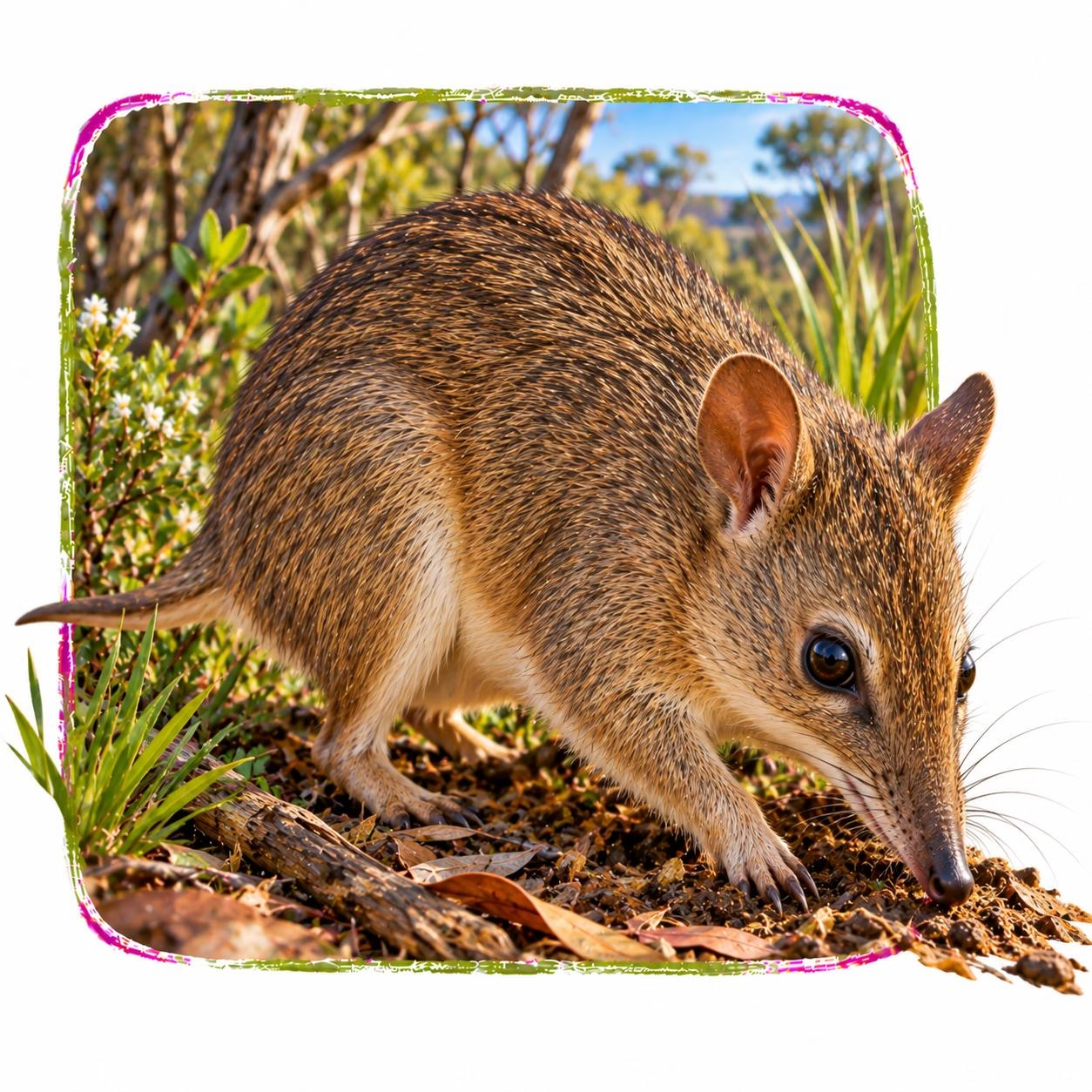
Southern Brown Bandicoot in its natural Dense heath, scrub, tussock grass, forest understorey, wetland edges, sandy or friable soils, and other Australian habitats with thick low ground cover habitat