
White-Handed Gibbon Facts for Kids
The White-Handed Gibbon, Hylobates lar, also called the Lar Gibbon, is an Endangered small ape of Southeast Asian forests. It has extremely long arms, hook-like hands, no tail, and pale hands and feet that give the species its familiar name. Adults can be dark brown or blackish or much paler cream and buff, but both colour forms keep the contrasting pale face ring, hands, and feet. White-Handed Gibbons spend most of their lives high in the canopy, moving hand-over-hand through branches in a style called brachiation. They eat mostly ripe fruit along with leaves, flowers, and some insects, disperse seeds through the forest, and communicate with long powerful songs and pair duets. Habitat loss, fragmentation, hunting, and capture for the wildlife trade remain major threats.
Quick White-Handed Gibbon Facts
- Animal Type: Mammal and small ape
- Scientific Name: Hylobates lar
- Known For: Very long arms, white hands and feet, dark or pale colour morphs, brachiation, loud morning songs, pair duets, fruit eating, and life high in the forest canopy
- Habitat: Tropical evergreen forest, seasonal evergreen forest, mixed deciduous forest, bamboo forest, dipterocarp forest, peat-swamp forest, and other connected Southeast Asian canopy habitats
- Diet: Mostly ripe fruit, plus leaves, flowers, shoots, and some insects
What You’ll Learn
Discover 10 fun White-Handed Gibbon facts for kids with current primate science, quick facts, a quiz, glossary, drawing activity, and Asian rainforest links.
Simple explanations make them fun for kids, families, teachers, and young rainforest explorers.

10 Fun White-Handed Gibbon Facts for Kids
1. It Is an Ape, Not a Monkey
White-Handed Gibbons belong to the ape superfamily Hominoidea with the other gibbons, great apes, and humans. Like other apes they have no tail, even though their small bodies and fast tree travel can make them look monkey-like at first glance.
Kid Decode: No tail is the first clue that this tiny canopy acrobat belongs on the ape branch.
2. Long Arms Turn Branches Into Swinging Roads
Their arms are much longer than their legs, and mobile shoulders plus curved fingers make hand-over-hand brachiation extremely efficient. A gibbon can release one branch and swing or leap toward the next without climbing down the trunk.
Kid Decode: The rainforest becomes a three-dimensional road network built from branches instead of pavement.
3. White Hands Do Not Mean White Fur
The species occurs in both dark and pale colour forms. Adults may be blackish, dark brown, buff, or cream, but the hands, feet, and ring of fur around the dark face remain noticeably pale; the colour morph is not simply a male-versus-female uniform.
Kid Decode: Two gibbons can wear completely different coats while keeping the same pale gloves and slippers.
4. They Can Walk Upright on Branches
Although swinging is their signature movement, White-Handed Gibbons can also walk on two feet along large branches or on the ground. They often hold their extremely long arms out or upward to help balance.
Kid Decode: When the swinging stops, those giant arms become balancing poles.
5. Ripe Fruit Is the Favorite Fuel
White-Handed Gibbons are strongly frugivorous and selectively choose ripe fruits when available. Leaves, flowers, shoots, and insects supplement the diet when fruit changes with season and location.
Kid Decode: A gibbon can inspect the canopy like a fruit expert waiting for exactly the right ripeness.
6. Fruit Eating Helps Plant New Forest
Many swallowed seeds pass through or are carried away from the parent tree, making gibbons important seed dispersers. Their ability to move rapidly between fruiting trees connects plant populations across large areas of forest.
Kid Decode: A swinging fruit eater quietly works a second job as a flying forest gardener.
7. Pairs Sing Powerful Duets
Adults produce long, complex songs, often during the morning. A bonded pair can combine male and female phrases into a duet that helps advertise the group, strengthen coordination, and defend a home range from neighbouring gibbons.
Kid Decode: The forest boundary can be drawn with music instead of fences.
8. Families Are Small and Flexible
A typical group contains adults and dependent young, but gibbon social systems are more flexible than the old idea of one perfectly permanent monogamous pair. Group composition and mating relationships can vary with habitat, resources, deaths, dispersal, and individual history.
Kid Decode: The canopy family has rules, but nature did not write them with permanent ink.
9. One Baby Gets Years of Care
Females usually give birth to one infant after about seven months of pregnancy. The newborn clings to its mother, nurses for an extended period, learns routes and foods, and remains with the family for years before eventually dispersing.
Kid Decode: A baby begins life as a furry passenger and graduates into a high-speed branch navigator.
10. Broken Forests Are a Major Threat
White-Handed Gibbons are globally Endangered. Logging, farming, roads, forest fragmentation, hunting, and capture for the pet and entertainment trades remove animals and break the connected canopy routes they need for feeding, travel, and finding mates.
Kid Decode: A champion swinger still cannot cross a highway where the forest roof has vanished.
The Weirdest White-Handed Gibbon Fact
Dark and pale White-Handed Gibbons can belong to the same species and the same sex, so a cream-coloured adult and a nearly black adult may still share the same unmistakable white hands, feet, and face ring.
Try This White-Handed Gibbon Activity
White-Handed Gibbon Canopy Activity
Draw a connected Southeast Asian rainforest canopy with one dark and one pale White-Handed Gibbon. Add extremely long arms, pale hands and feet, a white face ring, no tail, hook-like fingers, hand-over-hand brachiation, a two-footed branch walk with arms raised for balance, ripe fruit, leaves and flowers, seed dispersal, a singing pair with duet sound waves, a mother carrying one infant, and a conservation panel showing intact canopy beside a fragmented forest road.
Quick White-Handed Gibbon Quiz
- What is the White-Handed Gibbon’s scientific name? Answer: Hylobates lar.
- Is a gibbon a monkey? Answer: No, it is an ape.
- What is hand-over-hand swinging through branches called? Answer: Brachiation.
- What food forms much of its diet? Answer: Ripe fruit.
- What is its current global IUCN category? Answer: Endangered.
Mini Glossary
- Brachiation: Hand-over-hand swinging beneath branches using the arms.
- Frugivore: An animal that eats a large amount of fruit.
- Duet: A coordinated song performed by two animals.
- Canopy: The upper leafy layer formed by the crowns of forest trees.
- Seed Dispersal: Movement of seeds away from the parent plant so they can grow elsewhere.
 Pipefish Facts for Kids
 Porcupinefish Facts for Kids
 Clam Facts for Kids
 Tasmanian Tiger Facts for Kids
More Animal Facts for Kids
Visit the full animal facts library or explore a focused animal group.
More Extinct Animal Facts for Kids
Discover dinosaurs, Ice Age giants, prehistoric sea creatures, recently extinct species, and other animals from the past.
Fact check note: Fact checked with the American Society of Mammalogists Mammal Diversity Database version 2.5 account for Hylobates lar and its current Endangered status; Animal Diversity Web’s White-Handed Gibbon account for range, canopy habitat, dark and pale coat forms, white hands and feet, brachiation, no tail, fruit-rich diet, seed dispersal, pair duets, reproduction, and threats; and Smithsonian National Zoo gibbon resources on brachiation, hook-like hands, long arms, bipedal balance, fruit feeding, and territorial songs.

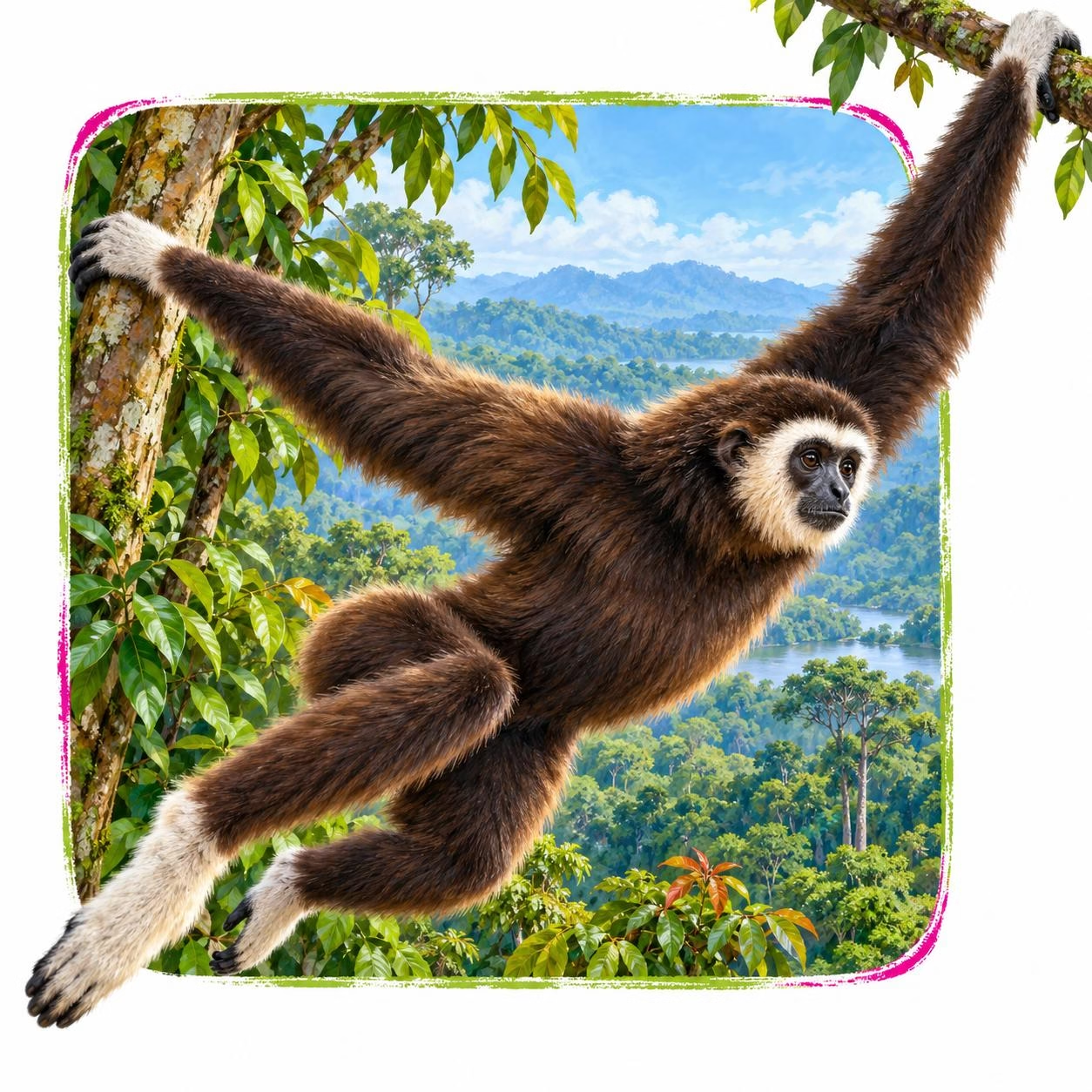
White-Handed Gibbon in its natural Tropical evergreen forest, seasonal evergreen forest, dipterocarp forest, mixed deciduous and bamboo forest, peat-swamp forest, and other connected Southeast Asian canopy habitats habitat